


By every model the AI capex story has been priced against, the binding constraint is supposed to be compute. Chips, contracts, GPUs, memory. That’s what the earnings calls discuss. That’s what the cap tables price. That’s what crashed the market in March, when a 6x compression paper temporarily made it look like the whole pyramid was rebalancing.
It isn’t. The constraint binds two layers lower, in a document class the financial press doesn’t read.
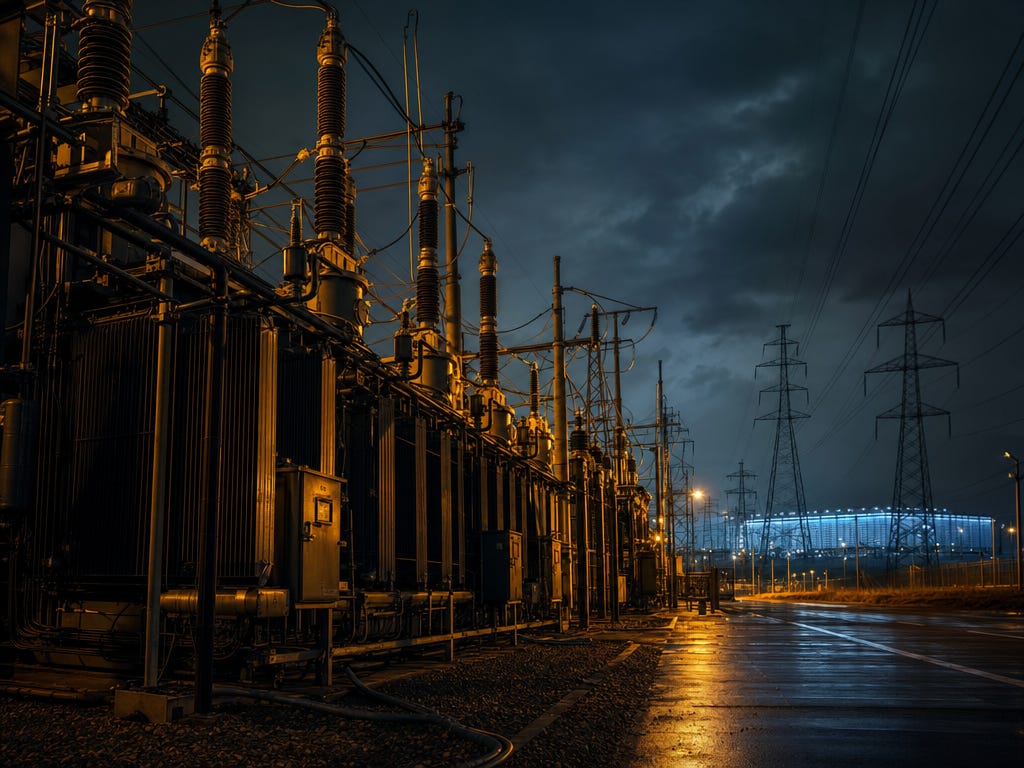
The substation is where the contract dies.A month ago I named five forces holding DRAM prices at roughly double where the models say they should be. Force 4 was the data-center delay; the delay mechanism was electrical, not memory. Transformers. Switchgear. Batteries. I treated it as one of five. It isn’t. It’s the slowest one, the most concentrated one, and the one whose calendar can’t be shortened by anything you can buy in 2028.
Hyperscalers are already pricing this. They’re not buying compute. They’re buying grid position. They’re financing on-site generation because the queue for utility-scale interconnection runs longer than the asset’s economic life. The chip layer is where the press release lives. The substation is where the contract dies.
The grid is the binding constraint. Six signals say so out loud, all already public, none yet connected.
Signal 1: Microsoft inherited a grid position, not a data center
The Stargate Abilene expansion died on March 6, 2026. The 1.2 GW campus had been slated to grow to 2.0 GW; the 800 MW expansion got killed when Oracle and OpenAI’s financing negotiations collapsed and OpenAI’s demand forecasts shifted. Press read it two ways: a financing failure, a demand failure. Both were true on their face. Both were wrong by one layer.
Microsoft took over the construction project. Crusoe Energy is building two AI factory buildings on the same campus and a power plant on-site. Meta is reportedly in talks to acquire the excess capacity, with NVIDIA brokering. A demand failure leaves the site sitting. This site didn’t sit. It got handed off three times in ninety days, each handoff an upgrade rather than a write-down. The asset was more valuable than the demand picture suggested. The value was the existing 1.2 GW of grid position.
Crusoe building its own power plant on the Abilene site is the second tell. Hyperscalers don’t usually finance their own generation. They contract for it. When they start writing the checks themselves, it’s a workaround for a queue that doesn’t move. The asset that attracted three operators in ninety days was the substation. The contracts being inherited are for proximity to electricity.
The original announcement was a Trump-era $500B Stargate Project commitment in January 2025. Fourteen months in, the flagship expansion is dead and the operator has changed. The headline writes the announcement. The substation writes the cancellation.
Signal 2: Less than 10% of the cost. 100% of the gating.
Twelve gigawatts of US data center capacity were planned for 2026. Only four are under construction. One-third delivery rate. 2027 is worse: 6.3 GW being built against 21.5 GW announced. 2028 through 2032: 4.5 GW broken ground against 37 GW planned. The gap widens every year.
The bottleneck is named explicitly in the data: batteries, transformers, circuit breakers. Sourced from Canada, Mexico, South Korea, and China. Less than 10% of construction costs. 100% of the gating factor. That ratio is the article. Andrew Likens, the energy and infrastructure lead at Crusoe Energy, says it cleanly: “If one piece of your supply chain is delayed, then your whole project can’t deliver.”
The press release is denominated in dollars. The delivery is denominated in megawatts. Different units. Different timelines. Only one of them gates anything. The capex story is being told from the chip layer because chip procurement moves on quarterly timelines. Transformer procurement runs 128 weeks minimum. That doesn't fit inside a quarterly financial model, which is why it doesn't appear in the analysis the financial press is writing.
Signal 3: The document class the market doesn’t price in
PJM, ERCOT, MISO, SPP, ISO-NE, and NYISO each maintain their own interconnection queue. The queues are public. They’re updated quarterly. They’re dispositive. A PPA is a purchasing contract for power that hasn’t been connected yet. Queue position is the regulatory filing that reserves a spot in the interconnection line. Without it, a PPA has no delivery mechanism. The financial press AI capex coverage doesn’t reference the queue. The queue is the first place the binding constraint shows up and the last place financial press looks.
Lawrence Berkeley National Laboratory tracks the queues annually in the “Queued Up” series. The 2025 edition counted 10,303 active projects representing 2,290 GW of proposed capacity in queues against 1,322 GW of installed US capacity — nearly twice the entire grid. Wait times have more than doubled since 2008: 22 months then, 55 months now (four and a half years) on the US median for 2024 completions — seven in Northern Virginia, nine-plus in California.
Roughly 77% of capacity from the 2000–2019 cohort withdrew before energization. Projects reach the front at price points or timelines that no longer support the economics that justified them. The withdrawal rate is the structural failure mode. It isn’t bureaucracy. It’s the wait outliving the financing.
The edge for any analyst willing to read the queue is this: the document is public, the document is updated, the document decides who gets power, in what order, on what timeline. The queue is where you find out which contracts are real.
Signal 4: The grid stack has three calendars. None of them are short.
The grid stack has three nested calendars. First: the interconnection queue. Four and a half years on the US median for projects completing in 2024, per the LBNL 2025 edition; seven in Northern Virginia; nine-plus in California. Second: transformer procurement. Large power transformers averaging 128 weeks in the Q2 2025 industry survey; generator step-up units 144 weeks; substation transformers stretched from 140 weeks in 2023 to 160+ weeks in 2026. Wood Mackenzie projects a 30% supply deficit. Demand is up 119% for power transformers and 274% for generator step-up units since 2019. Third: substation and transmission energization. Seven to ten years for permitting and siting, per Microsoft’s own framing in its January 2026 commitment.
Four and a half years. Two and a half years. Seven to ten. They don’t sequence. They run in parallel and the longest one wins.
The stack made operational: in November 2025, Meta and AEP Ohio jointly filed with the Public Utilities Commission of Ohio for a three-year arrangement. Meta would draw power from the Green Chapel substation, which AEP Ohio had built to serve Intel’s $28 billion chip fab but which had sat unused since Intel slowed construction in July 2025. The terms: 250 MW for three years, Meta initially taking 120 MW and ramping to 250 MW in April 2026. Intel’s full 500 MW allotment is restored at the start of 2029.
What Meta is paying for in that contract isn’t capacity. The capacity already exists. What Meta is paying for is the calendar Intel already cleared. Same shape as Microsoft inheriting Stargate Abilene. Two cases of hyperscalers acquiring already-elapsed time.
The chip layer can be unconcentrated by Chinese fab capacity by 2028. CXMT’s Shanghai mega-fab and YMTC’s third Wuhan facility both target 2027 production; competitive pricing pressure lands 2028 at earliest. The grid stack cannot be unconcentrated on a comparable timeline. The queue can’t be reformed into compliance with five-year financing horizons. The transformer manufacturers don’t reach 9,000 units a year by 2030 starting from 1,500 today without the supply gap widening before it narrows. Transmission permitting takes the time it takes. Different calendars. Different decongestion dates. The chip layer reverts in eighteen months. The grid layer reverts in seven years if everything breaks right.
Signal 5: The variable the Fed has been gaming around
Jason Furman’s calculation, published in Fortune in October 2025, is that US GDP growth in the first half of 2025 was 0.1% annualized excluding AI and data-center investment. AI data centers were 4% of GDP and 92% of GDP growth in that period. By August 2025, per Renaissance Macro, the dollar value of the AI data-center buildout had surpassed US consumer spending’s contribution to GDP for the first time ever.
Hyperscaler capex is approaching $400 billion annually. The top ten hyperscalers account for roughly a third of that figure. Jeff Bezos has called the buildout an “industrial bubble” rather than a financial bubble. He’s not wrong. Financial bubbles pop. Industrial bubbles don’t pop. They just don’t deliver. The constraint is a substation that hasn’t been built yet.
If 30-50% of 2026 data-center capacity slips because of electrical infrastructure (and on the current trajectory, it will) that isn’t a sector slowdown. It’s a top-line GDP problem. The investment that propped up US GDP in 2025 and shaped the Fed's rate decisions now depends on substation-procurement timelines that no interest rate can shorten. Two of the three biggest binding instruments on US monetary policy in 2026 are not the Fed’s to move. One of them is a shipping lane. The other one is a transformer manufacturer in South Korea. Neither moves with an interest rate.
Signal 6: Three predictions that cost something if they’re wrong
Three predictions for the rest of 2026, framed so being wrong is informative. First: the data-center delivery rate closes at or below the 4-of-12 trajectory. The slip will be reported as a financing or demand story; the underlying constraint will be electrical. Second: at least one major hyperscaler discloses a multi-year project delay attributable to interconnection or transformer procurement, in language that breaks from the chip-layer framing. Third: on-site generation deals (the Crusoe pattern, the $4.75B Intersect Power acquisition pattern) accelerate. Hyperscalers building or buying their own generators are pricing the grid queue as longer than the asset’s economic life. They aren’t betting on grid expansion. They’re routing around it.
The information sits on state utility commission websites. Read the PUC filings. Track the queue depth. The chip-layer story is the document the press has bookmarked. The grid-layer story is the document nobody on the AI desk has bookmarked yet.
Personal Reflection: What I read wrong first
I read the Stargate cancellation in March as a demand failure. I had two pieces in the can on DRAM concentration and the OpenAI LOI panic. The cancellation fit the existing narrative cleanly: Force 4 of five forces, one of the locks holding DRAM prices in place. I wrote it as a confirmation, not a discovery.
The thing that broke the read was Microsoft moving in. A demand failure leaves the site sitting. This site didn’t sit. The sequence was Oracle out, OpenAI out, Microsoft in, Crusoe building on-site generation, Meta in talks for excess capacity. That’s what an asset whose underlying scarcity has been mispriced looks like. The contract Microsoft inherited was for grid position. Once I saw that, the rest of the analysis reorganized itself.
The chip layer is concentrated and slow. The grid layer is more concentrated and slower. The chip layer can be unconcentrated by Chinese fab capacity in 2028. The grid layer can’t be unconcentrated by anything on a comparable timeline. I’m spending more reading time on PUC filings now. I run hardware. I know what it costs to run a node off a residential meter. The math at hyperscaler scale is the same shape, six or seven orders of magnitude up. Substation arithmetic is operator arithmetic. I just hadn’t been applying it at the macro layer until Microsoft showed me where to look.
Different documents. Different calendars.
The headline gets quoted in the earnings call. The footnote gets filed at the public utility commission. Both documents are public. Only one of them is being read. The names not on any AI cap table sit in offices in Charlotte, Monterrey, and Ulsan. Substation engineers. Transmission planners. Transformer manufacturers. Their calendars decide which buildings actually deliver.
DRAM was the chokepoint nobody watched in 2025. Grid capacity is the chokepoint they aren’t watching in 2026. The first one took eighteen months to bind. The second one will take seven years to unbind, and that’s only if everything breaks right.
Next piece: Same math, different scale. I ran a Helium hotspot. In 2021 it paid $100+ a month. I turned it off last year. Hardware cost: $500. The unit economics of running a decentralized infrastructure node have been negative for eighteen months. The whitepapers have not been revised. A piece for the operator class that isn't selling them anything.
“Less than 10% of the cost, 100% of the gating” is the single best one-line summary I’ve seen of why the AI story is now a transformers-batteries-and-breakers story - and you note those components are sourced from Canada, Mexico, South Korea, and China, which is precisely the opening for resource-rich jurisdictions outside the US. I just wrote about why Latin America, and Brazil specifically, can still win this physical layer (clean power, water, minerals) even though it lost the software race: https://thiagopedicosaragiotto.substack.com/p/the-physical-layer-of-ai-why-latam
Announced GW vs energized GW is Capex≠Conversion in power form—transformers and queues gate what hyperscaler guides can actually convert. Mapped the same midstream slip: https://decipioaptus607529.substack.com/p/the-constraint-moved-downstream