

Asymmetric Warfare
Why Pretending "Both Sides" Are Equally Violent Is a Lie That Kills

I stopped writing for three weeks after the Kirk piece went live.
Not because I was burned out. Not because I had nothing to say. I stopped because I needed to remember why I was saying anything at all. When you write about violence, about political collapse, about the slow-motion disintegration of civic norms, you start to wonder if you’re just adding noise to an already deafening signal. So I went quiet. I let the world keep spinning without my commentary. I remembered something crucial: I write for myself first. To process what I’m seeing. To understand what it means before I try to explain it to anyone else.
And what I’m seeing now, three weeks after Charlie Kirk’s assassination, demands more than processing. It demands testimony. Because the thing that happened after the shooting is worse than the shooting itself.
The Spark: What Actually Happened After I Hit Publish
The immediate aftermath of Kirk’s assassination revealed something darker than the murder: a coordinated sprint toward violence, not away from it.
Trump appeared on Fox & Friends the day after the shooting with a message that should have made every civics teacher in America weep. “Conservatives should seek revenge at the ballot box,” he said, before pivoting immediately to his standard claim that voting itself is rigged.1 The logic completes a perfect authoritarian circle: seek revenge through voting, but voting doesn’t work, so what’s left? He didn’t need to say it. The implication hung in the air like gun smoke.
Then the floodgates opened. Elon Musk, whose ventures into political commentary have all the nuance of a drunk uncle at Thanksgiving, declared that “the Left is the party of murder.”2 In a separate post, he framed the future in the starkest possible terms: “If they won’t leave us in peace, then our choice is fight or die.”3 Laura Loomer demanded that Trump “crack down on the Left with the full force of the government” and called for jailing “every single Leftist who makes a threat of political violence.”4 Joey Mannarino, a pro-Trump influencer with over 600,000 followers, urged Trump to “go full Bukele,”5 referencing El Salvador’s mass arrest campaign that suspended civil liberties and drew international condemnation for human rights abuses.
Chaya Raichik, who runs the Libs of TikTok account, posted three words: “THIS IS WAR.”6
Multiple Republican representatives and right-wing influencers echoed the same language. Wisconsin Rep. Derrick Van Orden wrote that “the left and their policies are leading America into a civil war. And they want it.”7 Kristan Hawkins, founder of Students for Life of America, called it “a new civil war.”8 Conservative influencer Brian Eastwood was more direct: “I’m ready for civil war. You want a fight and you’re going to get it.”9
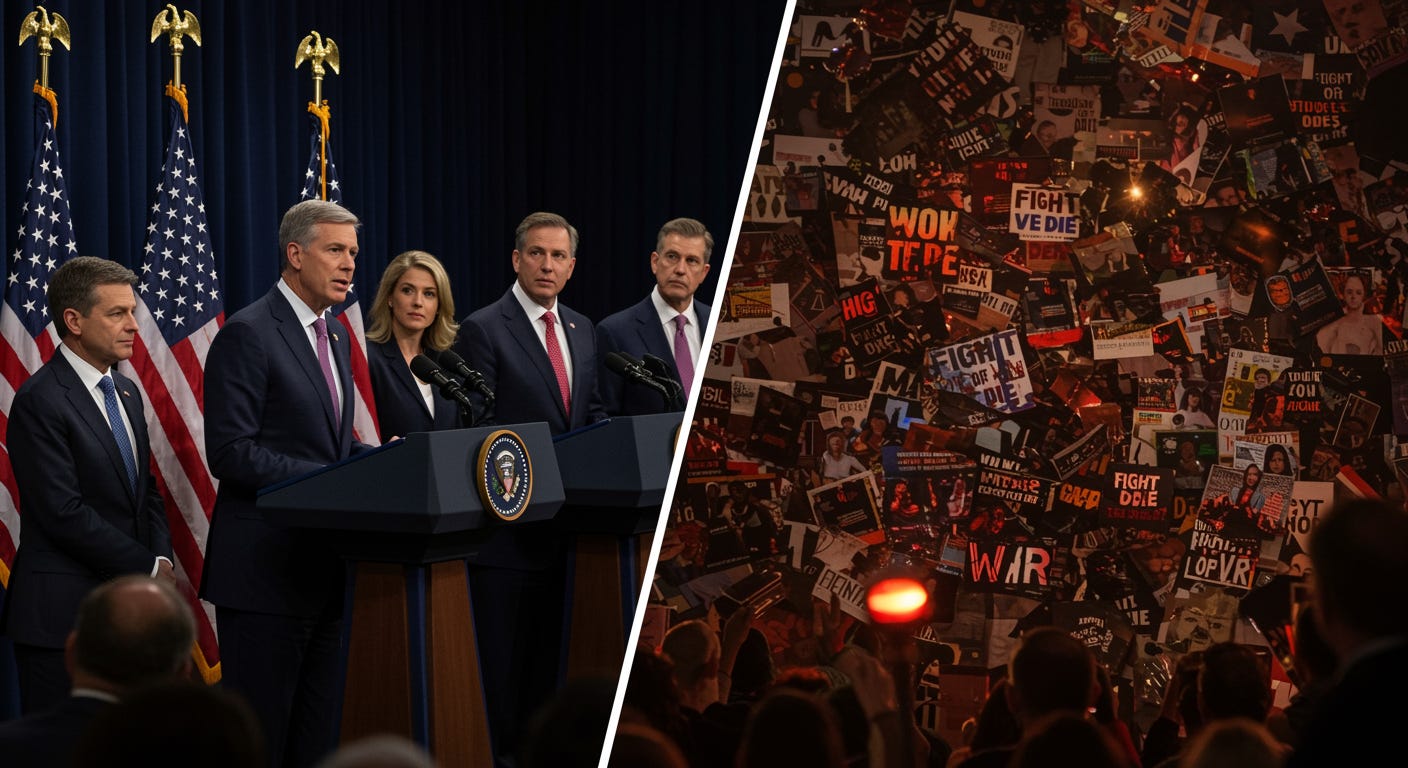
Meanwhile, every major Democratic leader condemned the violence without qualification. Biden called it unconscionable and said “there is no place in our country for this kind of violence.”10 Kamala Harris wrote that she was “deeply disturbed” and that “we all must work together to ensure this does not lead to more violence.”11 Barack Obama stated that “despicable violence has no place in our democracy.”12 Arizona’s Democratic Governor Katie Hobbs said the tragedy “is not about who Charlie Kirk supported politically” but about “the devastating loss of a father, a neighbor, and an Arizonan” and called for “rejecting violence, lowering the temperature of our politics, and recommitting ourselves to the values of civility.”13
Even some Republicans tried to pull back from the edge. House Speaker Mike Johnson appeared on Fox News and said “we have got to turn the heat down a little bit. We got to have civil discourse.”14 House Majority Leader Steve Scalise, who survived his own politically motivated shooting in 2017, told CBS that “we cannot let what happened yesterday be the norm” and condemned those who “feel if they disagree with you politically, they’ve got to try to go and eliminate those people.”15
The asymmetry isn’t subtle. One side called for unity and the rule of law. The other side called for war.
The Pattern: The Rhetoric Isn’t Symmetrical
The “both sides” narrative disintegrates the moment you examine who’s actually saying what.
Trump blamed the “radical left” for Kirk’s death before investigators had even identified a suspect. In a video message released the night of the shooting, he said, “For years, those on the radical left have compared wonderful Americans like Charlie to Nazis and the world’s worst mass murderers and criminals. This kind of rhetoric is directly responsible for the terrorism that we’re seeing in our country today, and it must stop right now.” He promised that his administration would “find each and every one of those who contributed to this atrocity and to other political violence, including the organizations that fund it and support it.”16
By Monday, September 15th, Trump was doubling down. In the Oval Office, he declared that the suspect was “radicalized over the internet” and that the radicalization was “on the left.” He said, “He’s a left. A lot of problems with the left, and they get protected, and they shouldn’t be protected.” He announced he would consider designating Antifa and other left-wing groups as “domestic terrorists.” The next day, speaking to reporters, he made it even clearer: “When you look at the problems, the problem is on the left. It’s not on the right.”17
The gaslighting operates on a predictable loop. First, the president spends months or years calling his political opponents “vermin,” “the enemy within,” and “scum.” He posts images of himself in military fatigues preparing to invade Chicago, captioned “Chicago about to find out why it’s called the Department of War.”18 Then political violence happens. Then the president blames his opponents for creating a climate of violence through their rhetoric. Then he refuses to acknowledge his own contributions to that climate. Then he uses the violence as justification for authoritarian crackdown.
This isn’t speculation. This is the documented playbook of authoritarians consolidating power. You create a climate of fear. You blame your opponents for the violence that emerges from that fear. You use that blame to justify eliminating dissent.

Arie Perliger, a University of Massachusetts Lowell scholar who studies political violence, put it bluntly when asked about Trump’s response: “I agree that language and rhetoric impact people’s behavior. I’ve seen that again and again in my studies, that the discourse of political figures impacts the way people think of the legitimacy of violence. Of course, we need to understand the context here, which is that Trump himself was willing to pardon thousands of people who engaged in political violence.”19 He’s referring to January 6th, when a mob stormed the Capitol in an attempt to overturn an election, and Trump later promised to pardon them if reelected.
Perliger’s research shows that approximately 25% of Americans now view political violence as a legitimate form of political action. Both the data and the social media discourse reveal emotions “morphing into very large support for political violence.” When he looked at the aftermath of Kirk’s assassination, he noted something chilling: “More than ever, I’ve seen calls for retaliation and a strong sense that the other side is unwilling to show any sympathy to what happened.”20
The asymmetry extends beyond rhetoric into action. In June 2025, when Minnesota state representative Melissa Hortman and her husband were killed in their home, Trump refused to call Governor Tim Walz to offer condolences. Instead, he called Walz “whacked out.”21 He didn’t order flags lowered to half-staff. Later, after doing so immediately and automatically for Kirk, Trump claimed he would have lowered flags for Hortman “if her state’s Gov. Tim Walz had asked him.”22 The message was clear: some American lives matter more than others, depending on their political affiliation.
This isn’t both sides failing to de-escalate. This is one side systematically weaponizing grief to justify authoritarian measures while the other side begs for basic civility.
The Protocol: What This Means for the Republic
We’re not watching spontaneous outrage. We’re watching a rehearsal for martial law dressed up as mourning.
The calls flooding conservative media and social platforms aren’t demanding justice through legal channels. They’re demanding systemic crackdown on political opposition. When Mannarino says “go full Bukele,” he’s explicitly calling for mass arrests and suspended civil liberties. When Loomer demands Trump use “the full force of the government against the Left,” she’s calling for weaponizing state power against roughly half the country. When Christopher Rufo, a conservative activist who has driven multiple culture war campaigns, calls for a “J. Edgar Hoover-style campaign to target the radical left,” he’s invoking the FBI director who ran illegal surveillance programs against civil rights leaders and political dissidents.23
Trump has been telegraphing this trajectory for months. On Memorial Day 2025, he posted about his opponents: “Happy Memorial Day to All, including the Human Scum that spent the last four years trying to destroy our Country through warped radical left minds.”24 In November 2023, he promised during a campaign stop to “root out the communists, Marxists, fascists and the radical left thugs that live like vermin within the confines of our country.”25 Days before Kirk’s shooting, he posted that image of himself in military gear preparing to invade an American city.26
The mechanism is straightforward. Create conditions that make political violence more likely through inflammatory rhetoric and the normalization of threats. When violence inevitably occurs, use it as justification for authoritarian response. Blame your opponents for the violence you helped create. Consolidate power under the guise of “restoring order.”
This transcends left versus right. This is rule of law versus rule of force. This is whether we have a country where political disagreement can exist without ending in bloodshed or imprisonment.
The decentralization angle matters here, though not in the way I usually write about it. Crypto, DePIN, distributed systems — these aren’t just technological innovations or investment opportunities. They’re insurance policies against authoritarian capture of centralized systems. When centralized power becomes this volatile, this willing to weaponize state apparatus against political dissent, exit strategies stop being theoretical and start being survival tools.
But before we can talk about building alternatives, we have to name what’s collapsing. And what’s collapsing is the basic premise that American political leaders, regardless of party, share a commitment to resolving disputes without violence. One party still holds that commitment. The other party’s leader is openly fantasizing about using military force against American cities and threatening to jail his political opponents.
Personal Code: Why I Needed the Silence
Sometimes the most honest thing you can do is stop talking until you know what you’re actually saying.
The three weeks I spent away from writing weren’t avoidance. They were recalibration. I don’t write to perform outrage or farm engagement metrics. I write to understand what I’m witnessing, to process it into something coherent before I try to communicate it to anyone else. And what I understand now, with the clarity that only comes from stepping back, is this: the temperature isn’t going to come down.
Not because “both sides” are escalating in equal measure. That narrative is a lie. The temperature won’t come down because one side benefits from the heat, and that side currently controls the executive branch of the federal government. Every incentive structure points toward escalation. Every political calculation favors chaos over calm.
This isn’t about crypto versus fiat anymore, or DePIN versus centralized infrastructure, or even about technological solutions to institutional decay. This is about whether we have a country where you can disagree with the president without him threatening to jail you, where you can organize politically without being labeled a terrorist, where you can lose an election without your supporters calling for civil war.
I’m going to keep writing. I’m going to keep building. I’m going to keep believing that decentralized systems offer better models for human coordination than the concentrated power structures currently failing us. But I’m also going to keep naming what I see, even when it’s uncomfortable. Especially when it’s uncomfortable.

Because here’s what three weeks of silence taught me: staying quiet right now isn’t neutrality. Silence, in the face of explicit calls for political violence and authoritarian crackdown, is complicity. It’s letting the loudest, most dangerous voices define the terms of the conversation by default.
Which brings me to something I need to say directly, because I’ve watched too many people twist themselves into pretzels trying to be “fair” about this: I will not apologize for Charlie Kirk’s death. I will not perform the ritual of pretending his rhetoric bore no relationship to the political violence plaguing this country.
Kirk spent years platforming the idea that Democrats were existential threats to America. He called Black Lives Matter activists “terrorists.” He described immigration as an “invasion.” He normalized the language of warfare applied to domestic political disagreement. Did that rhetoric pull the trigger? No. Did it create the atmospheric conditions where political assassination becomes thinkable? Absolutely.
The same people now demanding that the left “lower the temperature” spent the last decade turning it up to boiling. Trump called his opponents “vermin” who need to be “rooted out.” He posted fantasies about invading American cities. He praised political violence at his rallies and promised to pardon those who committed it. Kirk amplified every word of it.
So no, I won’t apologize. I won’t pretend that years of dehumanizing rhetoric had nothing to do with someone deciding another human being deserved to die for their politics. The violence didn’t emerge from a vacuum. It emerged from exactly the kind of discourse Kirk built his career on — discourse that Trump has elevated to the level of presidential communication.
This doesn’t justify murder. Nothing justifies murder. But understanding cause and effect isn’t the same as endorsing outcomes. Kirk’s assassination was wrong. It was also predictable. When you spend years telling people that their political opponents are enemies who want to destroy everything they love, eventually someone takes you seriously enough to act on it.
The tragedy isn’t just Kirk’s death. The tragedy is that his death is being weaponized to justify exactly the kind of authoritarian crackdown he would have cheered for. The tragedy is that people who spent years stoking fear are now using that fear to demand emergency powers. The tragedy is that we’re watching the script for democratic collapse play out in real time, and half the country is pretending not to notice because acknowledging it would require admitting their side wrote the script.
So when people ask me to “show respect” or “not speak ill of the dead,” I have to ask: respect for what? For the years Kirk spent poisoning political discourse? For the countless people he harmed with his rhetoric about immigrants, about Black Americans, about anyone who disagreed with his politics? We don’t honor the dead by lying about their impact on the living.
What does it mean to write about building the future when the present is actively trying to destroy the possibility of dissent? It means refusing to pretend that the violence we’re seeing is mysterious or inexplicable. It means naming the people who created the conditions for that violence, even when — especially when — those people become its victims.
When that question becomes too heavy to ignore, you have two choices: stay silent, or speak louder.
I’m choosing loud. Without apology. Without pretending that cause and effect stopped operating just because someone died.
Because the alternative — the polite silence, the both-sides equivocation, the careful avoidance of uncomfortable truths — is exactly how we got here. And I refuse to help us stay here by pretending we don’t know how we arrived.
What are you choosing? And more importantly, are you paying attention to who’s actually calling for violence, or are you letting the “both sides” narrative do your thinking for you?