

Datagram's $106M Launch
When DePIN Finally Stopped Being Theoretical

The Spark: AWS is Dying. Nobody Told Amazon Yet.
November 18, 2025. Bitcoin was having one of its theatrical mood swings, altcoins were hemorrhaging value like a punctured water balloon, and somewhere in the background noise of crypto chaos, a project most people had never heard of just casually launched with $106 million in first-day trading volume.
Not airdrop farmer money. Institutional capital. The kind that suggests someone did actual research instead of just vibing on Twitter sentiment.
Datagram Network’s token hit Binance Alpha at 8:00 UTC and immediately started behaving like it had somewhere important to be. Within hours, DGRAM was trading across multiple platforms with the kind of liquidity that separates “real thing people are actually using” from “manufactured hype that will collapse by Thursday.” The token opened around $0.019, settled into more modest territory, but the volume kept screaming a truth most projects can’t fake: people were using this, not just flipping it.
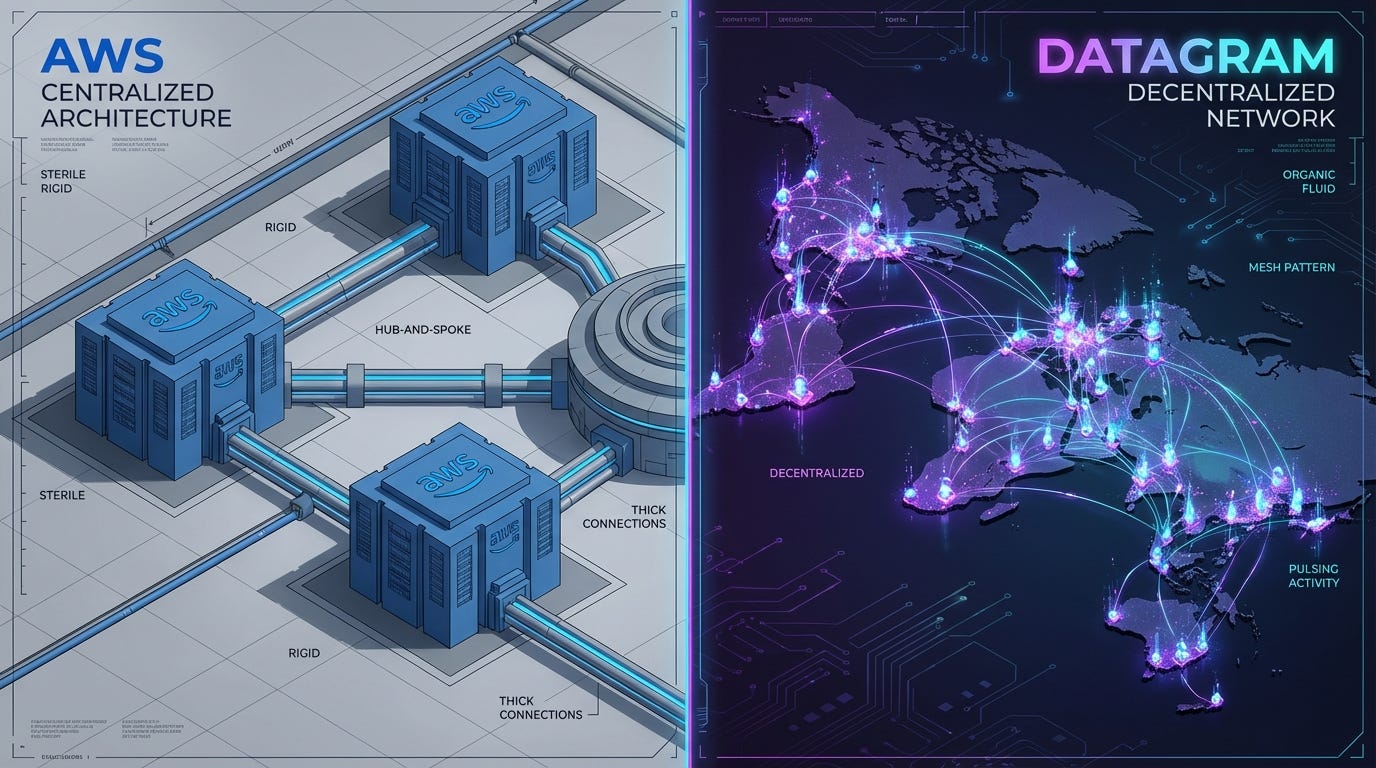
Something weird happened here. Datagram didn’t sell narrative. They sold functioning infrastructure. Like, actual working infrastructure that was already routing packets and generating revenue before token speculators even knew the project existed. By launch day, the network was serving 200+ enterprise clients and 1.2 million users. That’s not a roadmap promise. That’s a business with customers who pay money for services.
For context: most DePIN projects follow a predictable script. Raise capital based on vibes and whitepapers. Promise revolutionary infrastructure. Deliver incremental updates and revised timelines. Eventually fade into the background noise of “projects that seemed cool in 2023.” Datagram inverted this entire playbook. They built the network first, proved it worked with actual paying enterprise clients, secured funding from serious infrastructure investors who understand that real businesses require real revenue, and only then decentralized ownership through tokenization.
The Alpha Testnet launched in June 2025. By November, the network was already handling real-time communication, content delivery, and AI inference workloads. The token generation event wasn’t a fundraising mechanism. Datagram had already closed $4 million in pre-seed funding from Blizzard (the Avalanche Fund), Polychain Capital, BlockTower Capital, and Animoca Brands. The TGE was about distributing ownership of infrastructure that already demonstrated it could generate value without relying on speculative token appreciation.
The Pattern: The Three-Company Cartel That Eats $261 Billion Annually
Amazon Web Services pulled in $107 billion in 2024.1 Microsoft Azure grabbed $112 billion.2 Google Cloud scooped up $42 billion.3 Three companies, controlling roughly 65% of global cloud infrastructure spending, have constructed one of the cleanest oligopolies in modern capitalism.
This didn’t happen through superior technology or brilliant innovation. It happened because building planet-scale infrastructure networks requires capital reserves so absurd that only trillion-dollar corporations can play. The barriers to entry aren’t just high - they’re designed to be insurmountable. By 2015, meaningful competition had essentially stopped existing. Game over before most players even knew the rules had changed.
Predictable consequences followed. Inflated pricing structures that would make telecom monopolies blush. Vendor lock-in so comprehensive that switching providers feels like relocating to a different country. Structural inefficiencies that customers absorb because the alternative is... what, exactly? Building your own data centers? Good luck with that.
AWS charges you premium rates for bandwidth that costs them pennies to deliver. Azure constructs massive data centers that run at 40-60% utilization - meaning nearly half their infrastructure sits idle - while customers pay for reserved capacity they’ll never touch. Google Cloud routes your traffic through centralized failure points because distributed architecture, despite being technically superior, would cost more to maintain. The inefficiency isn’t accidental. It’s profitable.
Datagram’s research uncovered something wild: up to 80% of bandwidth, CPU power, and storage across personal and enterprise systems just sits there. Unused. Your laptop right now probably has more idle compute capacity than most small businesses actively need during peak hours. My desktop has more processing power sitting dormant than the server that hosted my first website could dream of using.
Centralized cloud architecture can’t tap into this ocean of stranded capacity. The coordination costs explode without a central authority managing everything, and the trust model disintegrates the moment you try to distribute control across thousands of independent nodes. So AWS keeps building new data centers that will spend most of their operational lives waiting for work, and we keep paying for it.
DePIN flips this economic model on its head. Distributed physical infrastructure networks don’t just decentralize control for ideological purity - they unlock capacity that centralized systems structurally cannot access. Every idle server, every underutilized bandwidth connection, every gaming PC sitting dormant while its owner sleeps becomes potentially productive infrastructure. The laptop I’m typing this on could be routing packets for a livestream happening in Seoul. It just needs coordination protocols that don’t require Amazon’s permission.
Datagram’s “Hyper-Fabric Network” takes this concept and adds AI-driven routing that dynamically allocates resources based on real-time demand patterns. Instead of forcing traffic through fixed data center locations like AWS does - “your request will go through US-East-1 because that’s where we built our server farm” - Datagram routes through whichever nodes currently offer optimal latency and availability. Network adapts to conditions rather than forcing conditions to adapt to infrastructure constraints. Simple inversion, massive implications.
The economics shift dramatically when you aggregate idle capacity instead of constructing dedicated infrastructure. Datagram doesn’t need to build billion-dollar data centers in Virginia. They leverage capacity that already exists but isn’t being monetized. Node operators contribute their unused bandwidth, storage, and compute power. They get compensated based on actual network usage rather than farming governance tokens with no underlying utility.
Traditional cloud providers operate with massive fixed costs and relatively low marginal costs - build the data center once, then serve customers at incrementally small additional expense. DePIN networks invert this structure: almost zero fixed costs, slightly higher marginal costs because they’re compensating distributed contributors. But total delivered infrastructure can cost significantly less because there’s no need to maintain unutilized capacity or subsidize centralized overhead.
The market noticed. A DePIN project launching with $106 million in first-day trading volume while the broader sector hits $13.4 billion in market cap signals capital rotating into infrastructure with demonstrable utility rather than purely speculative narratives. DePIN became one of 2025’s strongest-performing sectors precisely because it solves actual economic problems instead of manufacturing synthetic financial instruments that exist only to be traded.

The Protocol: What Infrastructure Looks Like When Engineers Get Left Alone
Datagram’s architecture reveals something most people miss when they’re busy arguing about whether blockchains are revolutionary or just databases with trust issues. The network operates as a sovereign Layer 1 blockchain built on Avalanche, giving it the finality and low-latency performance real-time applications actually require while maintaining composability across the broader Avalanche ecosystem. But here’s the trick: the blockchain isn’t the product. It’s the coordination layer. The actual infrastructure runs through what Datagram calls the “Core Substrate.”
Think of it as an abstraction layer that lets decentralized networks communicate without each one building custom integration protocols from scratch. This matters because the DePIN sector’s biggest limitation was never technical capability. It was fragmentation. Helium does wireless connectivity beautifully. Filecoin handles storage like a distributed hard drive that can’t be unplugged. Akash tackles compute with the enthusiasm of someone who just discovered you can rent out idle servers for actual money. Each network works brilliantly within its domain but can’t easily talk to the others, which guts the economies of scale that make infrastructure economically viable.
Datagram’s Core Substrate solves this by providing standardized cross-network communication protocols. Suddenly these isolated networks can compose into something larger than their individual parts. Storage talks to compute talks to bandwidth talks to AI inference, and you get infrastructure that behaves like an actual ecosystem instead of a collection of competing fiefdoms.
The token economics reinforce long-term infrastructure development rather than the usual “farm tokens for three months then dump everything and disappear” playbook. Of the 10 billion total DGRAM supply, 50% goes to node operators through performance-based mechanisms. Not speculative airdrops. Not governance theater. Compensation for providing actual infrastructure services. Node operators earn based on uptime, bandwidth contribution, and network usage, with liquid rewards starting in 2025 and no long-term lockups designed to trap capital.
Another 13.5% flows to ecosystem incentives and 1.5% to referral programs, but the distribution model avoids token dumping dynamics because rewards vest over 12 months contingent on active node participation. You can’t farm points for a month, cash out, and vanish into the night. You need to contribute sustained infrastructure to earn sustained rewards. Alignment through economics, not through promises.
The node sale that launched August 10, 2025, sold Full Core node licenses as NFTs rather than selling tokens directly. Each license grants you the right to operate infrastructure and earn protocol-level rewards, but licenses are non-transferable for the first 12 months. Clever mechanism. It creates alignment between node operators and network health because your ability to monetize depends on the network actually working, not just on finding some retail investor willing to buy your tokens at increasingly delusional prices.
For enterprises and developers, Datagram offers something centralized cloud providers structurally cannot deliver: decentralized infrastructure-as-a-service with no single point of failure, no centralized control, and pricing that reflects actual resource costs rather than oligopoly premiums. Applications can run real-time communication, content delivery, AI inference, and interactive gaming on infrastructure that scales horizontally through distributed nodes rather than vertically through data center expansion.
The use cases span everything currently shackled to centralized cloud infrastructure but screaming for decentralization. Livestreaming platforms that can’t be deplatformed when they discuss topics Silicon Valley finds uncomfortable. AI training that doesn’t require trusting centralized providers with proprietary data. Gaming servers that don’t suffer from regional latency because they’re routing through optimal nodes instead of whatever data center Amazon built in 2012. Enterprise communication systems that don’t route through surveillance-friendly choke points.
Datagram is already handling these workloads. Those 200+ enterprise clients and 1.2 million users aren’t speculative future adoption metrics. They’re current network activity. Real packets getting routed right now through real nodes operated by real people earning real compensation. The token launch wasn’t about bootstrapping usage. It was about decentralizing ownership of infrastructure that already generates value.

My Debug: Why I’m Actually Paying Attention This Time
Years of watching DePIN projects promised me revolutionary infrastructure. They delivered whitepapers describing networks they’d build eventually, maybe, if market conditions stayed favorable and the technical challenges weren’t quite as insurmountable as they looked from the initial research phase. Same pattern every time: manufactured hype cycle, token launch orchestrated like a product reveal for the next iPhone, slow dawning realization that building global infrastructure networks is significantly harder than tweeting about them, quiet pivot to something easier or just gradual fade into the background noise of projects that seemed brilliant in 2023.
Datagram ran this script in reverse. Built the network first. Proved it worked with actual paying enterprise customers - not “partnerships” that exist only in press releases, but companies routing real traffic through real nodes and paying real money for the service. Raised capital from infrastructure investors who actually understand that businesses generating revenue tend to survive longer than businesses generating only governance proposals. Only then, after proving the infrastructure could function without speculative token mechanics propping it up, did they decentralize ownership through tokenization.
The $106 million first-day trading volume matters because it represents capital finally differentiating between infrastructure theater and infrastructure reality. DePIN has spent years being dismissed as vaporware wrapped in blockchain buzzwords, and honestly most of that dismissal was completely justified. Watching project after project promise decentralized AWS while delivering incrementally improved torrent protocols got exhausting. But when something launches with enterprise clients already using the network and trading volume that rivals major exchange listings, the market signals that utility-driven infrastructure just crossed some credibility threshold that pure narrative plays can’t fake.
I started running a testnet node in May, mostly out of curiosity about whether the economics would actually work without requiring delusional assumptions about adoption curves or magical thinking about human incentive structures. Node operators contribute resources they already have sitting idle - my desktop spends 16 hours a day doing absolutely nothing while I sleep or work or pretend to be productive elsewhere. Getting compensated for letting that unused capacity route packets for applications I’ll never directly interact with makes more sense than 90% of crypto tokenomics I’ve evaluated.
The test isn’t the token launch. Token launches are performance art. The test is whether the network continues scaling after initial hype dissipates, whether enterprises keep using it when cheaper centralized alternatives exist, and whether node operators find the economics compelling enough to maintain infrastructure even when token prices inevitably fluctuate downward because crypto markets have the emotional stability of a caffeinated squirrel. Those questions separate real infrastructure from well-funded cosplay.
But if this actually works - if distributed networks can deliver infrastructure services at costs and scale that compete with AWS, Azure, and Google Cloud without requiring users to sacrifice performance or reliability - we’re watching the start of the biggest infrastructure shift since cloud computing replaced on-premise servers. Not because decentralization is ideologically superior or philosophically purer. Because the economics of aggregating stranded capacity eventually outcompete the economics of building dedicated infrastructure that sits 60% idle burning electricity just to stay ready for potential demand spikes.
The centralized cloud model dominated for two decades because no better economic model existed. Coordination costs were too high, trust mechanisms didn’t scale, and the technology for dynamically routing workloads across thousands of independent nodes hadn’t matured beyond academic research. Those constraints are dissolving. Datagram is betting the better model is decentralized coordination of distributed resources. The first week of trading suggests the market thinks they might be onto something real.

What happens when coordination costs drop low enough that centralized aggregation stops being optimal? What does internet architecture look like when economic incentives shift from building proprietary infrastructure to composing shared resources? And can infrastructure networks actually scale without becoming the very centralized entities they claimed to replace?