

Nodes Over Numbers
The Rams dominated every yardage metric and lost by four. Here's how Seattle eliminated failure at the moments that mattered.

Confession: I spent the first half of the 2025 season convinced Sam Darnold was an expensive mistake in shoulder pads.
The evidence seemed airtight. Vikings playoff game? Nine sacks, complete demolition, courtesy of these same Rams. Jets and Panthers tenure? Turnover factory. The $100.5 million contract? Classic “capable backup who caught lightning” money, not “franchise quarterback” money. Simple math.
Somewhere around Week 8, the math stopped mathing.
Seattle’s defense wasn’t covering for Darnold’s turnovers. They were buying him runway to stop making them. Picture a margin of error wide enough to land a 747 in fog. The #1 scoring defense in the NFL had built that runway, and Darnold was learning to use it without crashing into the terminal. One realization crystallized: if this guy could just avoid self-destructing, this team could win everything.
Sunday night at Lumen Field: 25-of-36, 346 yards, 3 touchdowns, 0 turnovers. Final score: Seahawks 31, Rams 27.1
Now here’s where sports logic breaks its own ankles trying to explain what happened.
The Rams outgained Seattle 479-396 in total offense.2 Matthew Stafford threw for 374 yards. Puka Nacua caught 9 for 165.3 Every yardage metric screamed Los Angeles dominance. They lost by four points.
Championships don’t reward teams for piling up stats like a kid collecting baseball cards. They reward teams that eliminate catastrophic failures at the precise moments when failure costs everything. Six micro-decisions separated a Super Bowl team from a 12-5 outfit that generated 83 more yards of offense and went home with nothing but regret.
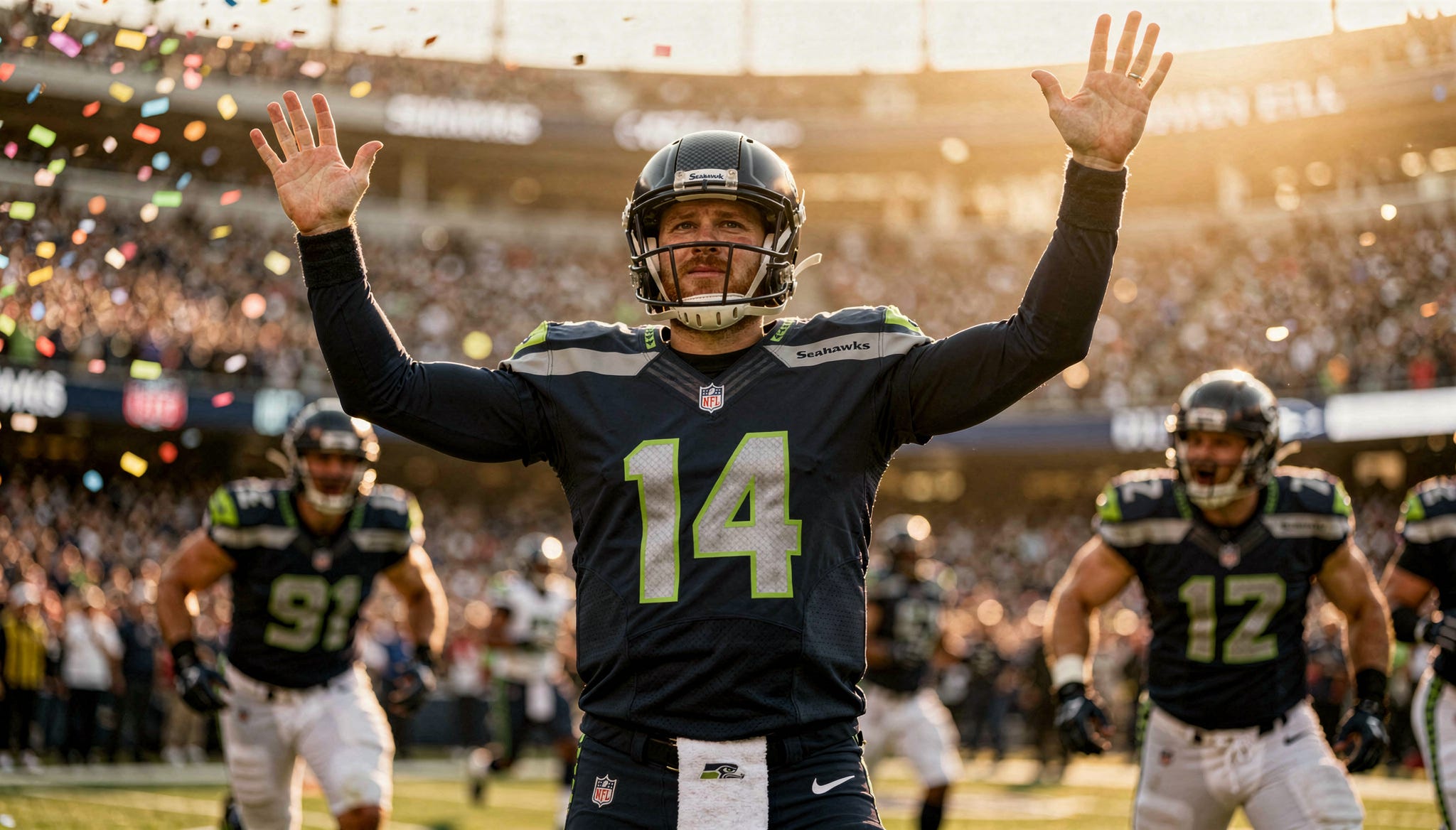
Decision 1: Xavier Smith’s Muffed Punt Creates an 11-Point Error Budget
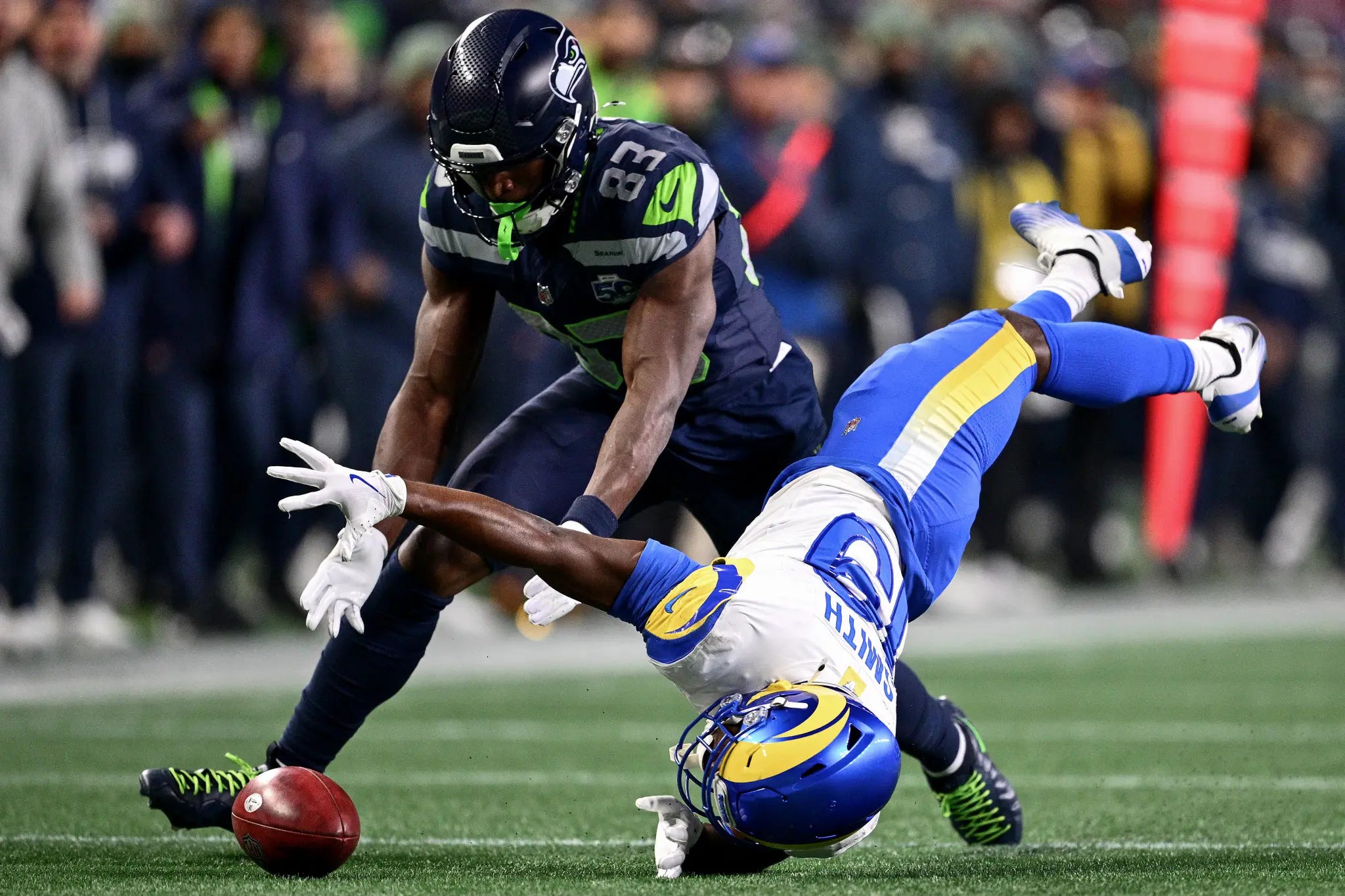
Early third quarter. Rams force Seattle three-and-out, trailing 17-13. Momentum shifting. Michael Dickson punts. Xavier Smith settles under it, loses his footing like a drunk trying to parallel park, muffs the catch. Dareke Young falls on it at the Rams' 17.4
Next play: Sam Darnold to Jake Bobo, 17-yard touchdown. Seattle up 24-13.5
That 11-point cushion became the structural foundation everything else rested on. Think of it as the load-bearing wall in a house that’s about to get hit by a tornado. When Riq Woolen committed his catastrophic taunting penalty later, it cut the lead to 31-27 instead of tying the game at 27. When the Rams mounted their final scoring threat, they were chasing four points instead of fighting for the lead. When Cooper Kupp made his game-sealing third-down catch, Seattle had already absorbed multiple errors and still held breathing room.
Smith’s fumble was a single point of failure that cascaded through the entire second half like a cracked dam leaking water into every downstream system. Jay Harbaugh’s special teams unit, ranked #1 by ESPN Analytics since Week 10, created one catastrophic moment for the Rams that Sean McVay’s 479 yards of offense couldn’t repair.6
Special teams isn’t glamorous. Neither is infrastructure maintenance. Both will absolutely destroy you when they fail at the wrong moment.
Decision 2: Darnold Executes a 34-Second Masterclass in Not Panicking
Rams up 13-10. They force a Seattle three-and-out with 1:33 left in the half. Standard playbook says run some clock, head to the locker room with momentum and a lead, make adjustments, come out strong for the second half.
Los Angeles goes three-and-out. Punts it back with 54 seconds remaining.
Darnold drops a 42-yard bomb on Jaxon Smith-Njigba, who absorbs a hit from Kam Curl that could’ve separated his soul from his body and holds on anyway. Four plays later: 14-yard touchdown to Smith-Njigba. Seattle leads 17-13 at halftime.7
Elapsed time: 34 seconds.
This was the moment that validated everything I’d been watching all season. The guy who threw six turnovers against this exact Rams team in two regular-season games (four interceptions in Week 11 alone) just ran a flawless hurry-up drill under championship pressure without a single mistake.8 Sports media spent the week asking whether Darnold could “handle the big moment.” He handled it by scoring faster than it takes most quarterbacks to call the play.
The four-point swing flipped the psychological ledger. What could’ve been 13-10 Rams entering the tunnel became 17-13 Seattle. Los Angeles never led again. Momentum is just accumulated micro-decisions dressed up in mystical language, and Darnold made better ones in 34 seconds than the Rams made all half.
Decision 3: Woolen’s Taunting Penalty Proves Emotional Regulation Is a Measurable Stat
Late third quarter. Seattle up 31-20 after a Cooper Kupp touchdown. Rams face 3rd-and-12. Stafford throws to Nacua. Riq Woolen breaks it up, nearly intercepts. Perfect defensive play. Game effectively over.
Woolen trots toward the Rams sideline, opens his mouth, gets flagged for taunting. Fifteen yards. Automatic first down.9
Next play: Stafford finds Nacua in the corner for a 34-yard touchdown. Same guy Woolen just taunted. Lead cut to 31-27.10
Three seconds of emotional dysregulation erased an 11-point cushion and turned a comfortable win into a stress test on Seattle’s ability to close without collapsing. Woolen’s brain executed perfect coverage. His mouth executed perfect sabotage.
Sports media loves selling narratives about “fire” and “playing with an edge” and “letting your emotions fuel you.” Nobody sells the invoice that arrives when passion overrides protocol. Woolen made the right football decision. Break up the pass, nearly intercept. Then he negated it by failing the basic emotional regulation test that separates professionals from amateurs.
After the game, he owned it: “Even though I made a great play, I wasn’t great for my team.”11
That’s the whole lesson compressed into one sentence. Individual excellence means nothing when it destabilizes the collective system. Woolen gave the Rams four points and something far more dangerous: belief they could still win this game.
Decision 4: Witherspoon’s Fourth-Down Stop Proves Output Doesn’t Equal Outcome
Rams drive 84 yards on 14 plays, converting one fourth down along the way. Methodical, professional, exactly what championship offenses do. Now they face 4th-and-4 from the Seattle 6, down 31-27, 4:59 remaining.12
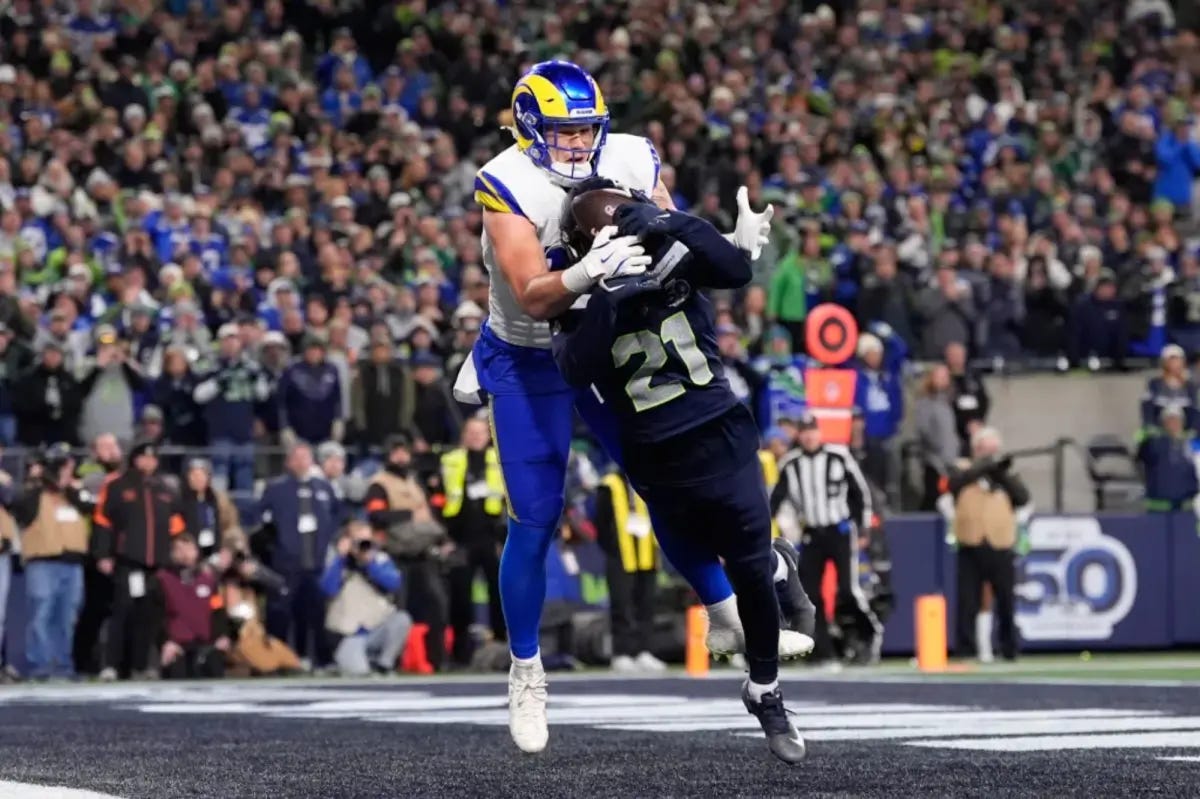
Stafford drops back, scans the end zone, targets tight end Terrance Ferguson over the middle. Devon Witherspoon breaks it up. Turnover on downs. Seattle ball on their own 6.13
A touchdown makes it 33-31 Rams. Extra point: 34-31. Two-point conversion: 35-31. Every version gives Los Angeles the lead.
Instead, Seattle got the ball with 4:54 left and bled the clock to 25 seconds before punting.
This is where the #1 defense bet cashed out. The Rams generated 479 total yards, the most any team put up against Seattle’s defense all season. Stafford, probable MVP, threw for 374 yards and three touchdowns. Nacua recorded his third career playoff game with 100+ receiving yards.14
None of it mattered when Witherspoon blanketed Ferguson and knocked the ball away on 4th-and-4.
Yardage accumulation is like cryptocurrency mining. You can pile up hash rate all day, generate impressive numbers, convince yourself the work matters. But when the network validates transactions, only one thing counts: did you solve the block when it mattered? The Rams accumulated output like a mining rig running 24/7. When it came time to validate the transaction that would flip the ledger, the network rejected it.
Output doesn’t equal outcome. Never has. Never will.
Decision 5: McVay’s Fourth-Down Gamble Chose Ceiling Over Floor and Lost Both
Same moment, different lens. Fourth-and-4, Rams down four, 4:59 left. Sean McVay faces a decision that will define his entire season.
Option A: Kick the field goal. Down 31-30. Force Seattle to get a first down or punt it back with 3+ minutes remaining, timeout still in pocket.
Option B: Go for the touchdown. Score and take the lead, or fail and give Seattle the ball on their own 6 with all the pressure flipped.
Watching live, I said to my dad watching the game with me: “They’re going to regret not kicking the field goal.”
Analytics models say go for it. Win probability calculators suggest a touchdown gives you better odds than a field goal in that situation. The math assumes you’ll either score immediately or get the ball back with meaningful time if you fail.
The math didn’t account for Seattle’s ability to execute surgical, clock-killing drives when backed against their own goal line with zero room for error. Seahawks ran the clock from 4:54 to 0:25, converting a crucial third down along the way, before punting to the Rams at their own 7-yard line with no timeouts remaining.15
McVay optimized for the highest ceiling outcome (immediate lead) and got the lowest floor result: no time, no position, no chance. A field goal keeps the Rams within one, forces Seattle to play offense instead of defense, preserves options if the first attempt fails.
Analytics models are beautiful until they collide with game theory. Win probability calculations can’t capture what happens when your opponent methodically destroys your assumptions about getting the ball back. McVay trusted his model without stress-testing the failure scenario, and the failure scenario destroyed him.
Decision 6: Kupp’s Third-Down Catch Starts the Sequence That Seals the Clock
Seattle ball, own 6-yard line, 4:54 left after Witherspoon’s fourth-down stop, up 31-27. One job: bleed the clock until the Rams have nothing left but desperation.
Kenneth Walker catches a checkdown for 15 yards, makes three Rams defenders miss. McVay calls timeout #1 at 3:26.
Walker runs for 3 yards. McVay burns timeout #2 at 3:11.
Third-and-7 from Seattle’s 24. Darnold throws over the middle to Cooper Kupp, who stretches out for the first down by the thinnest possible margin. McVay doesn’t challenge. Can’t afford to risk losing his final timeout on a call that might not get overturned.
Walker gains nothing on the next carry. McVay uses timeout #3 at 3:05.
Play-action to Jaxon Smith-Njigba. First down, but JSN goes out of bounds. Clock stops at 3:00.
Two Walker carries drain a full minute to the two-minute warning. Seattle has second-and-4 at the Rams 43.
Darnold to Smith-Njigba for 14 yards. Incomplete pass on second down, but Cobie Durant gets flagged for holding Kupp. Fresh set of downs at 2:12.
Seattle punts with 31 seconds left. Rams get the ball at their own 7 with no timeouts and 25 seconds to manufacture a miracle that mathematics says doesn’t exist.
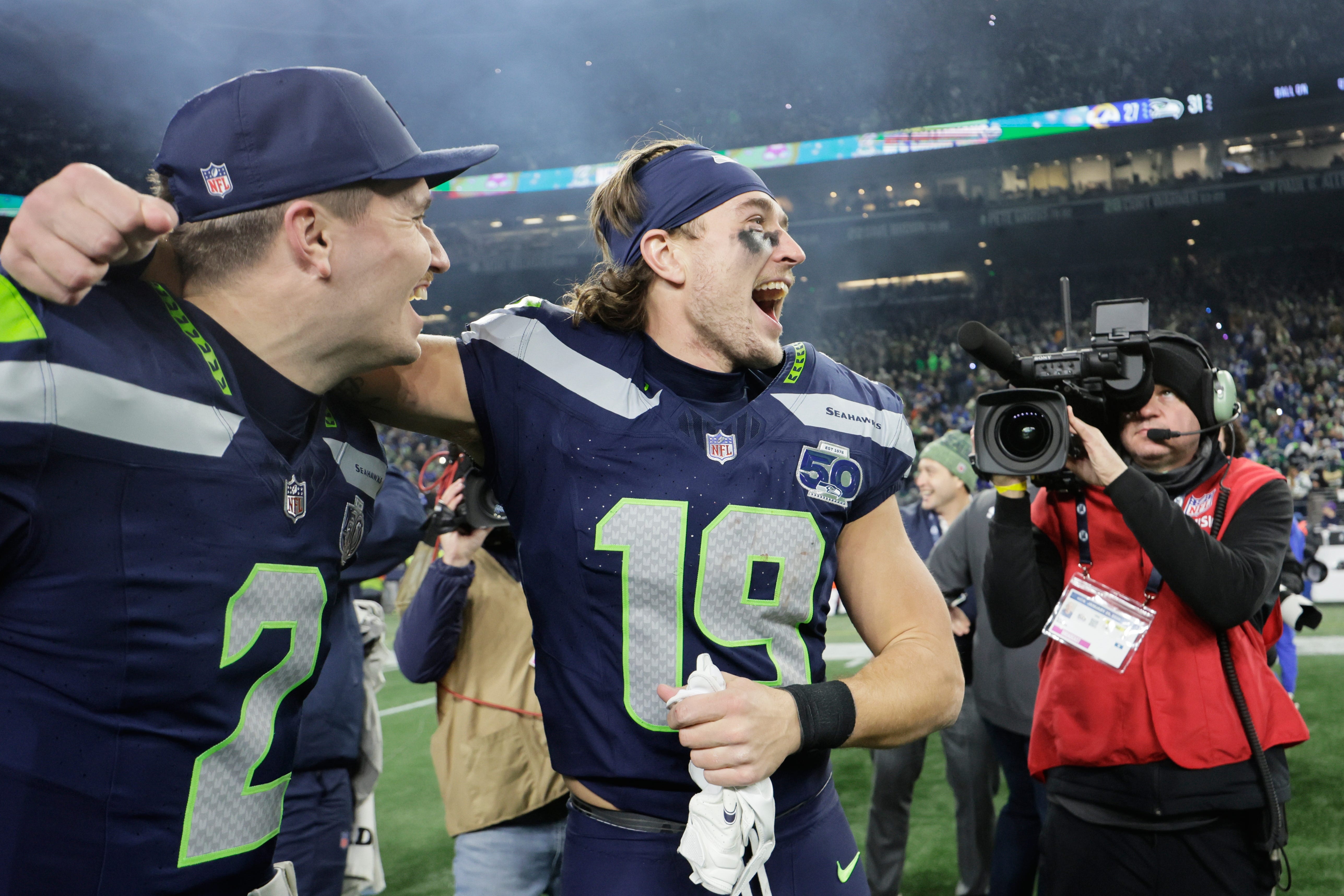
Cooper Kupp, Super Bowl LVI MVP for these same Rams, made the third-and-7 conversion that started the execution sequence.16 Seven yards, stretched just far enough to move the chains. Not a highlight. Not a touchdown. Just precision when precision was the only thing that mattered.
The invisible architecture of winning football doesn’t make SportsCenter’s top 10. Kupp’s most important catch of the playoffs kept the drive alive long enough for Seattle to methodically run the clock down to nothing, making McVay’s fourth-down gamble look even worse in retrospect.
Former Super Bowl MVP executes his old team with a seven-yard catch. Sports writes its own revenge narratives, but this one bothered to make mathematical sense.
Why the Confidence Held
The prediction landed: #1 defense beats #1 offense, special teams provides the edge, Darnold doesn’t turn the ball over. But the underlying mechanism runs deeper than matchup analysis you’d find in a pregame breakdown.
Championship teams don’t accumulate stats. They eliminate catastrophic failures at critical decision points. The Rams generated 83 more yards of offense and still lost because they committed six unforced errors at the worst possible moments:
Muffed a punt that created an 11-point insurance policy for every mistake Seattle made afterward.
Let Darnold score in 34 seconds before halftime when they should’ve run clock and protected their lead.
Benefited from Seattle’s taunting penalty that nearly erased their deficit, proving even championship teams hand out gifts.
Couldn’t convert 4th-and-4 when their entire season compressed into a single throw.
Chose touchdown over field goal and lost both the points and the clock, optimizing for ceiling and getting floor.
Couldn’t stop a former Ram from making the play that sealed the game, watching their Super Bowl MVP execute the most boring, most critical catch of the night.
Darnold finished with the exact stat line that justified the entire season-long evolution from skeptic to believer: 25-of-36, 346 yards, 3 TDs, 0 turnovers. The $100.5 million question has been answered. He’s not a capable backup who stumbled into success. He’s a quarterback who learned to operate within a defensive infrastructure that gave him room to stop making the mistakes that defined his career.
Seattle faces the Patriots in Super Bowl LX on February 8th at Levi’s Stadium. If Darnold continues operating with zero-turnover efficiency while the defense executes at the nodes that matter, this evolution from doubter to believer might end with a ring.
The Rams generated more yards. Seattle generated better decisions at the moments when decisions became destiny. That’s not a paradox. That’s just the difference between measuring output and measuring outcomes in a system where only outcomes matter.