

Octopus Mode
Why My Spirit Animal is Basically an Alien With Anxiety

The Spark: When You Realize You’re Not Broken, Just Cephalopod
An octopus has 500 million neurons. Only one-third are in its brain. The other two-thirds live in its arms. Each arm has its own “mini brain” that can taste, touch, move, and make decisions without checking in with headquarters.
I learned this after watching Better Call Saul, where Jimmy jokes about his spirit animal being a gila monster. Got me wondering about mine. My therapist suggested reading about octopuses. Turns out this explains everything about how I work.
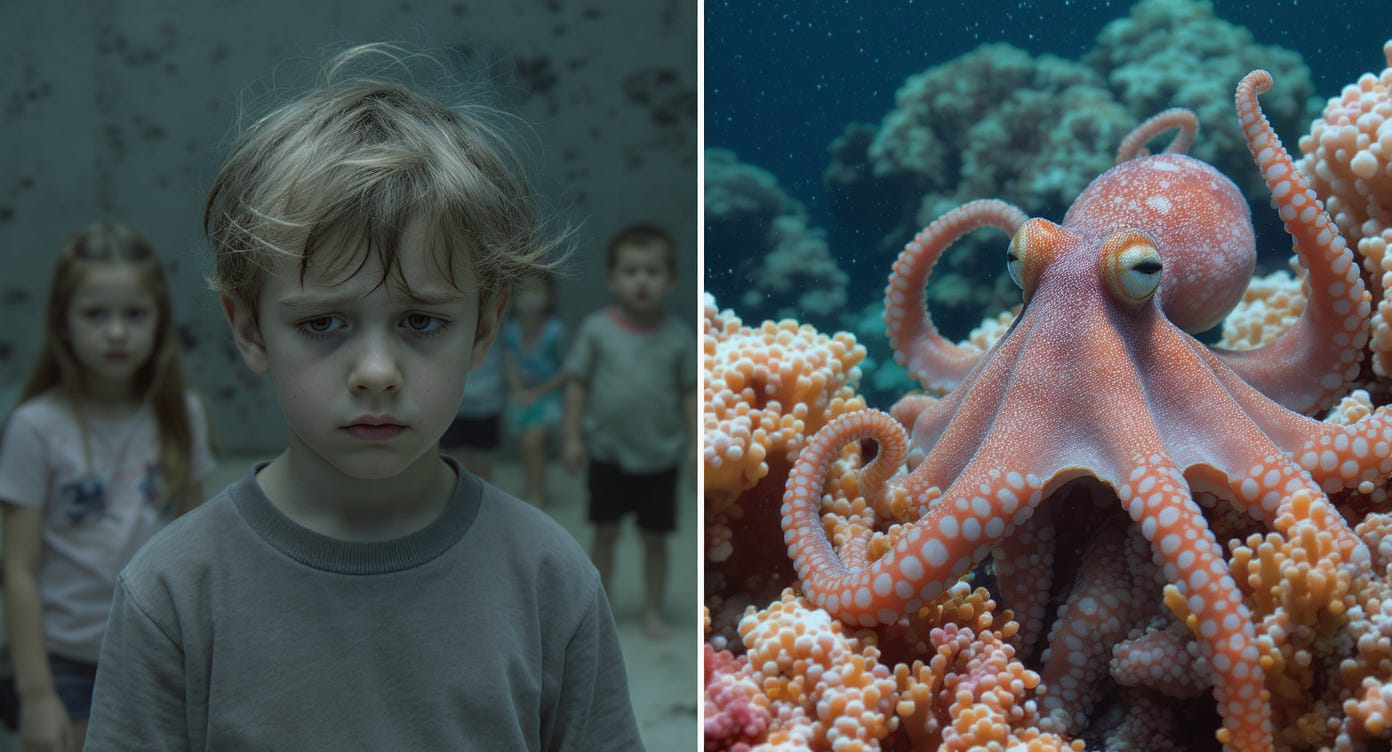
I don’t think, then do. I think by doing. When I’m learning a new programming language, I need to start coding immediately. Watching tutorials doesn’t help. I need to break things and fix them to understand how they work.
This started early. When I was 6 or 7, I broke the family computer. Completely bricked it. My parents weren’t thrilled when their PC did nothing but blink an error icon. The repair shop said it would cost more to fix than buying a new machine. I spent the entire weekend figuring out how to get it running. I did manage to fix it, but not before causing some serious panic.
That’s how I learn everything. I take things apart. I poke at them. I need to manipulate the environment physically to process information. Static thinking feels impossible.
For years, I thought this made me broken. Turns out it makes me a highly sophisticated invertebrate with anxiety.
The anxiety part comes from having eight arms’ worth of processing power in a world designed for creatures with two hands and one train of thought. While everyone else follows neat, linear problem-solving sequences, I’m simultaneously testing seventeen different approaches, getting overwhelmed by the sheer volume of possibilities, and then somehow arriving at solutions that I can’t really explain because they emerged from the whole system.
This isn’t ADHD behavior. This is octopus behavior. And octopuses are brilliant.
The Pattern: The Alien Intelligence We’ve Been Ignoring
Scientists describe octopus intelligence as “probably the closest we will come to meeting an intelligent alien.”1 Their evolutionary path diverged from ours over half a billion years ago, which means their version of consciousness represents a completely independent experiment in how complex thinking can emerge. They didn’t just evolve big brains, they evolved different brains.
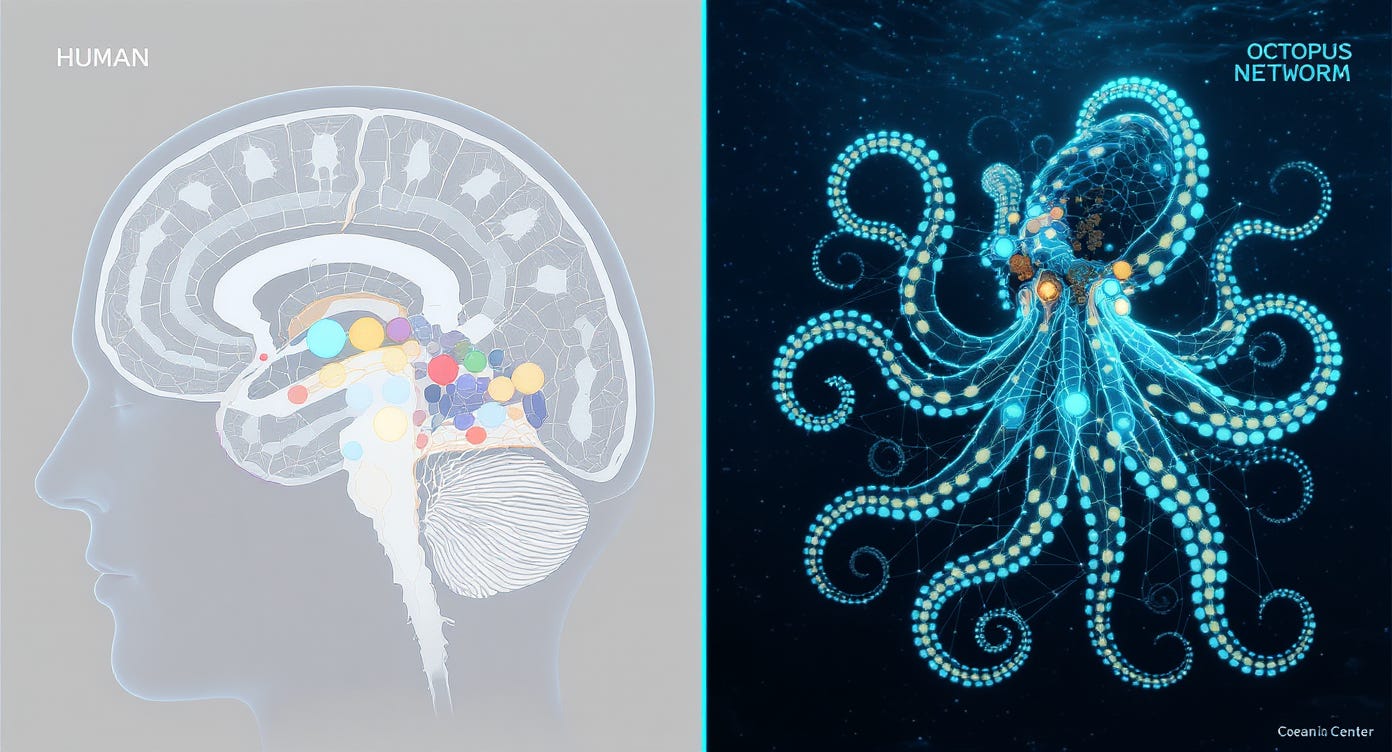
While human intelligence follows a top-down, hierarchical model, CEO brain issuing orders to various departments, octopus intelligence is genuinely distributed. Each arm contains millions of neurons organized into segmented “mini-brains” that can operate independently. An octopus arm can taste food, reject it, and continue searching for better options even after being severed from the body. This isn’t just biology. It’s a fundamentally different operating system.
The technical term is “embodied cognition,” which means thinking with your whole body instead of just your brain.
This distributed approach extends to their problem-solving style. Octopuses don’t tackle challenges through linear analysis. They explore multiple approaches simultaneously, one arm investigating a crevice while another arm tests the texture of a nearby rock, all while their skin experiments with camouflage patterns and their eyes track potential threats. They’re constantly running parallel processes, gathering sensory data from every possible angle.
Sound familiar? It should, if you’ve ever been told you “think too much” or “overthink everything” when what you’re actually doing is processing information through multiple channels simultaneously. The neurotypical world calls this scattered attention. The octopus world calls it advanced intelligence.
The creature’s legendary camouflage abilities aren’t just defensive, they’re cognitive. Recent research suggests that color-changing and cognition co-evolved, meaning their skin displays might actually be a “self-report” of their internal mental states. They’re literally thinking out loud through their entire body, broadcasting their cognitive process through dynamic visual patterns that shift in real-time.
This is why I’ve always processed emotions and ideas through physical expression. I don’t just feel anxious, my whole system broadcasts it through posture, movement, and energy. I don’t just think about concepts, I need to externalize them through writing, building, or some form of active engagement with the material world. My skin might not change colors, but my entire presence shifts based on what’s happening in my internal landscape.
For decades, this felt like a defect. Turns out it’s a feature.
The Protocol: Octopus Mode as Operating System
The octopus offers a radically different model for navigating complexity. Instead of the traditional “focus on one thing at a time” approach that dominates productivity culture, octopus mode embraces controlled chaos. Both approaches illuminate, but one reveals the whole environment while the other creates tunnel vision.
In octopus mode, you don’t fight your tendency to have multiple projects running simultaneously. You design systems that leverage it. Each “arm” of your attention can pursue a different thread while staying connected to a central core of values and goals. The key is making sure your distributed processing serves a unified purpose rather than just creating noise.
This matters because our world is becoming increasingly complex and non-linear. The problems we’re facing, climate change, technological disruption, social fragmentation, don’t respond well to traditional, hierarchical thinking. They require the kind of multi-pronged, adaptive intelligence that octopuses have been demonstrating for millions of years.
The neurodivergent crowd has been practicing octopus mode by necessity. We’ve had to develop workarounds for brains that don’t follow standard protocols. We think in networks rather than hierarchies. We make connections that seem random but often reveal hidden patterns. We process information through our entire nervous system rather than just the parts above our necks.
What I’ve learned is that octopus mode works best when you stop apologizing for it and start optimizing for it. This means building environments that support distributed processing rather than fighting against it. It means accepting that your creative process might look chaotic from the outside while being deeply systematic underneath.
The octopus doesn’t waste energy trying to think like a dolphin or a raven. It leverages its unique architecture to solve problems that other creatures couldn’t even perceive. When you’re operating in octopus mode, the goal isn’t to become more linear. The goal is to become more intentionally non-linear.
Personal Code: Embracing Your Inner Alien
Here’s what I wish someone had told me as a kid staring at the ceiling wondering if I belonged on this planet: You don’t need to fit into their operating system. You need to understand yours.
The octopus doesn’t apologize for having eight arms. It doesn’t try to function like a vertebrate. It uses its distributed intelligence to navigate environments that would overwhelm creatures with more “conventional” nervous systems. It’s an alien that’s perfectly adapted to its world.
I spent years trying to force my thinking into linear patterns, attempting to be the kind of person who could sit still and focus on one thing for hours. It didn’t work. Technically possible for short periods, but not sustainable and definitely not optimal.
The breakthrough came when I stopped treating my scattered attention as a disorder and started treating it as a design feature. Instead of fighting the urge to explore multiple ideas simultaneously, I built systems that could handle parallel processing. Instead of apologizing for thinking with my whole body, I leaned into environments where embodied cognition was an advantage.
The octopus taught me that intelligence isn’t about following the dominant model. Intelligence is about optimizing for your actual architecture. Some of us are built like alien invertebrates with anxiety, and that’s not a defect to fix. That’s a rare operating system that can solve problems other people can’t even see.
When you embrace octopus mode, you stop trying to become someone else and start becoming more precisely yourself. You stop apologizing for your complexity and start leveraging it. You realize that the thing that made you feel alien might actually be the thing that makes you most valuable.
The world needs more octopus people. We need the ones who think in networks, who process through their entire nervous system, who can adapt to chaos without losing their core identity. We need the aliens with anxiety who can see patterns that linear thinkers miss.
So the next time someone tells you to focus, to pick one thing, to be more like everyone else, remember: you’re not broken. You’re just operating on a different evolutionary timeline. And in a world becoming more complex by the day, that timeline might be exactly what we need.
What’s your spirit animal? And more importantly, have you learned to work with your actual operating system, or are you still trying to run octopus software on vertebrate hardware?
Peter Godfrey-Smith, “Other Minds: The Octopus and the Evolution of Intelligent Life”