

The CLARITY Act
How Congress Aims to End Crypto's "Wild West" Era and Foster Innovation

For years, the American crypto landscape has felt like the Wild West — a frontier of immense innovation overshadowed by regulatory chaos. Entrepreneurs and investors have been caught in a frustrating tug-of-war between two powerful federal agencies: the Securities and Exchange Commission (SEC) and the Commodity Futures Trading Commission (CFTC). The result? A "regulation-by-enforcement" environment where the rules are only revealed through costly lawsuits, driving talent and capital overseas.
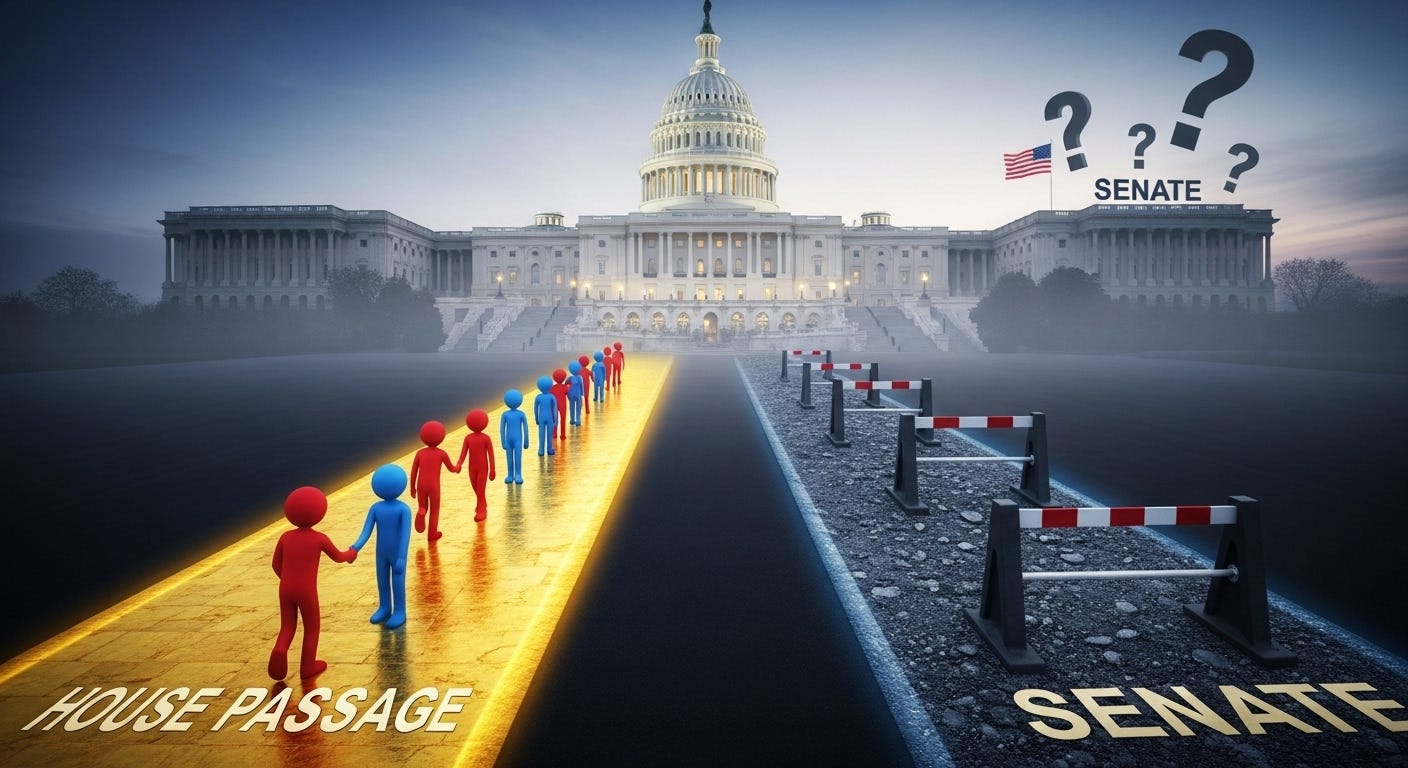
A major legislative effort, the Digital Asset Market Clarity Act (CLARITY Act), aims to finally bring order to this chaos. Having recently passed the House of Representatives1 after navigating significant political maneuvering, this bill represents the most comprehensive attempt yet to build a clear, functional regulatory framework for digital assets in the United States.

This post breaks down what the CLARITY Act is, the new concepts it introduces, and what it means for the future of crypto innovation and consumer protection.
Ending the Regulatory Tug-of-War
The central problem the CLARITY Act tackles is jurisdictional ambiguity. Is a given crypto asset a security, like a stock, under the SEC's purview? Or is it a commodity, like gold or wheat, overseen by the CFTC? Asking the wrong question can lead to disaster.
The CLARITY Act’s core purpose is to draw a bright line between the two. By creating clear definitions and a structured pathway for digital assets, it seeks to replace unpredictable enforcement actions with a predictable regulatory journey. This allows projects to understand their legal obligations from day one,2 fostering a more stable environment for innovation to flourish within the U.S.
The Heart of the Bill: "Digital Commodities" and "Mature Blockchains"
The legislation introduces two groundbreaking concepts that form the bedrock of its framework.3
Digital Commodity: The act formally defines a
digital commodityas a digital asset that is not inherently a security (i.e., it doesn't represent a debt or equity stake in a business enterprise). This category would include well-known assets like Bitcoin and, crucially, any other asset that runs on a certified "mature blockchain."Mature Blockchain: This is perhaps the most innovative element. For a digital asset to transition from a security to a commodity, its underlying network must be certified by the CFTC as a "mature blockchain." To achieve this status, the project must demonstrate true decentralization. The criteria for maturity include:4
Being operational for at least 12 months.
Having no single person or affiliated group with the unilateral authority to control the blockchain or its smart contracts.
Ensuring the code is open-source and transparent.
The issuer and its affiliates do not market the associated digital asset as a passive investment contract.
Achieving "mature" status unlocks significant regulatory benefits. The asset can be treated as a commodity, making it easier to list on exchanges and subjecting it to fewer of the intensive reporting requirements associated with securities.

A Dual Pathway: From Fundraising to Trading
The CLARITY Act doesn't just define assets — it creates a lifecycle for them, establishing distinct regulatory phases overseen by the appropriate agency.
Phase 1: Fundraising (SEC Jurisdiction): When a new project raises capital by selling tokens, those tokens are treated as "investment contract assets" — a type of security. During this phase, the project falls squarely under the SEC's jurisdiction. It must comply with federal securities laws, providing robust disclosures and ensuring investor protections are in place. This acknowledges the SEC's vital role in protecting capital markets.
Phase 2: Trading (CFTC Oversight): Once the project's network achieves "mature blockchain" certification from the CFTC, the underlying asset can be legally classified as a
digital commodity. At this point, regulatory oversight for spot market trading5 of that asset shifts to the CFTC, which will police the markets for fraud and manipulation.
This dual-path system provides a clear roadmap, allowing a project to launch and raise funds under the SEC's watchful eye and later transition into a decentralized commodity traded under the CFTC's rules.
More Than Just Rules: Strong Consumer Protections
A major criticism of past crypto legislation has been a perceived lack of consumer safeguards. The CLARITY Act addresses this head-on with some of the strongest protections proposed to date:6
Mandatory Disclosures: Digital asset exchanges will be required to provide customers with clear, easy-to-understand information about each asset, including details on its operation, source code audits, and custody arrangements.
Segregation of Customer Funds: In a direct response to the FTX collapse, the bill mandates that exchanges keep customer assets separate from their own corporate funds. This would prevent a firm from dipping into customer accounts to cover its own losses.
Robust Market Supervision: The CFTC is granted explicit authority and funding to conduct oversight of digital commodity markets, protecting them from fraud and manipulation.

The Road Ahead: Bipartisan Support and Lingering Hurdles
The CLARITY Act achieved strong bipartisan support in both the House Financial Services and Agriculture Committees,7 a rare feat in today's political climate. It recently passed a historic, marathon vote on the House floor, demonstrating a significant consensus on the need for action.
However, the path forward is not without challenges. Some prominent Democrats and consumer protection groups argue8 that the bill is overly deregulatory, fearing it could strip the SEC of necessary authority and create loopholes that endanger consumers. The bill's future in the Senate remains uncertain, where it will face further debate and potential amendments.
Key Takeaway: Certainty Comes with Complexity
The CLARITY Act is a landmark piece of legislation designed to provide the legal certainty the digital asset industry has desperately needed to innovate and compete on a global scale from within the United States. It thoughtfully tackles the core jurisdictional conflict and offers a novel solution with the "mature blockchain" concept.
However, this new clarity comes with its own set of complexities and trade-offs. The certification process will be rigorous, and the dual-agency oversight will require seamless coordination. For businesses, this means navigating a new, multi-stage regulatory system. For investors, it means understanding the rights and risks associated with assets at different stages of their lifecycle.
Whether the CLARITY Act becomes law in its current form or not, it has fundamentally reshaped the debate. It lays down a comprehensive blueprint for how America can move beyond the "Wild West" and build a regulated, innovative, and safer digital asset market for the future.
Conservative crypto rebellion breaks after longest House vote in US history accessed July 17, 2025
The Digital Asset Market Clarity (CLARITY) Act accessed July 17, 2025
RULES COMMITTEE PRINT 119–6 TEXT OF H.R. 3633, THE CLARITY ACT OF 2025 accessed July 17, 2025
Section-by-Section: Digital Asset Market Clarity (CLARITY) Act of 2025 accessed July 17, 2025
CLARITY Act: Shifting Oversight of Digital Assets Classified as Commodities to the CFTC accessed July 17, 2025
Overview and Analysis of the CLARITY Act accessed July 17, 2025
H.R.3633 - Digital Asset Market Clarity Act of 2025 accessed July 17, 2025
Fact Sheet: CLARITY Act Worse than Last Year’s FIT 21 Crypto Deregulation accessed July 17, 2025