

The Collision Course
Two Americas Hurtling Towards an Unprecedented Economic Showdown

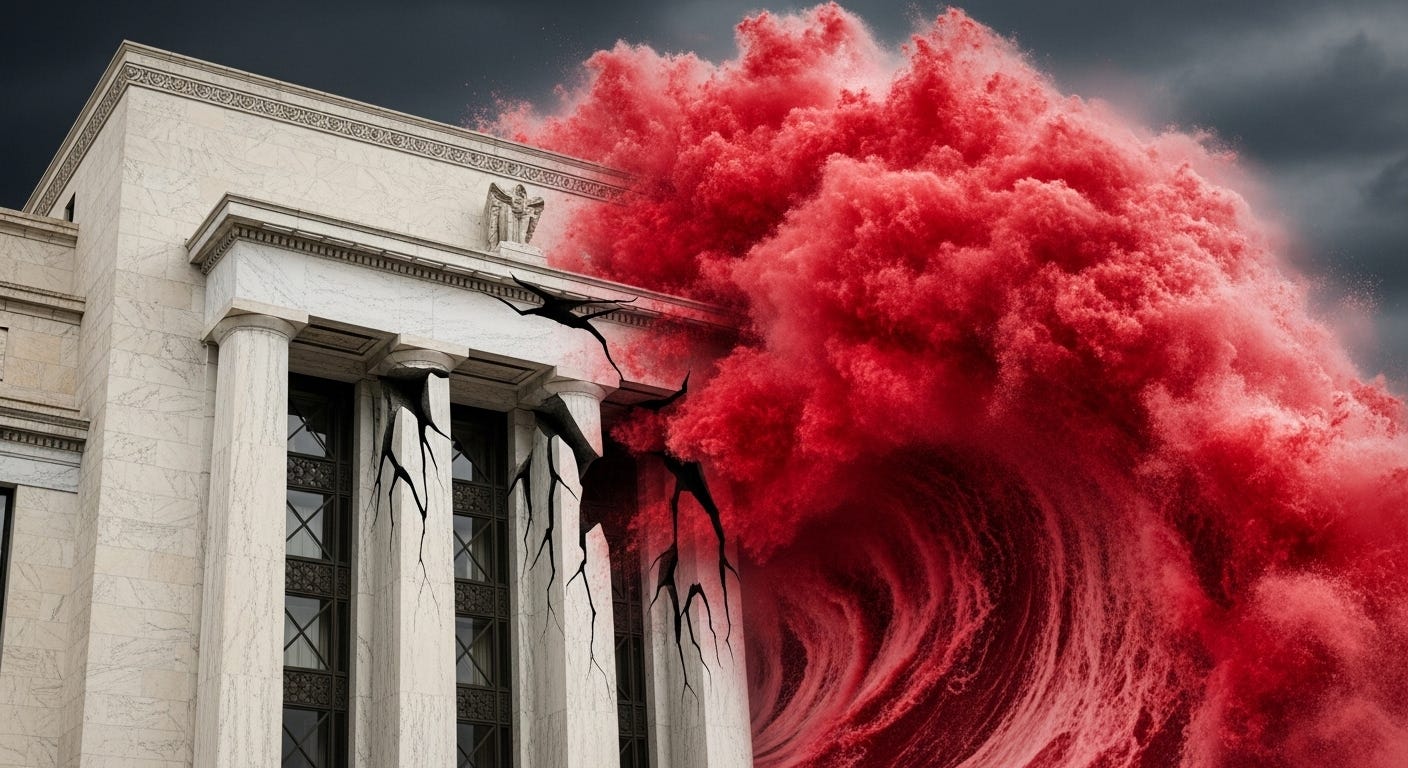
There are two Americas in the summer of 2025. They are not just Red and Blue. They are driven by fundamentally different forces, they speak different languages, and they are on a direct collision course. Your job, your savings, and the future of the American economy are caught in the middle.
In one America, men and women in quiet rooms in Washington D.C. stare at spreadsheets. They are data priests, disciples of dual mandates and logarithmic charts. Their high priest is Jerome Powell, the Chairman of the Federal Reserve. His world is one of decimal points and lagging indicators. His goal is a delicate, almost impossible one: to steer the gargantuan vessel of the U.S. economy to a "soft landing," taming the monster of inflation without crashing the ship into the rocks of a deep recession.
In the other America, the air is thick with passion, grievance, and a burning sense of cultural anxiety. This America gathers in rallies, not boardrooms. Its language is not of GDP forecasts, but of national identity, sovereignty, and borders. Its standard-bearer is Donald Trump, and its mandate is not economic equilibrium, but a promise to restore a nation they feel is slipping away.
For months, these two worlds have spun in different orbits. But as we head towards 2026, their paths are set to violently intersect. The Federal Reserve's data-dependent caution is about to slam into a political movement that runs on ideological fuel, and the consequences could reshape our country's economic and institutional landscape.
The Fed's Lonely Tightrope Walk
To understand the coming crash, you first have to understand the bind Jerome Powell is in. Picture him at the helm of that economic vessel. For the better part of two years, he has been desperately trying to slow it down. The inflation that peaked in 2022 was a multi-headed hydra, and the Fed’s only real weapon was the bludgeon of interest rate hikes. It worked, but not without a cost.
Now, in mid-2025, the situation is agonizingly complex. Economic growth has slowed to a crawl, but inflation remains stubbornly, infuriatingly persistent.
Here’s the data the Fed is staring at right now. First, look at inflation. While down from its terrifying peaks, the Fed’s preferred measure — Core Personal Consumption Expenditures (PCE) — is still hovering around 3%. That’s a full percentage point above their sacred 2% target.
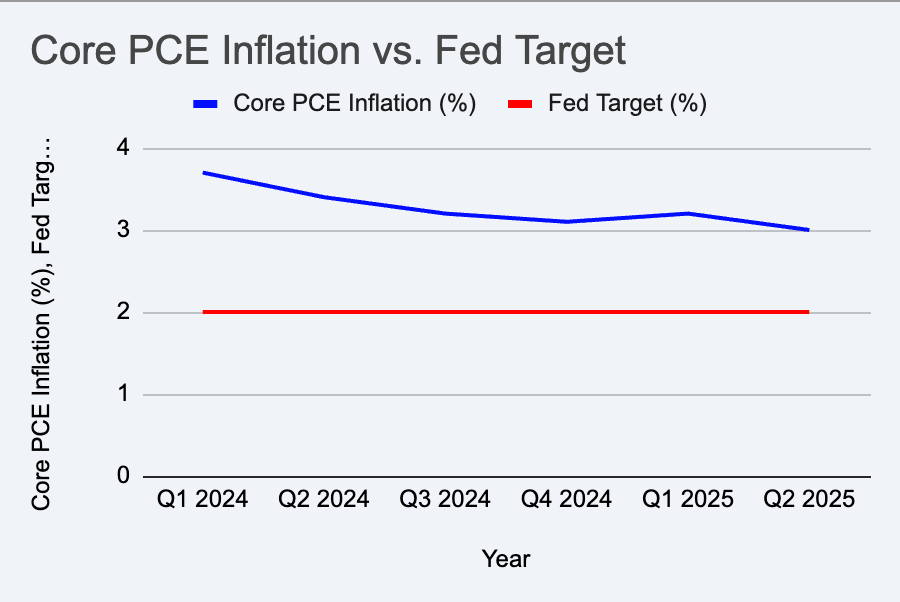
For you and me, that means prices are still rising faster than anyone is comfortable with. For the Fed, it means they can't declare victory. They are terrified of cutting rates too soon, only to see the inflation hydra grow a new head and come roaring back.
At the same time, the economy is showing clear signs of strain. The Fed's own projections have revised GDP growth for 2025 down to a sluggish 1.4%.
This is the tightrope: Cut rates to stimulate the sputtering growth engine, and you risk unleashing inflation. Keep rates high to fight inflation, and you risk tipping the economy into a full-blown recession, costing millions of Americans their jobs.
Faced with this dilemma, the Fed has chosen to wait. They are in a state of suspended animation, holding rates steady and repeating their mantra: they are "data-dependent." They will not move until the numbers — unemployment, inflation, growth — give them a clear signal. It is a world of pure, cold, technocratic caution.
The Populist Mandate: An Entirely Different Reality
Now, step out of the Fed’s quiet room and into the other America. Here, the metrics aren't economic, they're existential. The central concern isn't the PCE price index; it's the perceived threat to national culture and identity.
A potential second Trump administration, propelled by a base animated by these fears, is implementing an agenda that operates on a completely different logic. The "Project 2025" blueprint, a comprehensive governing plan developed by conservative think tanks, outlines an immigration policy of unprecedented scale and aggression.
We’re talking about plans to end birthright citizenship, to use the National Guard for mass deportations, to impose ideological purity tests on visa applicants, and to reinstate and expand the travel bans. This isn't just policy; it's a project of cultural fortification.
Polling reveals the deep partisan chasm on this issue. While a majority of Americans see immigration as a net positive, a formidable bloc of Republican voters sees it as a critical threat, demanding decisive and dramatic action.
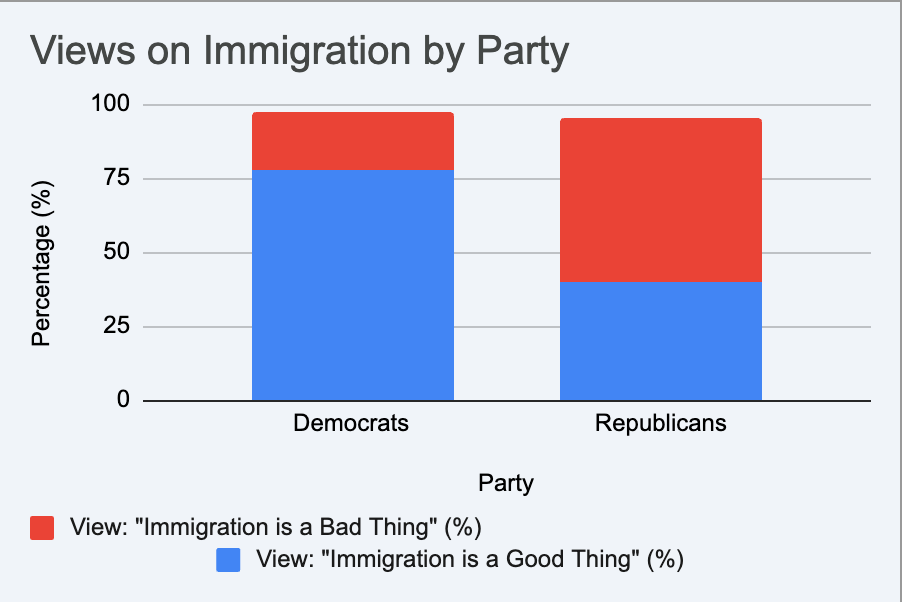
(Source: Synthesized from recent Pew Research and Gallup polling)
For this America, a "soft landing" for the economy is an abstract, secondary concern. The primary goal is to secure the nation's borders and cultural identity, and they are prepared to endorse disruptive, even chaotic, measures to achieve it. The economic consequences are, at best, an afterthought.
The Imminent Collision
Here, then, is the collision course:
Imagine a version of 2025. A new administration takes office with a mandate, as it sees it, to crack down on immigration. It begins to implement policies designed for mass deportation. Millions of people, many of whom are employed, are removed from the labor force.
What happens next? A labor shortage of immense proportions. Businesses, from farms to construction sites to restaurants, are suddenly unable to find workers. They are forced to raise wages dramatically to attract the few remaining applicants. To cover these new costs, they jack up prices.
And just like that, the inflation monster the Fed spent years trying to cage is loose again, more ferocious than ever.
Jerome Powell and the Federal Reserve would be trapped in a nightmare scenario. Their data would scream for them to raise interest rates—and raise them high—to combat this new inflationary surge. But doing so would slam the brakes on an economy already reeling from the chaos of the new policies, almost certainly triggering the very recession they have worked so desperately to avoid.
This is where the two Americas collide. The Fed's data-driven world, with its goal of price stability, would be fundamentally at odds with a political agenda driven by non-economic, ideological imperatives.
The pressure on the Fed would be immense. Populist movements, by their very nature, are skeptical of independent institutions like central banks. They see them as part of an unaccountable "elite" establishment that thwarts the will of the people. A president focused on a populist agenda would likely view the Fed's inflation-fighting measures not as sound monetary policy, but as a direct political attack, an attempt to sabotage his administration.
We would see a war between the White House and the Federal Reserve on a scale that would make past conflicts look like minor skirmishes. It would be a test of institutional independence unlike any we have ever seen.
The Surprising Truth in the Numbers
But here is the final, fascinating twist in this story. While the political rhetoric is white-hot, the broader public—even within the Republican party—is not as monolithic as it seems.
Recent polling from Gallup has shown a surprising trend: the percentage of Americans, including Republicans, who see immigration as a "good thing" for the country is at a record high.
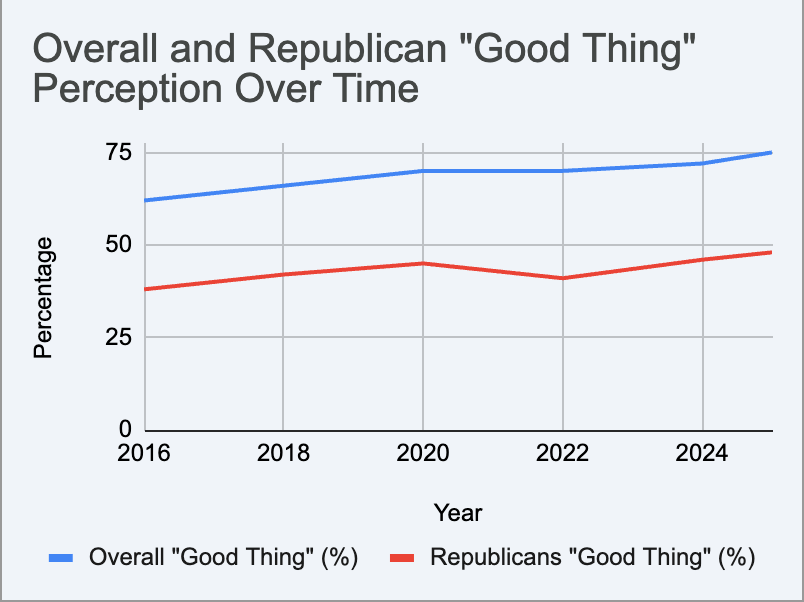
This suggests a profound disconnect between the base-stoking rhetoric that dominates our political discourse and the more nuanced, evolving views of the American people themselves. It points to a nation struggling with its own identity, where loud and angry voices often drown out a quieter, more ambivalent majority.
An Unprecedented Test Awaits
The rest of this year will be about more than just interest rates and immigration statistics. It will be a test of our entire system. Can a technocratic institution like the Federal Reserve, designed to be insulated from political whims, function when confronted with a populist political movement that operates on a completely different set of values and goals?
One America runs on data. The other runs on belief. They are speaking different languages, pursuing different ends, and they are now set to collide in the heart of the American economy. The outcome is anything but certain, but one thing is clear: the aftershocks will be felt by all of us.