

The GDP Illusion
America’s Economy is Three Data Centers in a Trench Coat

The Spark: When Statistics Become Performance Art
The economy is doing great. At least, that’s what the GDP numbers keep insisting, like a desperate stage manager frantically adjusting the lighting while the entire set collapses behind the curtain.
Harvard economist Jason Furman recently dropped an inconvenient truth that should make every economic forecaster question their entire profession: without AI data center investment, U.S. GDP growth in the first half of 2025 would have registered at 0.1% — a number so close to zero it might as well be a rounding error.1 This isn’t growth. This is statistical artifice.

The composition tells the real story. Investment in information-processing equipment represents just 4% of GDP, yet somehow managed to account for 92% of GDP growth. Manufacturing? Stagnant. Retail? Contracting. Real estate and services? Actively detracting from output. The entire American growth narrative hinges on a handful of hyperscalers — Microsoft, Google, Amazon, Meta — pouring nearly $400 billion annually into AI infrastructure.2
This creates a surreal disconnect between official statistics and lived experience. Headlines trumpet robust economic performance while your neighbor’s small business shutters, your rent climbs faster than your salary, and entry-level jobs evaporate into automated customer service portals. The GDP says we’re thriving. Your bank account suggests otherwise.
The first quarter of 2025 saw GDP contract by 0.6%.3 The second quarter rebounded with 3.8% growth — but strip away data center construction and you’re left with an economy treading water. Consumer spending, historically the engine of American growth, has been surpassed by corporate technology investment for the first time in modern economic history.4
This isn’t just a statistical quirk. This represents a fundamental measurement failure that obscures the actual distribution of economic activity. When the top ten corporate spenders account for nearly a third of all capital investment, you don’t have broad-based growth. You have concentration masquerading as prosperity.
The Pattern: How We Learned to Stop Measuring and Love the Aggregate
GDP was never designed to capture economic health. It was designed to measure industrial wartime production capacity during World War II, then awkwardly retrofitted into peacetime as a proxy for national wellbeing. Using GDP to assess economic vitality is like using your car’s odometer to determine whether you’re driving in the right direction — the number moves, but it tells you nothing about destination.
The Austrian economists saw this problem clearly decades ago. Friedrich Hayek spent considerable intellectual energy explaining that aggregate statistics mask the actual structure of production and capital allocation.5 When you collapse the complex web of economic relationships into a single number, you destroy the information necessary to understand what’s actually happening beneath the surface.
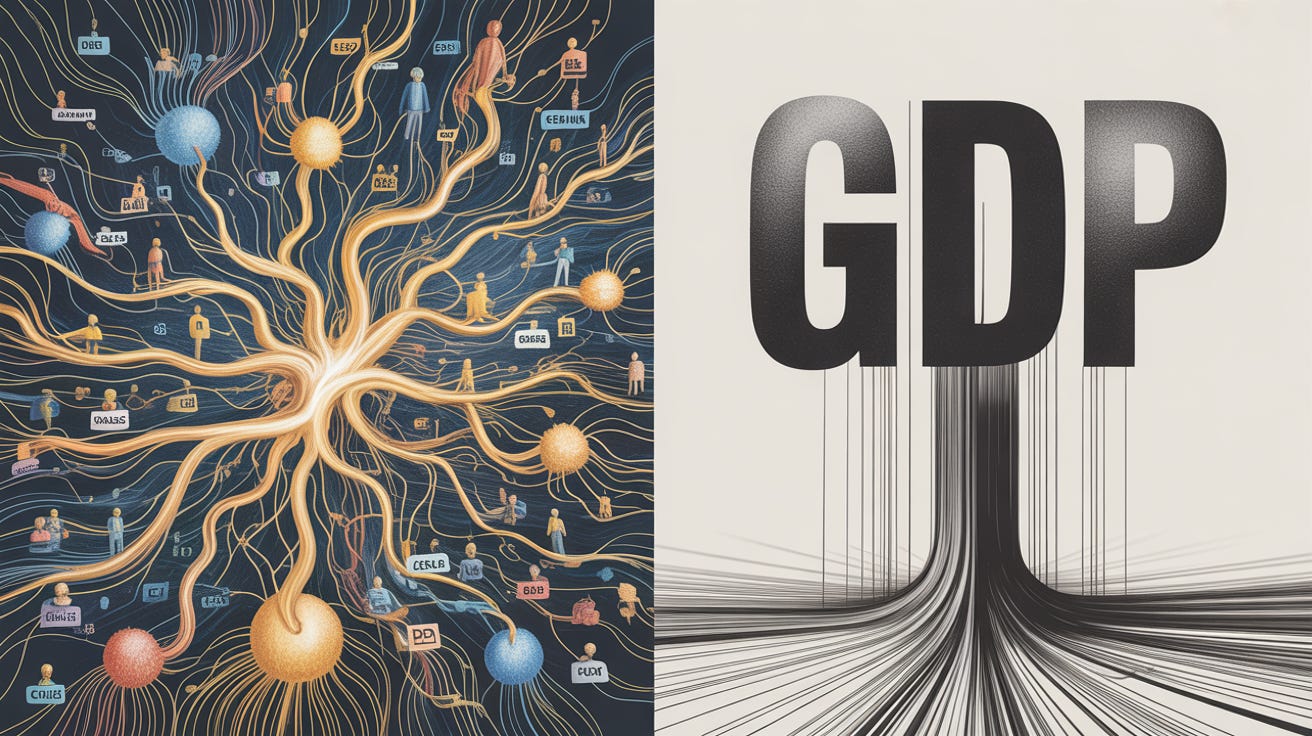
The current situation demonstrates exactly why this matters. Data center investment counts as capital formation in GDP calculations, creating the appearance of productive economic activity. But productive for whom? A small cluster of technology companies building infrastructure that may or may not generate returns, while the rest of the economy limps along, doesn’t represent sustainable growth. It represents misallocation at scale.
Morgan Stanley’s chief economist Michael Gapen recently called the disconnect between “solid spending data and weak hiring” a “mystery.”6 There’s no mystery if you understand what’s being measured. Spending isn’t broadly distributed — it’s concentrated in capital-intensive projects that require minimal labor. The spending data looks healthy because a few massive corporations are writing enormous checks. The hiring data looks weak because those corporations aren’t hiring people, they’re buying server racks.
Torsten Sløk at Apollo Global Management delivered the most honest assessment: “The consensus has been wrong since January...We in the economics profession need to look ourselves in the mirror.”7 The profession has been chasing aggregate numbers while ignoring compositional reality, producing forecasts that read like wishful thinking rather than analysis.
This pattern repeats throughout economic measurement. Unemployment statistics ignore discouraged workers who’ve stopped looking. Inflation metrics underweight housing costs that consume growing shares of household budgets. Stock market indices reflect the performance of the largest corporations while small business formation collapses. Each metric individually seems reasonable; collectively they create a statistical fiction that bears little resemblance to ground-level economic experience.
The gap between official data and personal reality isn’t accidental. Aggregate measures obscure distribution by design. When economic gains concentrate among a narrow slice of actors — whether geographic, sectoral, or demographic — averaging those gains across the entire population produces numbers that suggest widespread prosperity while masking actual deprivation.
GDP growth powered almost entirely by AI infrastructure investment tells you something important: the economy isn’t growing in any meaningful sense. A few technology companies are making massive capital expenditures that register as growth in our clunky measurement systems, while the economic structures that affect daily life — employment, housing, local business activity — deteriorate or stagnate.
The Protocol: Decentralization as Economic Reality Check
The data center economy exposes a deeper problem that decentralization technologies could actually address: when economic activity concentrates in a small number of actors, measurement becomes propaganda and planning becomes impossible.
The DePIN (Decentralized Physical Infrastructure Network) sector offers a useful contrast. Real decentralization distributes both infrastructure and economic benefit across networks of participants rather than consolidating everything under a handful of corporate balance sheets. Projects like Helium (decentralized wireless networks) and Filecoin (distributed data storage) theoretically create infrastructure where thousands of individual operators contribute capacity and capture value, rather than concentrating both in corporate data centers.8

The economic implications matter more than the technology. When infrastructure investment distributes across many participants, GDP growth from capital formation would actually reflect economic activity happening at the household and small business level. The statistics would align more closely with lived experience because the people experiencing economic activity would be the ones making the investments and capturing the returns.
This doesn’t mean every DePIN project represents genuine decentralization. Many dress up corporate infrastructure projects in decentralization aesthetics — token economics as theater rather than substance. But the legitimate implementations demonstrate a structural alternative to the current model where Amazon Web Services and Microsoft Azure essentially function as the American economy’s load-bearing walls.
The Austrian critique becomes practical policy here. When you can’t trust aggregate statistics because they mask the actual structure of economic activity, you need systems that inherently distribute information and incentives. Decentralized networks create price signals at the individual node level rather than hiding everything inside corporate balance sheets. You can observe actual supply, demand, and capacity constraints rather than inferring them from quarterly earnings reports.
The broader lesson extends beyond infrastructure. When economic measurement fails to capture reality, the problem isn’t just statistical — it’s structural. Systems that concentrate activity in a few actors will always create misleading aggregates. Systems that distribute activity across many participants generate more honest signals about actual economic health.
Bitcoin demonstrates this in monetary policy. Central banks manipulate aggregate statistics like M2 money supply and inflation targets while the actual purchasing power of currency erodes in ways that disproportionately affect different populations. Bitcoin’s distributed ledger makes monetary policy transparent and verifiable at the transaction level rather than trusting central bank pronouncements about aggregate targets.9
None of this solves the immediate problem — GDP growth built almost entirely on data center investment still represents a fragile, concentrated economic structure vulnerable to rapid collapse if those investments don’t generate expected returns. But it points toward why decentralization matters beyond ideological preferences: distributed systems produce more accurate information about actual conditions because they don’t rely on aggregation that obscures distribution.
My Debug: Learning to Distrust the Dashboard
I spent years trusting the dashboard metrics — GDP growth, equity valuations, employment statistics — before realizing I was navigating by instruments that measured the wrong things. The aggregate numbers looked solid while the underlying economic reality shifted in ways those metrics couldn’t capture.
When I lost everything in late 2023, the official statistics said the economy was recovering. Job market strong, growth returning, consumer confidence rebounding. My experience involved burning through savings while searching for employment in a market that had fundamentally changed beneath the surface-level numbers. The disconnect wasn’t just personal misfortune — it was structural misalignment between what gets measured and what actually matters.
The current data center economy reminds me of that experience. Official growth numbers look healthy while most people experience economic strain. The statistics aren’t technically wrong — investment in AI infrastructure does register as capital formation. But the composition tells a story those aggregates deliberately obscure: growth that benefits a tiny fraction of actors while everyone else navigates stagnation masked by statistical performance art.

The Austrian economists weren’t just making theoretical points about calculation problems in centrally planned economies. They were identifying a fundamental measurement issue that affects how we understand economic reality. Aggregates destroy information. When you collapse complex distributions into single numbers, you create the illusion of knowledge while eliminating the details necessary for actual understanding.
This matters now because policy gets made based on those misleading aggregates. Federal Reserve decisions hinge on GDP growth and inflation statistics that increasingly fail to capture the economic structures they’re supposed to represent. Fiscal policy targets aggregate demand while ignoring how economic activity distributes across different populations and sectors. The entire macroeconomic policy apparatus operates on instruments that provide false precision about poorly understood phenomena.
Decentralization isn’t just a technology preference or political ideology. It’s a recognition that distributed systems generate more honest signals than centralized aggregates. When you can observe individual nodes rather than trusting summary statistics, you develop a clearer picture of actual conditions. The current economy isn’t three data centers in a trench coat because of any technological limitation — it’s because our measurement and policy systems reward concentration while obscuring the consequences.
Learning to distrust the dashboard means developing alternative information sources that don’t rely on aggregate statistics. Network-level data from decentralized infrastructure. Transaction patterns from distributed ledgers. Price signals from markets that haven’t been completely financialized into abstraction. These aren’t perfect measurements, but they’re at least attempting to capture reality rather than performing it.
The GDP illusion persists because acknowledging it would require admitting that our entire framework for understanding economic activity rests on measurements that obscure more than they reveal. Easier to keep celebrating growth powered by data center construction while pretending those numbers represent broad-based prosperity. The trench coat stays on until someone finally notices there’s nothing underneath but concentrated infrastructure investment and statistical wishful thinking.
How long can an economy run on infrastructure investment for AI systems that may or may not ever generate returns? And when the measurement systems themselves obscure the answer, how would we even know when the illusion finally breaks?