

The Jawboning Papers
How a Homeland Security Agency You’ve Never Heard Of Decided What You Could Read Online

The Glitch: When the Thought Police Have a .gov Email Address
Most Americans couldn’t tell you what CISA stands for. The Cybersecurity and Infrastructure Security Agency sounds like exactly the kind of bureaucratic alphabet soup that makes your eyes glaze over during civics class. Created in 2018 under Trump to protect election infrastructure from foreign hackers, CISA was supposed to keep Russian bots from messing with voting machines and Chinese state actors from breaching critical systems. Boring but necessary cybersecurity work.
Instead, the Biden administration quietly transformed CISA into something far more interesting and far more dangerous — a switchboard operator for government censorship, flagging American citizens’ social media posts and pressuring platforms to remove speech the administration found inconvenient.
On October 8, 2025, Senator Ted Cruz convened a hearing titled “Shut Your App: How Uncle Sam Jawboned Big Tech Into Silencing Americans.”1 The witnesses weren’t theoretical victims. They were journalists who’d been personally deplatformed, shadowbanned, and silenced after CISA flagged their content to social media companies. Alex Berenson, formerly of the New York Times, testified about being banned from Twitter hours after President Biden said platforms were “killing people” by allowing vaccine skepticism. Sean Davis, CEO of The Federalist, described systematic throttling of conservative media outlets coordinated between government agencies and Big Tech platforms.
The term for this is “jawboning” — government officials using informal pressure, threats of regulation, and bureaucratic leverage to get private companies to do what the Constitution explicitly prohibits the government from doing directly. It’s censorship with extra steps. The First Amendment says the government can’t silence you, so instead the government suggests to Twitter that you’re a problem, mentions they’re concerned about Section 230 liability protections, maybe implies that regulatory scrutiny could increase, and suddenly you’re locked out of your account for violating terms of service you never actually violated.
Berenson’s case is particularly stark. Internal Twitter emails — released after Elon Musk’s acquisition — show the company admitted Berenson hadn’t broken any rules and “Mr. Berenson’s Tweets should not have led to his suspension.”2 Twitter even reinstated him in July 2022, before Musk took over. But the damage was done. During the critical period when Biden’s vaccine mandate was being debated, Berenson’s dissenting voice had been removed from the conversation. When he sued the Biden administration, a federal judge laid out all the facts — but current Supreme Court precedent makes it functionally impossible to win monetary damages for First Amendment violations by federal officials.3
This isn’t a glitch in the system. This is the system working exactly as designed — a workaround that lets government officials run censorship campaigns with near-total impunity while avoiding the constitutional constraints that would apply if they censored directly.
The Source Code: How CISA Became the Censorship Industrial Complex’s Switchboard
Cruz’s September 2025 investigative report reveals CISA’s transformation from cybersecurity agency to thought police happened systematically, not accidentally. The agency redefined “infrastructure” to include not just physical systems or software, but what people were saying about elections and public health.4 Once speech became “cognitive infrastructure,” CISA could justify monitoring, flagging, and coordinating its suppression.
The mechanism was elegantly simple. CISA created internal systems to monitor online speech that didn’t align with administration positions. When they found wrongthink — say, questioning mask efficacy, discussing mail-in ballot security, or posting data about vaccine side effects — they’d flag it for social media platforms. Sometimes through direct communication, sometimes through non-governmental intermediaries like the Election Integrity Partnership or the Stanford Internet Observatory.
The platforms faced a choice that wasn’t really a choice at all. They could ignore the flags and risk regulatory scrutiny, threats to Section 230 protections, and general government hostility across multiple agencies. Or they could sacrifice a few users who were making government officials uncomfortable and stay in the administration’s good graces.
Facebook exec Nick Clegg’s internal emails — uncovered during congressional investigations — capture the dynamic perfectly. After a meeting with White House COVID advisor Andy Slavitt, Clegg summarized the pressure: they viewed sacrificing speech from some users as “the price they had to pay” to maintain good relations with the federal government. This wasn’t hypothetical leverage. This was explicit coercion.
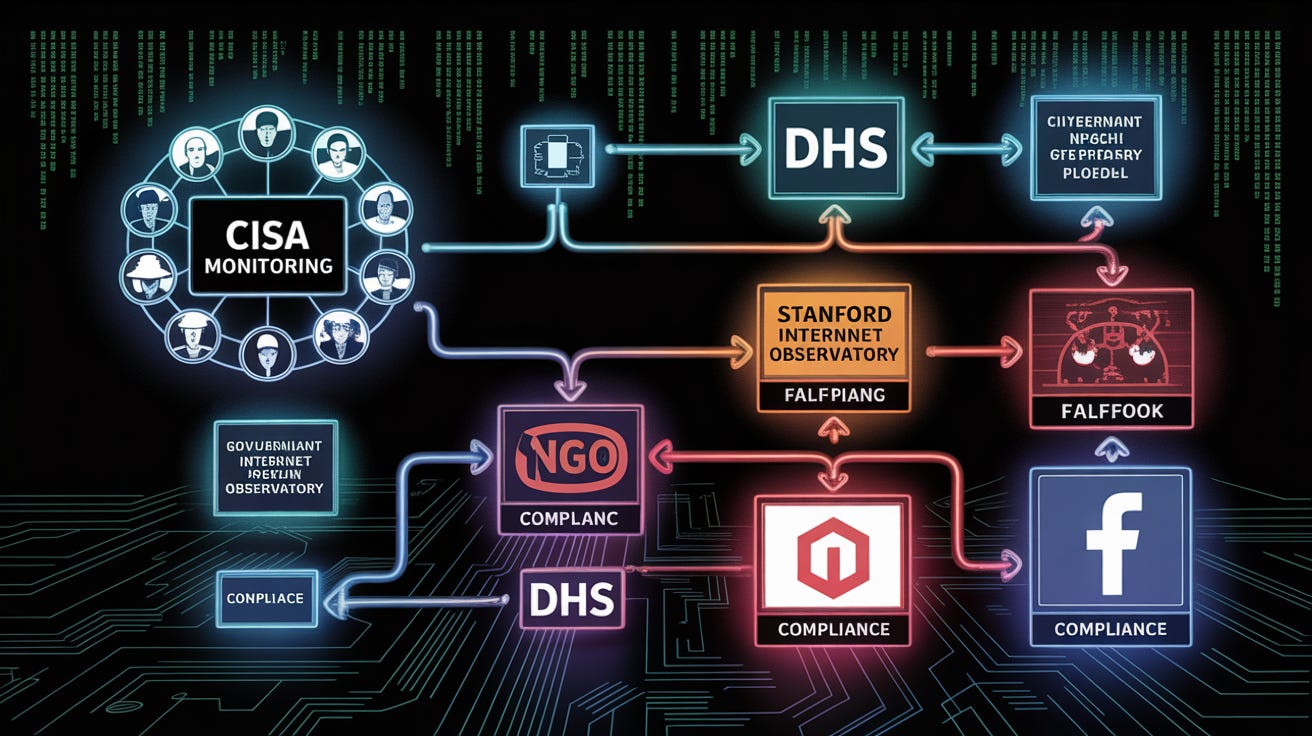
The sheer scope is staggering. During COVID, platforms removed posts questioning lockdowns, vaccine mandates, and natural immunity. During elections, they throttled stories about Hunter Biden’s laptop, flagged posts discussing ballot harvesting, and shadowbanned accounts raising concerns about mail-in voting integrity. CISA’s “switchboarding” operation — their own internal term for this coordination — ran from 2020 through 2022, when they quietly stopped after facing too much scrutiny.5
But stopping the switchboard didn’t end the infrastructure. The censorship tools, technologies, and organizational relationships CISA built continued operating through the nonprofits and academic institutions they’d funded and coordinated with. As Sean Davis testified: “Just because you pull the needle out, doesn’t mean the effects are gone.” The censorship industrial complex CISA helped construct didn’t disappear when CISA stepped back — it just became less traceable.
What’s truly remarkable about Cruz’s investigation is how little resistance CISA faced. The Department of Homeland Security Office of Inspector General didn’t push back. The tech industry didn’t object. Nobody with institutional power challenged an agency taking statutory authority to protect election infrastructure and reinterpreting it to mean controlling discourse about elections. The constitutional guardrails that should have prevented this expansion simply... didn’t.
A DHS bulletin from February 2022 briefly redefined “terrorism” to include “misinformation” — equating speech with violence before retracting under pressure. That bulletin reveals the endgame: if spreading disfavored information becomes terrorism, then surveillance, flagging, and suppression of that speech becomes counterterrorism. National security justifies anything.
The Supreme Court already examined these claims in Murthy v. Missouri and sided with the Biden administration 6-3, with Justice Amy Coney Barrett writing that plaintiffs lacked standing because they couldn’t prove direct causation between government pressure and platform censorship.6 That ruling didn’t exonerate the conduct — it just made the conduct functionally impossible to challenge in court. Government officials learned they could jawbone with impunity as long as they maintained enough institutional separation to claim they weren’t directly ordering censorship.
The Upgrade: Why the AI Censorship Apparatus Is Already Being Built
Cruz’s warning at the hearing wasn’t theoretical: “CISA’s unchecked censorship serves as a cautionary tale for future policy related to artificial intelligence.” The same officials, organizations, and mechanisms that built the social media censorship infrastructure are now positioning themselves to control AI outputs before the technology even fully matures.
The Biden administration’s AI Executive Order established frameworks for “safe, secure, and trustworthy” AI development — which sounds reasonable until you notice that “trustworthy” gets defined by the same people who labeled accurate COVID data as misinformation. The National Institute of Standards and Technology published guidance telling AI developers to watch for “potentially harmful content” their models might generate. The National Science Foundation’s AI research programs promote “responsible AI” aligned with the administration’s AI Bill of Rights.
By controlling AI inputs and outputs, government agencies decide what information Americans can access through the next generation of information technology. If ChatGPT won’t answer questions about vaccine side effects, or Claude refuses to discuss election integrity concerns, or Gemini blocks queries about gender-affirming care risks — that’s not the AI making neutral safety decisions. That’s government-influenced censorship baked into the architecture.
The decentralization movement offers a potential solution, but only if we build it correctly and build it now. Blockchain-based social platforms, decentralized content distribution networks, and AI models trained on uncensored datasets could create genuinely censorship-resistant alternatives. Projects like Nostr, Lens Protocol, and decentralized storage via Filecoin and Arweave provide infrastructure that no single government agency can pressure into compliance.
But here’s the problem: if centralized platforms maintain their dominance, decentralized alternatives become niche curiosities rather than viable ecosystems. Network effects mean people go where other people are. If Twitter, Facebook, and Google-funded AI models control 95% of discourse, CISA doesn’t need to worry about the 5% using censorship-resistant alternatives.
The real fix requires legislation with teeth. Cruz announced plans to introduce a bill prohibiting government jawboning and creating legal remedies for censorship victims. The framework would make it easier to sue federal officials who pressure platforms to suppress speech, eliminating the standing problem that killed Murthy v. Missouri. Two companion bills — the COLLUDE Act and the Censorship Accountability Act — would revoke Section 230 protections from platforms that censor at government request and allow citizens to sue officials who violate First Amendment rights through third-party coordination.
Decentralization provides the technology stack. Legislation provides the legal guardrails. But neither works without public awareness that the problem exists. Most people still don’t know CISA tried to become the Ministry of Truth. Most people don’t realize the AI safety frameworks being built right now contain the same censorship logic that deplatformed journalists for posting true information.
The infrastructure for controlling AI-mediated information is being constructed while we debate whether AI will take our jobs or write better poetry. Those questions matter, but they’re downstream from a more fundamental issue: who controls what AI systems can say, and whether government agencies will have veto power over outputs they find politically inconvenient.
My Debug: The Personal Cost of Discovering Your Reality Has Editors
I’ve spent months documenting my own collision with systems that weren’t designed for people like me — family dynamics that prioritized performance over presence, medical institutions that categorized my neurodivergence as disorder rather than design. Learning that the information environment itself has been quietly edited by bureaucrats who don’t face consequences for being wrong hits differently when you’ve already experienced institutional gaslighting.
When I was in crisis, when I was trying to understand what was happening to my nervous system, I turned to whatever information I could find. Some of it was wrong. Some of it was helpful. All of it mattered because I was the one evaluating sources and making decisions about my own recovery. The idea that government officials were simultaneously deciding which information sources I should have access to — flagging dissenting doctors, removing alternative perspectives, throttling researchers who questioned official narratives — makes my collapse feel even more isolating in retrospect.
I’m not saying the suppressed information would have saved me. I’m saying I deserved access to the full conversation. When you’re trying to put yourself back together, you need all the pieces available — not just the ones bureaucrats approved. The paternalism embedded in CISA’s mission — the assumption that officials know which speech is dangerous and which is safe — replicates the same dynamic that failed me in my family system. Someone else deciding what I need to know “for my own good” without transparency about their criteria or accountability for their mistakes.
Cruz’s hearing exposed something most people sense but can’t articulate: the information environment feels managed. Certain topics disappear from trending lists. Certain perspectives get throttled. Search results feel curated toward approved conclusions. It’s not paranoia when the emails prove coordination between government agencies and platform moderation teams.
What scares me isn’t that this happened under Biden. What scares me is that the infrastructure persists regardless of who’s in office. CISA was created under Trump, expanded under Biden, and will be available to whoever comes next. The mechanisms for controlling discourse don’t disappear when administrations change — they just get pointed at different targets. Today it’s COVID skeptics and election integrity questions. Tomorrow it’s whoever the next administration finds inconvenient.
Decentralized systems offer more than technical solutions. They offer the possibility of information ecosystems that can’t be edited by officials with immunity. They offer permissionless access to ideas that don’t require bureaucratic approval. They offer the chance to build digital public squares where speech rules are transparent code rather than secret coordination between agencies and platforms.
But only if we build them. Only if we recognize that centralized chokepoints, whether social media platforms or AI model providers, create the structural vulnerability that makes jawboning possible. Only if we understand that the First Amendment means nothing if government can outsource censorship to private companies who face regulatory pressure to comply.
The witnesses at Cruz’s hearing weren’t asking for sympathy. They were warning us.7 Berenson and Davis survived deplatforming and rebuilt their audiences elsewhere. But most people can’t. Most people don’t have the resources, platform, or legal knowledge to fight back when algorithms decide they’ve violated terms of service for speech that was actually true.
We’re watching the construction of AI censorship infrastructure in real time, using the same playbook that controlled social media discourse for years. The question isn’t whether this will be used to suppress speech. The question is whether we’ll build alternatives before centralized control becomes the only option.
I never thought I’d care this much about obscure DHS agencies and content moderation frameworks. But when you’ve lived through systems that gaslight you about your own experience, you recognize the pattern when you see it scaled to the information environment itself. CISA’s switchboard operation wasn’t about protecting Americans. It was about protecting officials from inconvenient truths.
The decentralized web won’t fix itself. Legislation won’t pass without pressure. And most people won’t pay attention until they’re the ones being flagged. By then, the infrastructure will be too entrenched to dismantle without tearing down the entire ecosystem.
So here’s my debug: pay attention to the mechanisms, not just the targets. Today’s censored journalist is tomorrow’s anyone who asks the wrong questions. The agencies building AI safety frameworks aren’t neutral arbiters — they’re the same people who redefined terrorism to include speech. And the platforms developing the next generation of information technology are already negotiating with government officials about what their models will and won’t say.
The future of free speech depends on whether we build systems that can’t be jawboned. Everything else is just choosing which bureaucrats get to decide what truth looks like.
Can you name the federal agency monitoring your online speech? Do you know which of your posts were flagged for content moderation at government request? And if the infrastructure for controlling AI outputs is already being built, what makes you think you’ll know when it’s deployed against you?