

The Receipts on Impossibility
Breaking Down the Comeback That Broke 172 Games of Precedent

Teams trailing by 15 or more points in the fourth quarter are 0-172 in NFL history. Except now they’re 1-172, because on December 18, 2025, the Seattle Seahawks decided that probability distributions are more like suggestions than rules. This isn’t a comeback story. This is a documented case study in how championship-caliber teams rewrite the fundamental assumptions about what outcomes the universe considers physically possible in professional football.
What follows is the systematic dismantling of a 97% win probability, executed in real-time against one of the best teams in the NFL, with a depleting defense and a quarterback who’d thrown two interceptions in the same game. Let’s reverse-engineer how Seattle turned mathematical certainty into overtime victory.
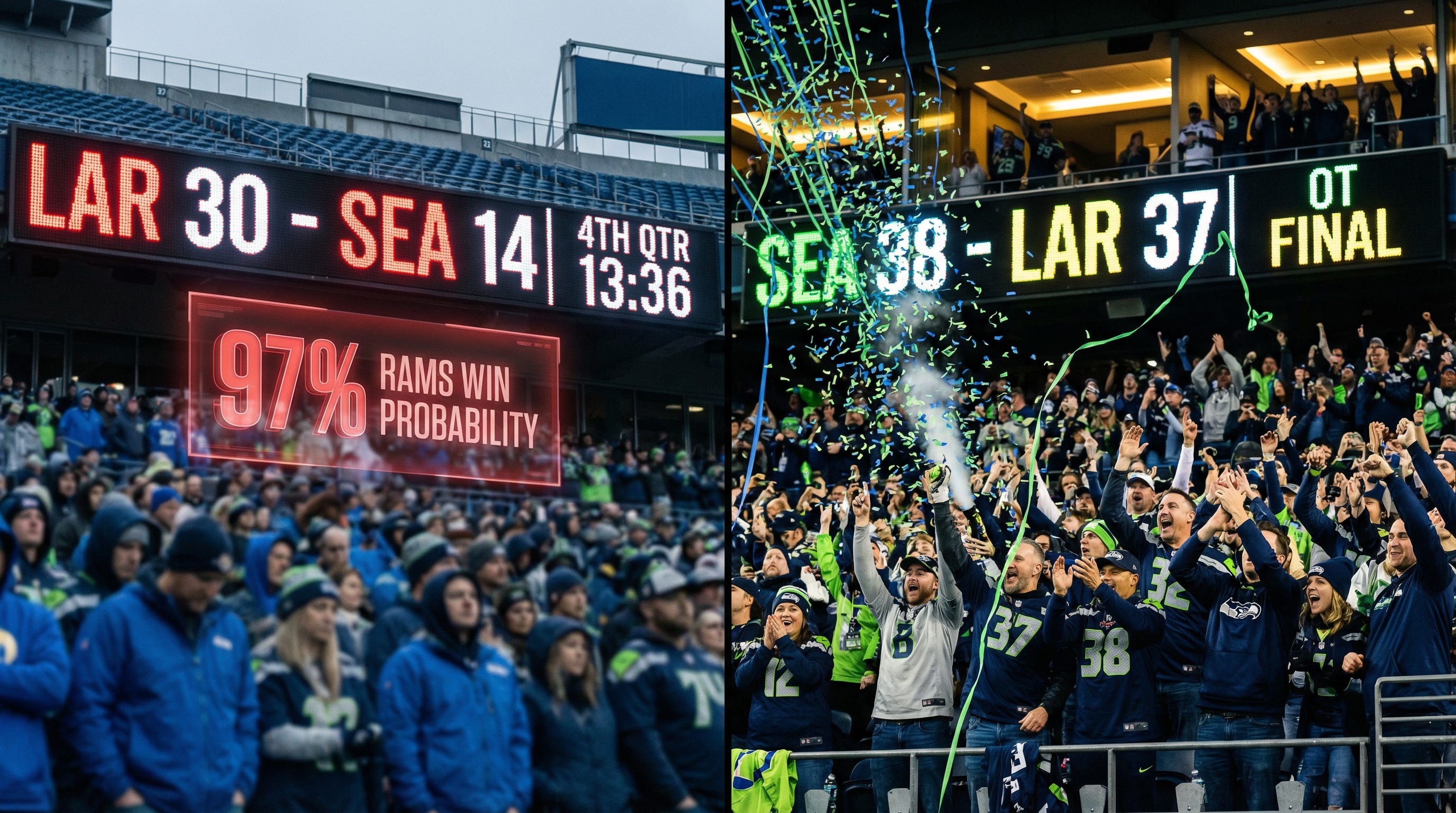
1. The Setup: When Good Teams Face Elimination Math
The Rams led 30-14 with 13:36 remaining in the fourth quarter. ESPN’s win probability model gave Los Angeles a 97% chance of victory1 — the kind of number where algorithms stop computing alternate scenarios because they’re functionally irrelevant. Matthew Stafford had thrown for 405 yards through three quarters without a turnover.2 Puka Nacua was collecting receiving yards like they were participation trophies, already over 180.3 Sam Darnold had thrown two interceptions, including one to a 297-pound defensive tackle.4
This is where normal teams start the mental math on playoff seeding scenarios. Championship teams start asking different questions.
2. The Darnold Interception That Should Have Ended Everything
At 9:39 remaining in the fourth quarter, Darnold threw his second pick of the night — this one to defensive end Kobie Turner, who returned it to Seattle’s 1-yard line.5 The Seahawks were down 16 points, their quarterback was throwing directly to defensive linemen, and the Rams were about to extend the lead to three scores with under nine minutes remaining.
Except the defense forced a three-and-out from the 1-yard line.6 Not a field goal. Not a touchdown. A punt. Mike Macdonald’s defense, which had been shredded for 30 points and 405 yards through three-plus quarters, suddenly remembered it ranked second in the NFL in scoring defense for a reason.
The first rule of statistical impossibility: you need multiple improbable events compounding in sequence.
3. The Punt Return That Rewrote Momentum Physics
Rashid Shaheed returned the ensuing punt 58 yards for a touchdown with 8:03 remaining.7 This wasn’t just a big play. This was a middle finger to momentum conservation. Teams don’t score on special teams when they’re down 16 in the fourth quarter of elimination games. They take safe returns, protect field position, and try to execute methodical drives that eat clock while manufacturing points.
Seattle skipped the methodology and went straight to thermodynamics-violating acceleration. The stadium went from funeral to resurrection in 9 seconds of real time.
Darnold hit Cooper Kupp on the two-point conversion.8 Score: 30-22 Rams, 8:03 remaining. Still a two-score game, but now the Seahawks had demonstrated they could manufacture 8 points in one possession without their offense touching the field. That’s not a comeback. That’s a proof-of-concept for alternative scoring architectures.
4. The Defense That Started Remembering Its Job Description
The Rams’ offense went three-and-out again.9 Then again. Then again. Los Angeles had four punts and a missed field goal on their final five possessions of regulation10 — a collapse so complete it looked like they’d forgotten Stafford spent three quarters performing surgical dissection on Seattle’s secondary.
But here’s the part that makes this mathematically fascinating: Seattle’s defense was losing personnel in real-time. Safety Coby Bryant left with a knee injury. Cornerback Riq Woolen exited with a knee injury. Rookie safety Nick Emmanwori got evaluated for a concussion.11 All three left during the fourth quarter while the comeback was happening.
Macdonald’s scheme was generating stops with backup safeties and third-string corners executing against an offense that had averaged 7.4 yards per play through three quarters. That’s not luck. That’s systematic resilience under conditions that should produce structural failure.
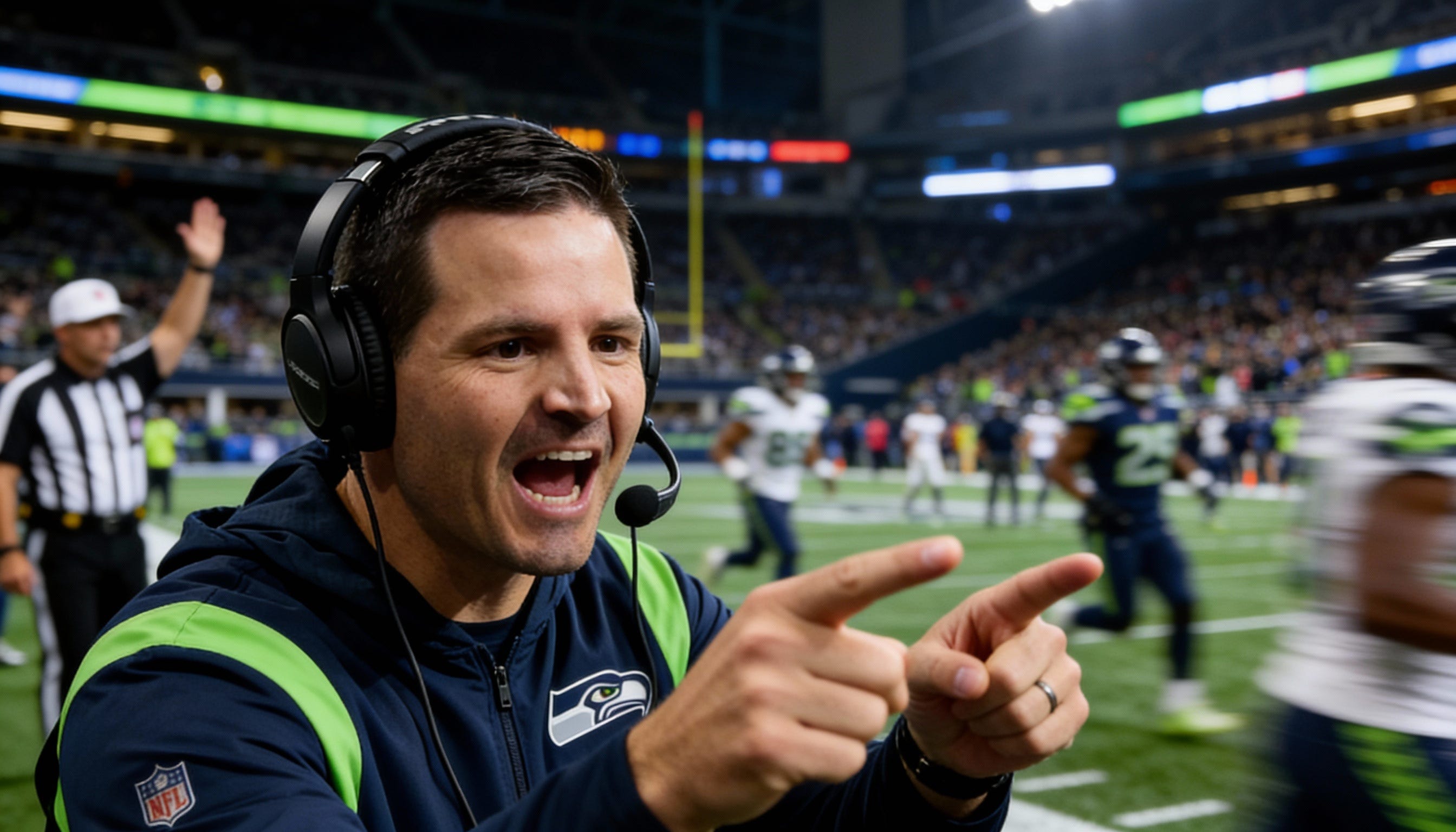
5. The AJ Barner Touchdown That Made It Interesting
Darnold hit tight end AJ Barner for a 26-yard touchdown with 6:23 remaining.12 The Seahawks were 8 for 12 passing for 101 yards and two touchdowns after Darnold’s second interception13 — statistical efficiency that suggests extreme clarity of purpose rather than desperate heaving.
Score: 30-28 Rams. The two-point conversion was coming. Everyone knew the two-point conversion was coming. The Seahawks weren’t playing for overtime at this point. They were playing for control of the NFC West and the conference’s #1 seed.
What happened next became the most legally contentious play of the entire comeback.
6. The Fumble That Wasn’t A Fumble That Was Actually A Fumble
Darnold’s quick screen to Zach Charbonnet got tipped by Rams pass rusher Jared Verse at the line of scrimmage.14 The ball popped into the air, bounced around the goal line, and fell incomplete. Officials initially ruled it a failed two-point attempt. Teams lined up for the kickoff.
Then the replay booth called down. The pass was ruled backward — making it a fumble, not an incomplete pass. Charbonnet, who had casually picked up the loose ball in the end zone “just in case,” was credited with recovering the fumble for two points.15
Score: 30-30. Tie game. 6:23 remaining.
Matthew Stafford questioned this ruling postgame, noting that fumbles typically can’t be advanced inside two minutes or on two-point conversions.16 The rulebook disagreed with Stafford’s interpretation, but his confusion was understandable — this exact scenario occurs approximately never in professional football. The Seahawks had just tied a must-win division game on a play that looked incomplete until review determined the laws of physics actually applied differently than everyone watching assumed.
This is how improbable comebacks work: the rules you think govern reality turn out to be slightly more flexible than anticipated.
7. The Missed Field Goal That Confirmed Mathematical Bias
The Rams’ Harrison Mevis missed a 48-yard field goal attempt with 2:07 remaining in regulation.17 This was Mevis’s first missed kick of any kind all season — a statistically perfect kicker finally encountering variance at the exact moment that would send the game to overtime rather than giving Los Angeles a three-point lead.
Probability doesn’t care about narrative. But when you’re watching a 0-172 historical record get challenged in real-time, you start wondering if maybe probability has preferences after all.
8. The Overtime Touchdown That Should Have Ended It (Again)
The Rams got the ball first in overtime. Stafford found Puka Nacua for a 41-yard touchdown on the opening drive.18 Nacua finished the night with 12 catches for 225 yards and two touchdowns.19 Stafford threw for 457 yards total — the third-most of his career.20
Score: 37-30 Rams. Under the new OT format, Seattle had to answer with a touchdown or lose. No field goal attempts. No methodical drives. Score or go home.
This was the fourth time in one game that the mathematical expectation pointed toward Rams victory. The fourth time Seattle had to manufacture an outcome that algorithms considered unlikely.
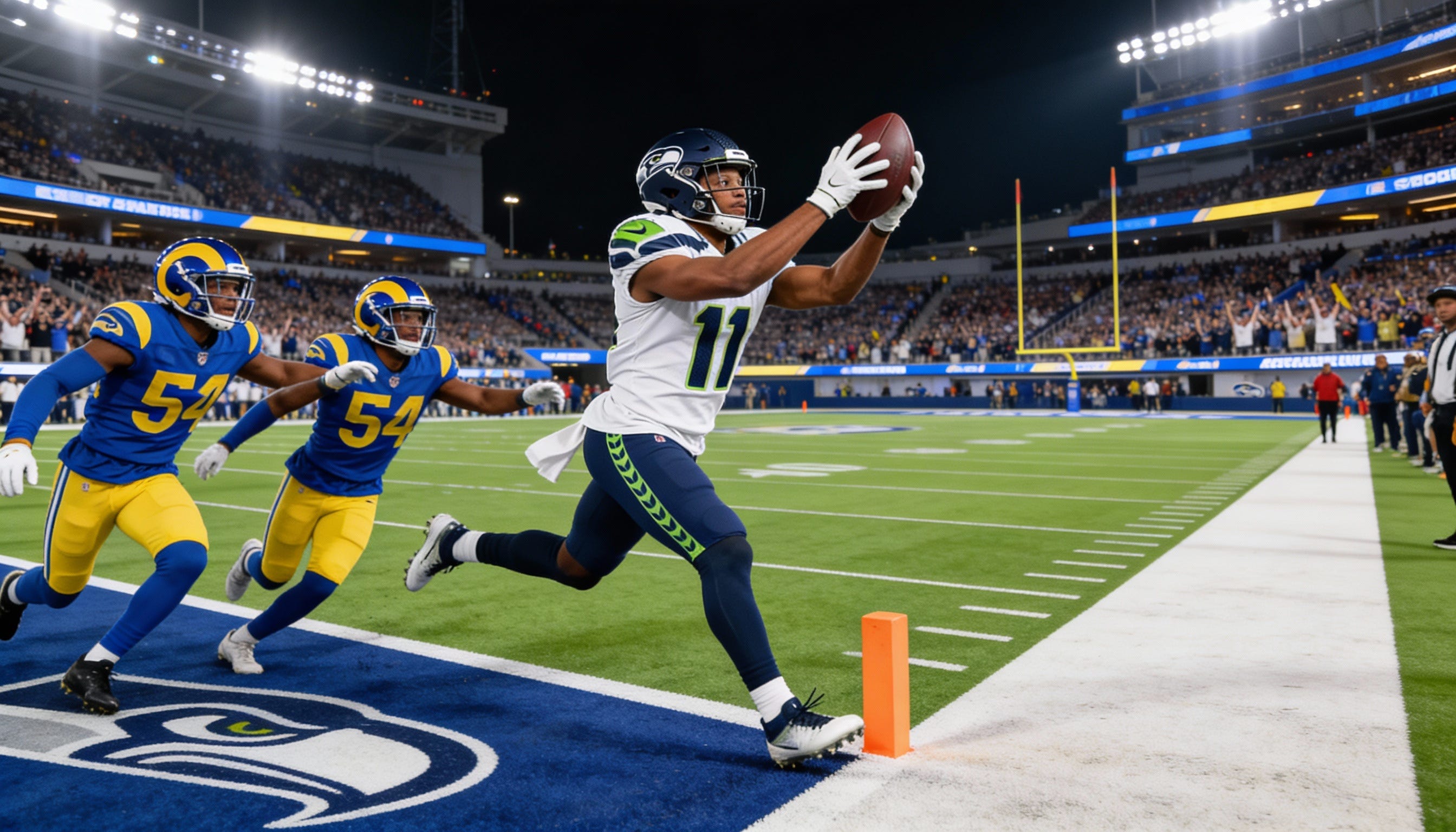
9. The Jaxon Smith-Njigba Touchdown That Kept Hope Mathematically Alive
Darnold hit JSN for a 6-yard touchdown with 3:13 remaining in overtime.21 Smith-Njigba, who leads the NFL with 1,637 receiving yards through 15 games,22 was open in the end zone doing what elite receivers do in moments where competence transforms into legacy.
Score: 37-36 Rams. Extra point ties it. Two-point conversion wins it.
Mike Macdonald didn’t hesitate. He called timeout and signaled for the two-point attempt.23
“You play for the tie and lock up a playoff seat,” Macdonald explained postgame, “but I just felt great about our play and I trusted our guys.”24
Translation: we spent four quarters proving we can execute under maximum pressure. We’re not delegating the outcome to a coin flip overtime system. We’re taking control of probability distributions right now.
10. The Eric Saubert Conversion That Rewrote 172 Games of History
The Rams’ defense locked down Seattle’s primary receivers. Darnold looked left, saw coverage. Looked right, saw coverage. Looked middle.
Tight end Eric Saubert was standing completely alone in the back of the end zone.25
Saubert had never caught a two-point conversion in his career. He had two receptions on the season entering this game.26 He was the definition of “emergency outlet receiver” — the player you target when all five better options are covered and you need to complete a pass to literally anyone wearing your team’s uniform.
Darnold threw him the ball. Saubert caught it. Game over.
Final score: Seahawks 38, Rams 37. Seattle became the first team in NFL history to win a game on a two-point conversion in overtime.27 They became the 1 in 1-172 for teams trailing by 15+ points in the fourth quarter.28 They clinched a playoff berth, took over first place in the NFC West, and moved into position for the conference’s #1 seed.29
The Seahawks went 3-for-3 on two-point conversions in a single game — with all three coming in the final 8:03 of regulation and overtime.30 That’s not variance. That’s systematic execution of high-leverage decisions under maximum pressure.
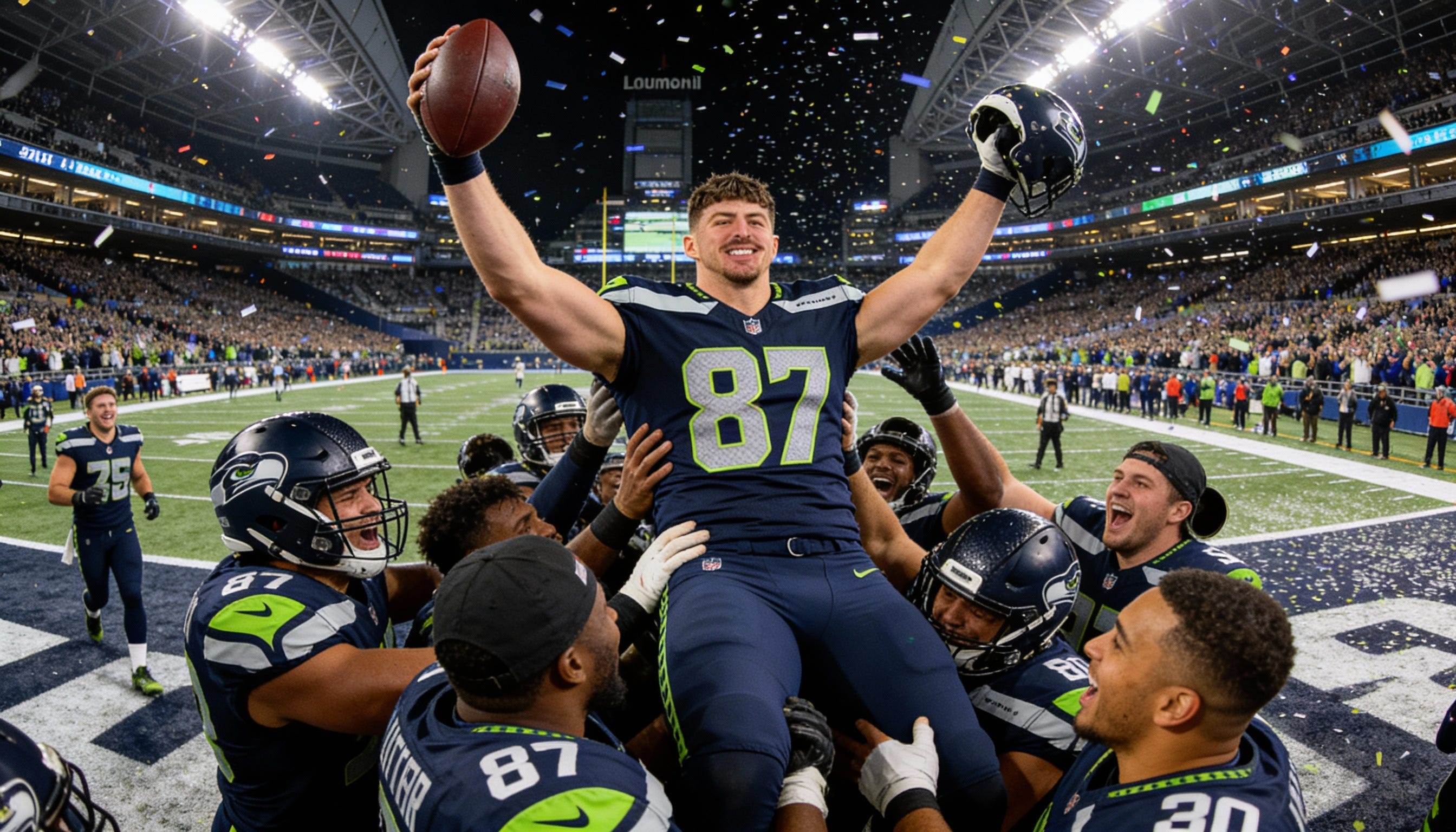
The Pattern: Championship Teams Rewrite What’s Possible
This wasn’t a comeback. This was a demonstration of what happens when systematic excellence meets elimination-level adversity. The Seahawks didn’t get lucky eight consecutive times. They executed a coordinated assault on probability that required their defense to generate stops with depleted personnel, their special teams to manufacture a touchdown, their quarterback to complete 8 of 12 passes under maximum pressure, and their coaching staff to make three consecutive correct decisions on two-point conversions with season-defining stakes attached to each one.
The 0-172 statistic exists because fourth-quarter deficits of this magnitude typically indicate fundamental performance gaps that can’t be overcome through execution alone. The Rams outgained Seattle by 279 total yards.31 Stafford threw zero interceptions while Darnold threw two.32 By every conventional metric, Los Angeles was the superior team for 45 minutes of game action.
But championships aren’t decided by three-quarter performance evaluations. They’re decided by which team can systematically execute when the game state demands perfection or elimination. Seattle’s 13-3 record and NFL-best +12.4 point differential exist because they’ve been practicing this exact scenario all season — finding ways to win games where the mathematical expectation pointed elsewhere.
The Seahawks aren’t lucky. They’re just operating on a different set of rules than everyone else thought governed professional football. They looked at 172 games of historical precedent and concluded that sample size wasn’t large enough to establish an ironclad law. They saw a 97% win probability for their opponent and recognized that 3% wasn’t zero.
And on a Thursday night in December, they showed the entire NFL what systematic resilience looks like when it encounters the opportunity to rewrite history.
The question for the rest of the league: are you prepared to face a team that doesn’t accept mathematical certainty as binding?
Comebacks like this don't emerge from talent alone or lucky momentum swings. They're built on systematic foundations that take months to construct. Mike Macdonald didn't create a defense capable of generating stops with backup safeties by accident. He engineered it. Over the next piece, we'll reverse-engineer exactly how a 38-year-old first-time head coach transformed the NFL's 25th-ranked defense into a championship weapon in 18 months — and why his scheme generates elite outcomes that look like magic until you check the architectural blueprints.