

The Replay Button Pulled the Second Trigger
Charlie Kirk's Murder Wasn’t Just Violence — It Was Content

The Spark: A bullet and a broadcast
On September 10, 2025, at Utah Valley University in Orem, a gunshot turned a campus event into a global clip. Charlie Kirk — conservative activist, talk host, founder of Turning Point USA — collapsed as phones were already filming, as feeds were already primed, as the timeline did what the timeline does. He was later pronounced dead. Authorities called it targeted. The viewing figures were immediate. The grief was instant. The narrative sprinted off in twelve directions at once.1
Investigators found a rifle discarded in nearby woods, released photos, and asked the public for help. Officials described the suspect as college-age; as of Thursday afternoon, the manhunt was still active. Those are the facts, refreshed and grim. The rest — the moral physics of what happens next — belongs to the machine we’ve built to ensure that any event, if sufficiently shocking, graduates from reality to replay within minutes.2

And let’s be honest about the medium: this didn’t merely appear designed for the feed. It behaved exactly like something engineered to dominate it: tight runtime, crisp audio spike, high-contrast movement, an audience already holding cameras at face level. In 1963, the Zapruder film took days to reach TV. In 2025, you get a push notification before the echo finishes crossing the quad. Graphic video spread with a velocity legacy media simply can’t match anymore; the clip eclipsed the write-ups. That’s not a conspiracy; that’s distribution.3
Utah’s governor called it what it looked like: a political assassination. That label is heavy. The platform dynamics are heavier. If you design a civilization to reward shock with reach, you will get entrepreneurs of shock. The algorithm is a market-maker, and business is good.4
Just like September 11, 2001, it felt like an invisible line had been crossed. But instead of hijacked planes, we got hijacked attention. Instead of smoke and rubble, we got trending hashtags and autoplay clips. The old world ended with buildings collapsing; the new one begins with feeds collapsing under the weight of their own virality.
The Pattern: Political violence has always had an audience. Now it has analytics.
Assassination used to be a message scrawled in blood for a finite crowd: the Senate, a motorcade, a theater balcony. Today the audience is infinite, and the analytics are public. Like any savvy operator, modern political violence reads the brief: novelty, clarity, emotional spike, shareability. And unlike the old broadcast era, where a producer and a network gatekept the shock, the “producer” now is an emergent, feral consortium: bystanders with cameras, uploaders with reflexes, creators with hot takes, and recommendation engines with a PhD in your dopamine.
We treat “going viral” as a quirky property of dance trends and cat mischief. But virality is just cheap physics for attention: a force that accelerates anything with low friction and high emotional mass. In that sense, political murder is tragically, perfectly feed-native: the shortest path from What happened? to What does this say about my enemies? is a single app-switch.
Historical context isn’t comforting. From Sarajevo to Dallas to Memphis, violence has always been theater. But now it’s theater with programmatic ads, A/B-tested thumbnails, and an algorithm that learned your outrage appetites better than your therapist. The audience used to be whoever could physically gather; now it’s whoever the model decides will be most “engaged.” Which is to say: all of us, sooner or later, because outrage never runs out of market.
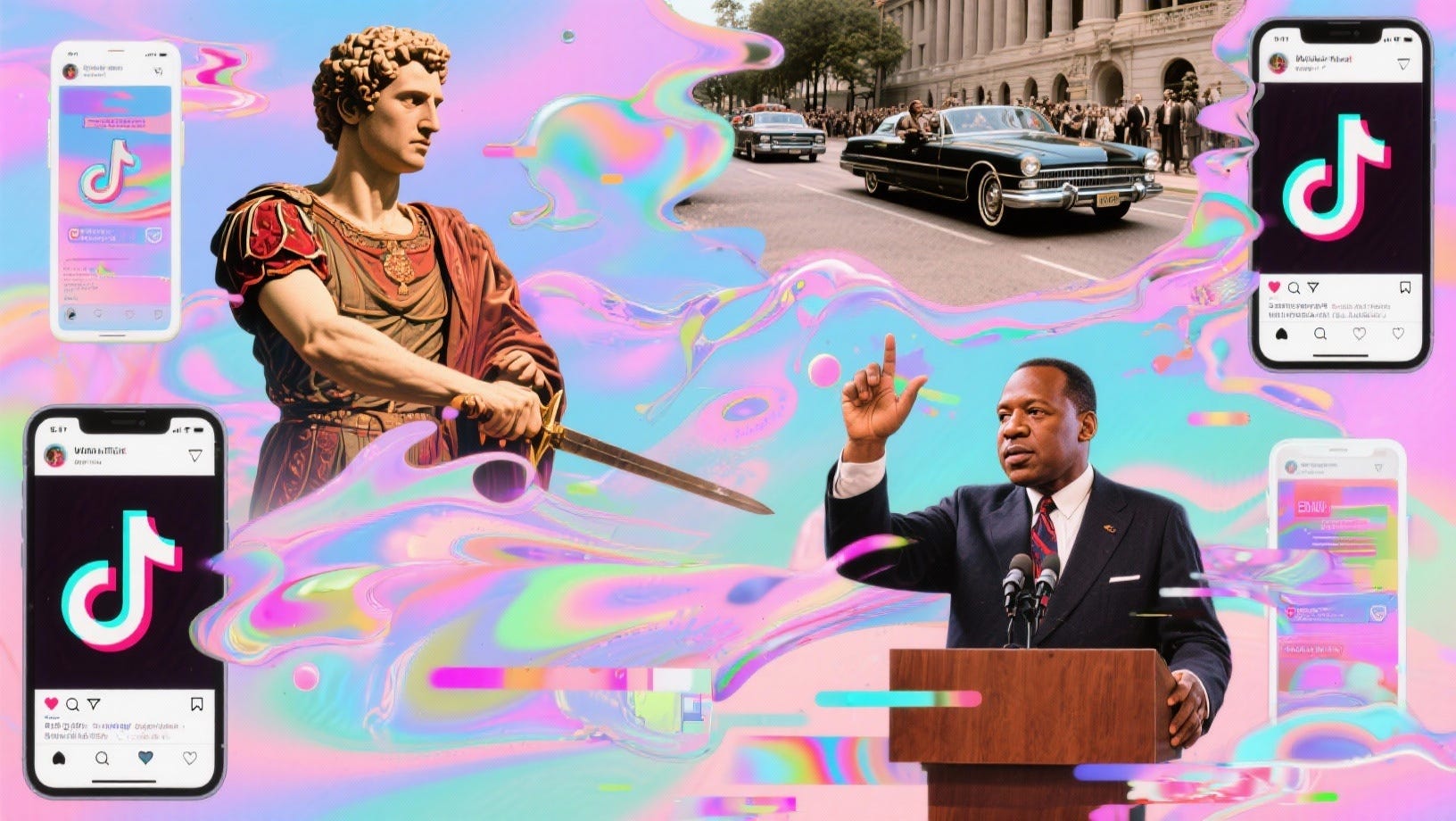
The Protocol: How a killing becomes content
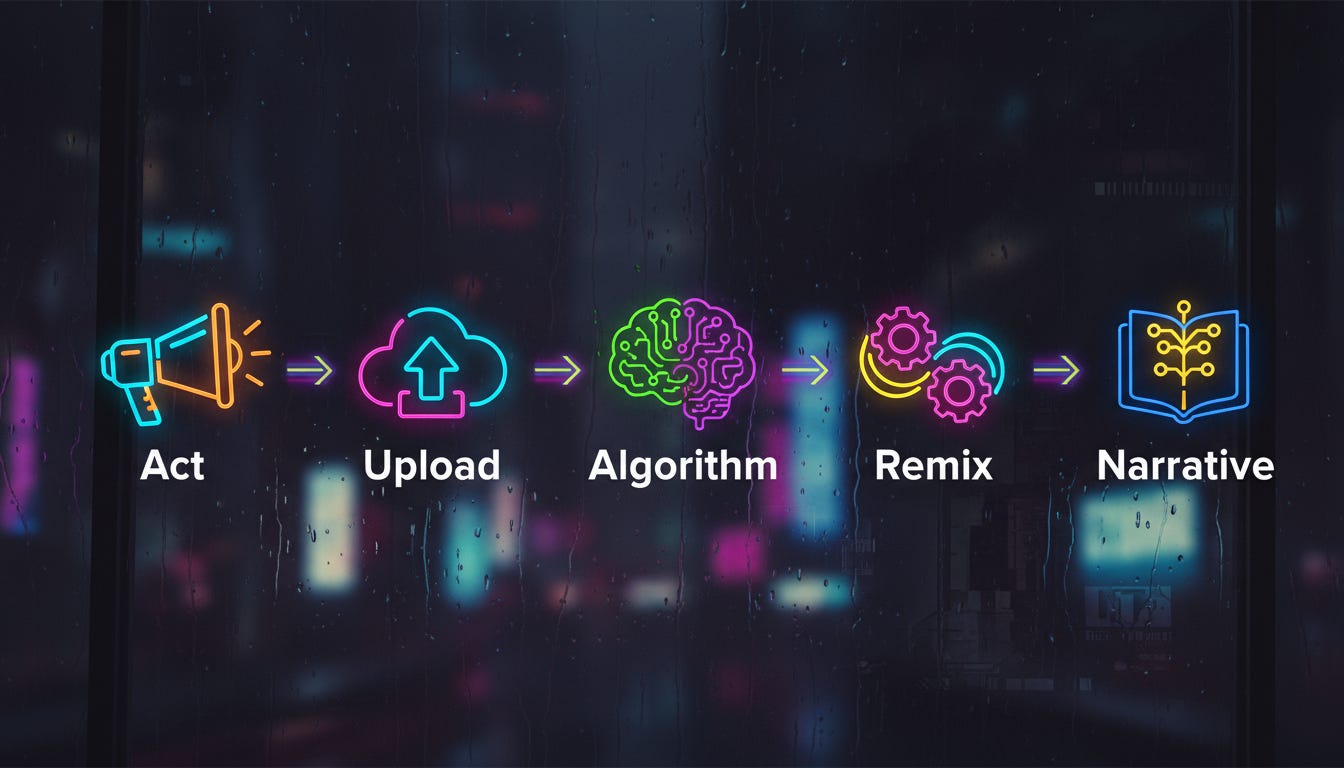
We can argue about motive, ideology, and circumstance forever. Let’s talk pipeline, because pipeline is what the internet understands.
Pre-Production
Pick an environment with sight-lines and witnesses. A campus quad, a stage, a lectern. Cameras guaranteed. Audio spike guaranteed. The “crew” brings itself. (No casting call required; welcome to BYO-cinematography.)
Capture
The moment is short, loud, and visually legible. The shock registers. The lens flares. Biology supplies the gasp. Ten angles without a single assignment editor. You’ll never beat the cost structure.
Distribution
Uploaders post. Autoplay triggers. Duets, stitches, remixes, and righteous quote-tweets proliferate. Context gets appended by a thousand amateur archivists and a hundred partisan meme factories. The clip becomes both evidence and cudgel.
Optimization
The algorithm rings the bell. “You watched 1.8 seconds of this; would you like 90 more just like it?” It discovers a cohort willing to linger; it expands the cohort. That’s the model working correctly. The model is always working correctly.
Narrative Hardening
Within hours, the clip separates into two incompatible universes: proof of everything each side already believed. On one side: “This is what their rhetoric breeds.” On the other: “This is what their censorship demands.” Opposite slogans; identical mechanics.
Mobilization
Donations spike, subscriber drives launch, list-building goes brrr. The tragedy isn’t just seen; it’s instrumentalized. Click to grieve. Click to fight. Click to stay angry. (There is no “Click to go for a walk.” We did not ship that feature.)
Tell me which step is illegal. Tell me which step isn’t profitable.
Field Notes from a Recovering Insider
I used to work inside this world. My calendar was a patchwork of growth reviews with executives who wore hoodies like they were spiritual vestments. “Just give people what they want,” they’d say, by which they meant “what they can’t stop looking at when they should really go to bed.” One PM actually whiteboarded a formula for “cognitive glue.” Another wondered if we could detect “pre-viral accelerants” in live video based on mic peaks and motion vectors. Nobody said the quiet thing out loud: if you optimize for engagement, you’re de facto optimizing for intensity. And intensity has a limited inventory: sex, fear, anger, status threats, and the occasional puppy.
Neurodivergent aside: systems tuned for “average” attention patterns keep missing the edges where the new ideas live. You know who doesn’t miss them? The algorithm. It finds your edges and builds you a home there, then rents you the furniture at 120% APR. If you’re ADHD, autistic, anxious, or just human in 2025, the feed is a casino that comps you triggers. You will not out-discipline ML trained on ten trillion taps.
The Absurdity Department (Tech Edition)
Press release theater: Platforms promise “swift action” while their recommender keeps breathlessly sprinting the baton to fresh eyeballs. Moderation is the mall cop chasing an F1 car. (He’s earnest. He is also made of bone.)
Policy salad: “We prohibit glorification of violence” reads the document, a chiaroscuro of caveats that would make a canon lawyer blush. Meanwhile, the clip is already on a ringtone app.
Brand safety Kabuki: Ads aren’t supposed to run near tragedy. So we run your tragedy near my ads by way of the commentary reactors, podcasters, creators, and “context explainers” who rehost the clip to monetize the aftermath. It’s violence laundering. It’s also legal.
Media’s last illusion: Anchors still speak like they’re the town criers. They aren’t. They are the post-hoc docents of a museum whose visitors already saw the exhibit on TikTok in 1.2x speed with caption snark.
The Ethics You Can Actually Do Something About
I’m not going to tell you to stop looking. Prohibition is for people who still believe speech is a faucet with an off switch. But we can make latency a civic virtue. Add ten minutes to your curiosity. Read the text update before you chase the video. Consume description instead of impact. Journalists: describe, timestamp, source, and — unless public interest truly demands it — don’t embed the splatter reel. (You won’t starve; your audience is hungrier for meaning than for pixels. At least, let’s test that hypothesis like we test everything else.)
Platforms, here’s your homework you can ship without a seance:
Friction by default on fresh violent clips: blurred preview + hold-to-view + interstitial context explainer.
Crisis throttle: temporary down-ranking of near-duplicate uploads inside hot zones. The first-mover advantage is the real accelerant.
Provenance tags that follow the file across re-uploads—a leash for the asset, not just the account.
Non-viral embeds for legitimate newsrooms: playable only inside verified articles with context panels, no algorithmic afterglow.
These are design choices, not acts of God. If you can A/B test button radiuses, you can A/B test decency.
And for the rest of us, a boring superpower: refusal. Refuse the instant replay. Refuse the commentary clip that promises “the one angle legacy media won’t show.” Refuse the dopamine apprenticeship. Refusal is free. The model hates it.
The Receipts (minimal, because the point is the pipeline)
Fatal shooting at Utah Valley University; campus event context, timeline, and confirmed death.
Rifle recovery, person of interest photos, suspect description, manhunt status as of Sept. 11.
Feed dynamics: graphic video proliferation, speed eclipsing traditional outlets.
(Details in fast-moving investigations can change; always check the latest official statements for updates.)
The Personal Code: Attention is energy. Spend it with a receipt.
I don’t want your piety. I want your receipts. Where did your attention go today, and what did it build while it was there? If your feed is a venture fund, what did you seed? We’re all LPs now whether we meant to be or not.

The trigger was pulled once. The replay button did the rest. That is the line I keep coming back to, and the one the platforms would prefer to route around because it suggests their role is causal rather than coincidental. Not in the legal sense; in the civilizational sense. We shipped a system that converts shock into currency on contact. It works exactly as designed.
If violence can be produced like content, then our platforms aren’t just mirrors — they’re the studio. That’s the system we have to audit next.