

The Thermostatic Principle
7 Ways to Watch a Political Ecosystem Self-Regulate

The Spark: When Prediction Becomes Performance Art
Last night I was half-watching Destiny dissect the latest Trump administration memes while election results trickled in. Expected outcome: Democrats perform reasonably well in blue-leaning states because Trump’s approval ratings have been circling the drain since approximately February. Political gravity exists. Water flows downhill. Parties in power during economic pain get punished.
Then the Virginia Attorney General race got called.
For Democrats.
It wasn’t even (that) close.
That’s when I realized this wasn’t just Democrats doing okay in friendly territory. This was a comprehensive demolition of every confident narrative constructed over the past year about permanent political realignment and the death of center-left politics in America. The margins weren’t squeakers. Abigail Spanberger won Virginia’s governorship 57.4% to 42.4% — a 15-point blowout that flipped control from Republican Glenn Youngkin while making her the state’s first female governor.1 Mikie Sherrill cruised in New Jersey. Zohran Mamdani, a 34-year-old democratic socialist, won New York City outright.
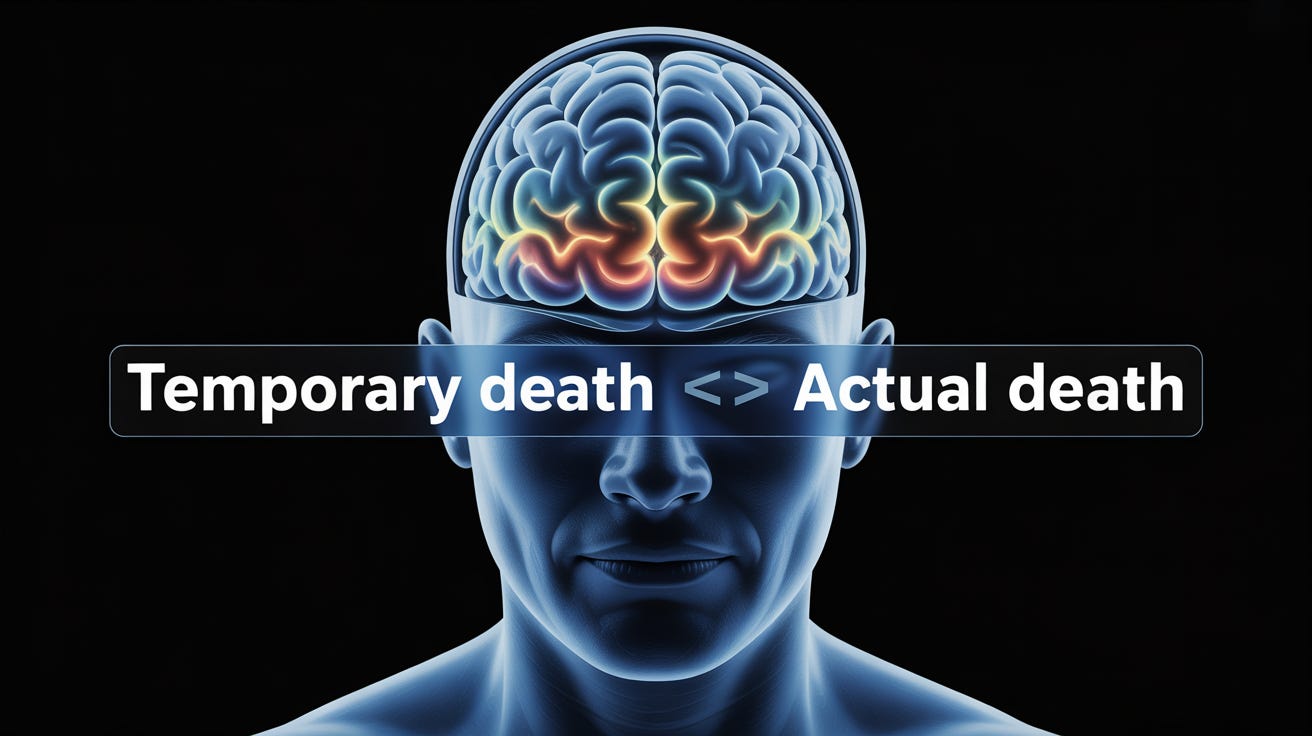
Political obituaries have the lifespan of mayflies. Twenty-four hours after the 2024 election, think pieces declared the Democratic coalition permanently fractured, the working class forever alienated, the MAGA movement an unstoppable force of nature. I believed some of it. The party looked temporarily dead because voters had just delivered a comprehensive rejection of Biden-era governance and economic pain.
But temporary death is just dormancy. And dormant systems wake up fast when conditions change.
Seven patterns emerged last night that reveal something more interesting than “Democrats won.” They reveal how political ecosystems actually function when you strip away the narrative construction and watch the raw behavioral data. This is systems analysis applied to democracy. Turns out humans are remarkably predictable when you account for their actual incentives rather than the stories they tell themselves.
1. Economic Pain Is A Variable, Not A Constant
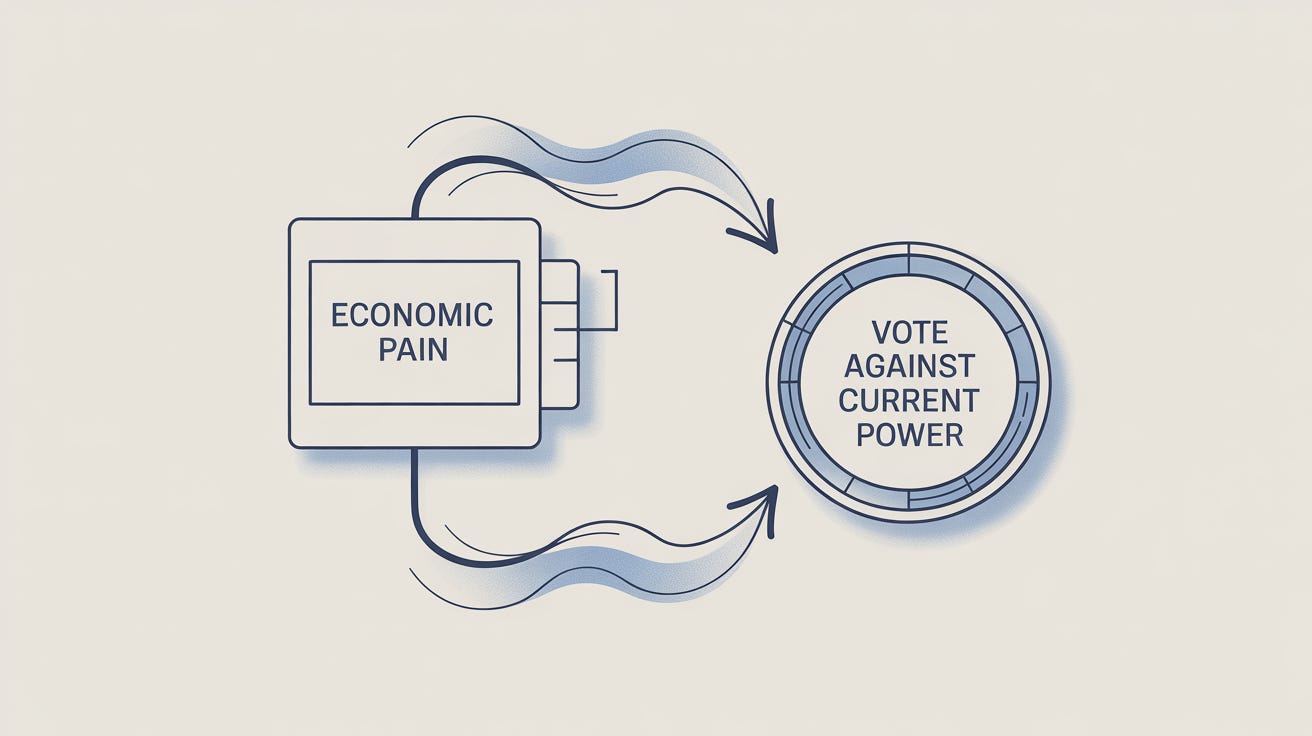
The Republican theory was elegant: inflation hurts, people feel economic pain, economic pain translates to votes against the incumbent party’s coalition. Since Biden presided over inflation and Harris lost, Democrats would continue losing until voters forgot about grocery prices.
Wrong operating system.
Voters do punish economic pain. But they punish whoever they think is causing it right now. Nearly half of Virginia voters identified the economy as their top concern — and they backed Spanberger by roughly 20 percentage points.2 In New Jersey, six in ten voters rated the state economy as “not so good” or “poor,” yet they still chose Democrat Mikie Sherrill. In New York City, affordability dominated every focus group and poll, and voters picked the guy promising to tax the wealthy to fund childcare.
The pattern clarifies when you stop treating “the economy” as a static Republican advantage and start treating it as a real-time attribution problem. Trump’s tariffs, the 36-day (and counting…) government shutdown, mass federal layoffs in states with hundreds of thousands of government workers — these aren’t abstract policy debates. They’re lived experiences with clear causality. Voters in Virginia see federal workers furloughed and connect it directly to the administration currently running the federal government.
Republicans assumed economic anxiety was a permanent condition they could exploit indefinitely. Democrats proved that economic anxiety plus clear blame assignment equals electoral collapse for whoever’s in charge. The thermostatic principle in action: when the temperature gets uncomfortable, voters adjust the thermostat by flipping control.
2. The Moderate-Progressive Binary Is A Category Error
Political analysts love constructing mutually exclusive identity categories. You’re either a pragmatic moderate or an energetic progressive. The Democratic Party must choose its lane. The two factions are locked in civil war. Pick one, abandon the other, or lose both.
Last night annihilated this framework so thoroughly it should qualify as scientific falsification.
Spanberger and Sherrill are textbook moderates — former CIA officer and Navy helicopter pilot respectively, running campaigns focused on pragmatism, affordability, and competent governance. Mamdani is an unabashed democratic socialist who opened his victory speech by quoting Eugene Debs and promises wealth taxes that make centrists deeply uncomfortable.3
All three won by double digits.
The moderate-progressive divide isn’t a real constraint on electoral success. It’s a media narrative that confuses messenger selection with message consistency. Spanberger ran in a purple state filled with federal workers terrified of Trump’s mass layoffs. She needed to project stability and institutional competence. Mamdani ran in a deep-blue city where progressive economic policies poll well and voters wanted someone who’d fight Trump’s administration directly. He leaned into his democratic socialist identity because it signaled authenticity and willingness to break with establishment failure.
Both candidates did the identical thing underneath the stylistic differences: they blamed Trump for economic problems and promised concrete solutions. Spanberger talked about “lowering costs, keeping communities safe, and strengthening the economy.”4 Mamdani talked about taxing the wealthy to fund public services. Different language, same target, same fundamental promise of economic relief from someone who isn’t currently screwing it up.
The supposed civil war between Democratic factions is mostly a rhetorical construction built on the assumption that policy preferences and stylistic presentation are the same variable. They’re not. Voters in different contexts want different messengers, but they want surprisingly similar messages: someone who understands their economic pain and has a plausible theory for fixing it.
3. Identity Politics Work When The Identity Is Real
Mamdani and Virginia’s lieutenant governor-elect Ghazala Hashmi both faced explicit Islamophobic attacks during their campaigns. Trump himself intervened in the New York City race, endorsing Andrew Cuomo’s independent bid while making thinly veiled suggestions that a Muslim mayor would be dangerous.5
Voters rejected this completely.
Mamdani won decisively. Hashmi became the first Muslim woman elected to statewide office in U.S. history.6 Both victories came despite (or possibly because of) coordinated attempts to weaponize their faith as a political liability.
The pattern here isn’t about symbolic representation or demographic pandering. It’s about authenticity in a political environment where most candidates feel manufactured by committee. Mamdani didn’t run from his identity or try to soften it for mainstream consumption. He integrated it into his broader narrative about fighting for working-class New Yorkers while explicitly naming the systems that disadvantage them. His Muslim identity wasn’t the campaign — it was part of the evidence that he understood what it meant to navigate hostile systems.
Republicans keep trying to use identity as a weapon, assuming voters will default to tribal suspicion of the unfamiliar. But voters in 2025 are sophisticated pattern recognizers living in one of the most diverse societies in human history. They can distinguish between “this person is different and that scares me” and “this person is different and that makes them credible when they talk about systemic dysfunction.”
Anti-Muslim campaigning failed for the same reason most fear-based identity politics fails: it assumes voters are stupider than they actually are. Turns out people can hold two thoughts simultaneously: “I’m unfamiliar with this person’s background” and “this person seems genuine and competent.” When forced to choose, competence wins.
4. Trump’s Political Capital Operates On Credit, Not Cash
Trump posted immediately after the results came in: “TRUMP WASN’T ON THE BALLOT, AND SHUTDOWN, WERE THE TWO REASONS THAT REPUBLICANS LOST ELECTIONS TONIGHT.”7
Technically accurate. Also completely missing the point.
Trump wasn’t on the ballot, but Republican candidates couldn’t stop talking about him. Jack Ciattarelli in New Jersey “vocally embraced and welcomed Trump’s support” despite Trump’s abysmal approval ratings.8 Winsome Earle-Sears in Virginia ran as the continuation of Glenn Youngkin’s Trump-adjacent governance. Curtis Sliwa in New York had Trump’s backing and still got crushed by Mamdani’s grassroots operation.9
All lost by double digits.
The pattern reveals something about how political capital actually functions in electoral systems. Trump maintains high approval among his committed base — the people who would vote for him regardless of economic conditions, policy failures, or administrative chaos. That base is real, committed, and electorally significant in Republican primaries. But it’s not growing. In fact, it’s contracting as the broader electorate experiences the consequences of his second-term policies.
Roughly six in ten voters in Virginia and New Jersey reported feeling “angry” or “dissatisfied” with the country’s direction under Trump.10 The man who promised to make America “healthier and wealthier” has delivered an economy voters describe as worse, federal workers experiencing the longest government shutdown in history, and enough chaos that even moderate Republicans struggle to defend the administration’s competence.
Republican candidates tried to have it both ways: embrace Trump enough to secure the base in primaries, then soft-pedal the association in general elections to appeal to independents. Voters saw through it instantly. If you campaigned with Trump, you owned Trump’s failures. No amount of rhetorical distance could separate you from the administration’s actual record.
Political capital isn’t an abstract quantity you possess. It’s a relationship between promises and results. Trump promised economic turnaround and delivered dysfunction. His capital isn’t depleted — it’s collateralized against outcomes he can’t deliver. And when the bill comes due, everyone holding his endorsement pays the price.

5. Redistricting Is Power, Not Principle
California’s Proposition 50 passed with roughly 65% support, allowing Democrats to redraw congressional maps to create five more Democratic-leaning districts.11 This was naked political hardball: a direct response to Trump’s directive for Texas Republicans to gerrymander five more GOP seats. Democrats called it the “Election Rigging Response Act” and voters said yes anyway.
The most expensive ballot measure fight in state history. Gavin Newsom’s campaign raised over $100 million, with major donors including House Majority PAC and George Soros.12 The opposition, bankrolled primarily by Republican donor Charles Munger Jr., spent $33 million arguing that Democrats were undermining California’s independent redistricting commission and betraying the state’s commitment to fair maps.
Voters chose power over principle by a 30-point margin.
This is what a functioning political coalition looks like when it stops pretending the other side is playing by gentleman’s rules. Republicans spent years weaponizing redistricting to create durable electoral advantages, gerrymandering maps to maximize their seats regardless of vote share. Democrats kept appealing to norms and fairness and independent commissions while watching Republicans lock in structural advantages that distorted representation.
Proposition 50 represents a strategic recalibration: if Republicans are going to rig maps, Democrats will too. The measure was explicit about this. Newsom didn’t pretend he was defending democratic norms. He argued that fighting fire with fire was the only response to systematic Republican bad faith.
California voters essentially said: “We know this undermines our independent commission. We know this is partisan gerrymandering. We’re doing it anyway because the alternative is permanent disadvantage against an opponent who already abandoned the principle.”
This isn’t a feel-good story about democratic ideals. It’s a story about power dynamics in a system where one side stopped caring about reciprocity. When norms become unilateral disarmament, voters authorize their side to fight with the available weapons. The implications for 2026 are straightforward: those five California seats, combined with the momentum from last night’s victories, could flip House control and constrain Trump’s ability to govern without opposition for his final two years.
Newsom bet his political capital on convincing voters to abandon principle for strategic advantage. He won overwhelmingly. Sometimes power is more important than consistency.
6. Down-Ballot Waves Reveal Systemic Preference Shifts
Beyond the headline gubernatorial races, Democrats won everywhere. Virginia Democrats added at least 10 seats in the House of Delegates.13 Pennsylvania voters retained three Democratic Supreme Court justices despite conservative billionaire Jeff Yass spending millions to unseat them. Democrats flipped two seats on Georgia’s Public Service Commission — the first Democratic wins in statewide offices there since 2006.14
These weren’t fluke victories in high-profile races with massive spending differentials and national media attention. These were systematic wins up and down the ballot, across different states and electoral contexts, often in positions that rarely penetrate public consciousness.
The Georgia Public Service Commission result deserves particular attention. This is a five-person utility regulator that controls energy rates and infrastructure policy. Democrats won by roughly 60% margins after voters experienced soaring energy costs and grew frustrated with incumbent management. These are the kinds of races that reveal raw voter sentiment divorced from candidate charisma or campaign spending — pure referendum on which party voters trust to manage their daily material conditions.
When voters flip utility commissioners, state supreme court seats, and state legislative districts all in the same direction simultaneously, you’re watching a systemic preference shift, not candidate-specific outcomes. The Democratic Socialists of America also celebrated municipal wins in Detroit, Atlanta, and Cambridge.15 The party’s progressive wing is building power at local levels while moderates win statewide offices.
This isn’t contradiction. This is a party building infrastructure across multiple levels simultaneously, creating redundancy in its electoral architecture. Down-ballot victories today become recruiting grounds for statewide candidates tomorrow. State legislative majorities today become redistricting control tomorrow. The compounding returns on systematic victory across tiers are substantial.
Republicans focused on defending their federal majority and assumed state-level politics would follow national trends. Democrats treated every level as connected infrastructure in a larger system. One strategy builds fragile single-point dominance. The other builds resilient distributed networks.

7. Midterm Gravity Remains Functional
Political scientists describe elections as “thermostatic” — they tend to swing against whichever party controls the White House.16 Voters regulate political temperature by adjusting control mechanisms when conditions become uncomfortable. This pattern is robust across decades of data.
Republicans spent the past year convincing themselves that Trump’s unique popularity and Democratic institutional weakness would somehow break this well-documented trend. They assumed the normal rules wouldn’t apply because Trump transcended normal politics.
Last night confirmed the rules still work fine.
These were off-year elections in a handful of mostly blue-leaning states, so caution is warranted about extrapolating to 2026 nationwide results. But the consistency of the margins, the breadth of victories across different contexts, and the clear voter sentiment about Trump’s performance all point in one direction: 2026 is shaping up as a referendum on whether Trump’s second term is delivering the outcomes voters wanted when they elected him.
The answer, based on preliminary data from last night, is comprehensively no.
Democratic National Committee Chair Ken Martin noted that the party has been overperforming in special elections throughout 2025 by an average of about 14%.17 Last night’s results suggest that pattern isn’t declining — it’s accelerating. Republicans hold a narrow House majority that depends on winning competitive districts in states where Trump’s approval ratings are underwater and his policy failures are increasingly tangible.
Democrats now have a clear playbook: tie every Republican candidate to Trump’s economic failures, the government shutdown, the chaos of mass federal layoffs, and the broken promises about making America wealthier. Make every House race a referendum on whether voters want to enable two more years of this or constrain it with opposition control.
Former President Obama, campaigning for Spanberger, framed these victories as proof that “when we come together around strong, forward-looking leaders who care about the issues that matter, we can win.”18 He’s positioning himself as elder statesman rebuilding Democratic infrastructure after 2024’s collapse. House Minority Leader Hakeem Jeffries declared: “Enough with the premature obituaries. The Democratic Party is back.”19
Turns out he wasn’t exaggerating about the obituaries being premature.
The Pattern: Systems Seek Equilibrium
Political gravity exists independent of narrative construction. Presidents who govern poorly lose support at predictable rates. Parties that ignore economic pain while creating more of it get punished according to well-documented behavioral patterns. Voters who feel materially worse than they did a year ago blame whoever’s currently in charge, regardless of the stories those leaders tell about whose fault it really is.
Last night wasn’t Democrats “being back.” They never left. They were temporarily dormant while voters processed the gap between Biden’s promises and inflation’s reality. Trump won in 2024 because he successfully blamed Democrats for that gap and promised to fix it. He’s now had nearly a year to demonstrate that he can deliver better outcomes.
He hasn’t.
The federal government is shut down for 36 days. Federal workers are furloughed. Tariffs are raising prices. The economy isn’t improving fast enough to override voters’ direct experience of dysfunction. Trump’s approval ratings reflect this reality: voters expected improvement and got chaos.
Thermostatic adjustment is simply pattern recognition applied to political systems. When temperature is too hot, voters cool it by flipping control. When temperature is too cold, they warm it. The system self-regulates toward equilibrium not because voters are particularly sophisticated political scientists, but because they’re reasonably competent at identifying cause and effect in their immediate environment.
Democrats won last night by doing what last night’s winners always do: they focused on Trump’s failures and their own solutions. Spanberger campaigned on “lowering costs, keeping communities safe, and strengthening the economy.”20 Mamdani promised to tax the wealthy and provide tangible relief. Sherrill tied her opponent directly to Trump’s chaos and positioned herself as the alternative.
Different messengers, different specifics, identical core message: the current system isn’t working, and we’ll fix it.
If Democrats maintain that clarity through 2026, House control is well within reach. If they get distracted by purity tests, internal faction wars, and circular firing squads over who deserves credit for last night’s wins, Republicans might hold on despite Trump’s obvious vulnerability.
Based on preliminary behavioral data from last night, my money’s on Democrats maintaining discipline. The party that was supposedly permanently dead just swept every race that mattered, built infrastructure for 2026, and demonstrated that Trump’s political capital is borrowed against promises he can’t keep.
The obituaries were wrong. Not because Democrats never died, but because temporary dormancy looks identical to death until the system wakes back up. Political ecosystems are resilient precisely because they’re designed to punish whoever’s currently failing to deliver results.
Trump is failing to deliver results. The system is responding exactly as documented. And 2026 is shaping up to be a case study in what happens when thermostatic adjustment meets compounding bad governance.
Watch closely. This is how democracies regulate themselves.
Ibid.
Ibid.