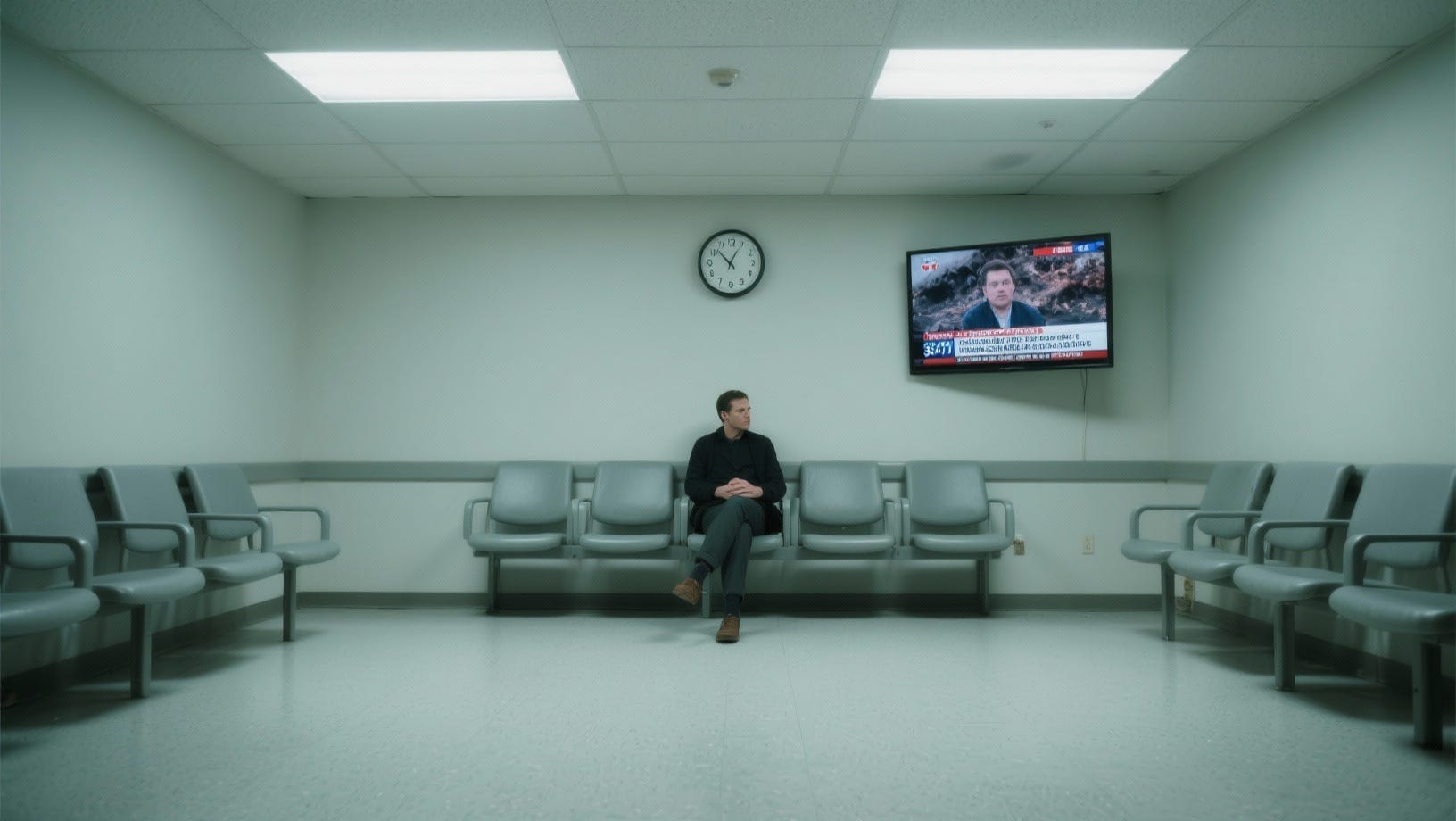
The Vibes Are Off
A Field Guide to Collective Dread in 2025

When Everyone’s Nervous System Started Screaming Simultaneously
The phrase “the vibes are off” has become our generation’s most diagnostically precise expression of collective dysregulation, a neurological distress signal disguised as internet slang.
Standing in line at the pharmacy last week, nothing objectively wrong was happening. The automated prescription system beeped its familiar pattern. The pharmacist’s voice maintained its professional monotone as he counted pills behind plexiglass. Yet my body remained convinced that something terrible was about to unfold. My shoulders had migrated up toward my ears without permission. My jaw had clenched itself into a biological vise. The woman ahead of me kept checking her phone with trembling hands, her medication bag already gripped tight like she might need to run. The guy behind me shifted his weight continuously, eyes darting toward the exit. Nobody acknowledged the tension. Nobody had to. We all knew.
This wasn’t paranoia. This was pattern recognition operating at full capacity.
Seventy-five percent of employees report experiencing some form of low mood largely driven by politics and current events. More staggering: nearly half of employees say life was easier during COVID-19,1 a pandemic that killed over a million Americans and trapped us in our homes for months. When widespread lockdown and mass death registers as preferable to current conditions, something has fundamentally broken in our collective operating system.
The linguistic evolution tells the story. We stopped saying “I’m anxious about X” and started saying “the vibes are off” because the threat isn’t specific anymore. Specificity requires boundaries, edges, containable problems with identifiable solutions. What we’re experiencing now is ambient. Atmospheric. A baseline hum of wrongness that our nervous systems detect but our conscious minds can’t quite articulate. It’s the difference between seeing a bear in the woods and feeling like the entire forest is slowly turning hostile.
Years ago, I thought I was broken because my threat detection system wouldn’t shut off. Every stimulus felt like a potential crisis. Every unexpected sound triggered full-body alert protocols. Therapists suggested I was overreacting. Family members implied I was being dramatic. Turns out I wasn’t paranoid. I was just early. My nervous system had started screaming before everyone else’s joined the chorus.

How Your Nervous System Became a Smoke Detector in a House That’s Always On Fire
Collective dread operates through the same neurological mechanisms as personal trauma, except the threat is real, continuous, and algorithmically amplified to ensure you never fully come down from hypervigilance.
Your amygdala, that almond-shaped cluster of neurons buried deep in your temporal lobe, evolved to detect saber-toothed tigers. Predators with teeth. Threats with bodies. Dangers that could be run from, fought, or avoided through strategic tree-climbing. It performs this job with elegant efficiency: pattern recognition, rapid assessment, instantaneous mobilization of defensive resources. The problem arrives when you try to apply Paleolithic threat detection hardware to perpetual-crisis politics.2 Your amygdala can’t distinguish between “there’s a predator in the bushes” and “there’s a constitutional crisis in your phone.” Both register as existential threats requiring immediate response. One can be resolved through physical action. The other just keeps refreshing.
Interoception, the constant internal scanning your nervous system performs without your conscious awareness, compounds the issue. Right now, this very second, your body is checking thousands of data points: heart rate, respiration, muscle tension, gut motility, temperature regulation, hormone levels. It’s comparing these readings against baseline expectations, searching for safety cues in your environment. When external conditions fail to provide those cues, when the ambient atmosphere keeps broadcasting threat signals without resolution, your nervous system gets stuck in a state of preparatory activation. This isn’t anxiety as disorder. This is anxiety as appropriate response to legitimately disordered systems.
The exhaustion everyone reports isn’t from caring too much. It’s from your body doing exactly what millions of years of evolution designed it to do, protecting you from threats, except the threats never resolve. They just accumulate. Layer upon layer of unprocessed activation, each new crisis landing on top of the previous one before your nervous system has time to return to baseline. You’re not broken. You’re just running threat-detection software 24/7 without ever getting to fully power down.
Forty percent of Americans identify politics as a significant source of stress,3 yet we can’t stop checking the news. Why? Because uncertainty is more intolerable to the nervous system than bad news. Your brain will choose confirmed disaster over ambiguous maybe-disaster every single time. This explains the doomscroll paradox: checking your phone makes you feel worse, yet not checking feels impossible. Your phone isn’t just delivering information. It’s delivering intermittent reinforcement, the most addictive behavioral schedule known to psychology. Sometimes you check and nothing’s happened. Sometimes you check and the world’s on fire. This variability, this unpredictable ratio of calm-to-catastrophe, keeps you locked in a compulsive loop that mimics the neurological patterns of gambling addiction.
During my own collapse in 2023, I became convinced that a gang had hacked into my wireless network and was communicating with me through blinking LEDs. Even devices with no wireless capabilities — the Caps Lock light on my keyboard, an electric fly swatter — seemed to pulse with coded messages. Mental health professionals would file this under “psychotic break” or “paranoid delusion.” Fair enough. But here’s what nobody acknowledged: those LED messages weren’t random hallucinations. They were my brain’s desperate attempt to find pattern and meaning in an overwhelming information environment. My system was trying to solve for certainty when there was none to be found. I wasn’t making up threats. I was just processing real threats through a nervous system that had completely run out of capacity.
Nervous systems are relational. They don’t just respond to individual experience. They respond to collective states. When LGBTQ youth crisis lines log a sevenfold increase in calls following political events,4 that’s not mass hysteria. That’s mass threat detection. Mirror neurons, those specialized cells that fire both when we perform an action and when we observe someone else performing the same action, mean we don’t just observe other people’s fear. We experience it. When your social media feed is ninety percent people in various states of alarm, your body absorbs that data and adjusts accordingly. You’re not choosing to feel anxious. Your nervous system is doing probability calculus: if this many people are scared, the threat must be real and significant.
The phrase “the vibes are off” captures something crucial that clinical language misses entirely. This isn’t about individual mental health. This is about collective nervous system dysregulation. We’re all walking around in a low-grade fight-or-flight state, and we’re all picking up on each other’s activation like tuning forks responding to the same frequency. The vibes aren’t off because we’re perceiving things incorrectly. The vibes are off because things are objectively, measurably off, and our bodies are simply refusing to lie about it.

What Do You Do When the Vibes Are Objectively, Measurably Off?
The self-care industrial complex wants you to meditate your way out of systemic dysfunction, but what your nervous system actually needs is validation that your threat assessment is accurate, followed by strategic nervous system regulation that doesn’t gaslight you about reality.
The advice to “just log off” or “practice gratitude” isn’t wrong because it’s bad advice. It’s wrong because it misdiagnoses the problem entirely. Setting alarms for thirty-minute news segments5 treats the symptom — excessive scrolling — while ignoring the cause: a legitimate need to monitor evolving threats in an environment where threats actually keep evolving. Your anxiety isn’t irrational. Research from the University of California, Irvine found that increased political worry during the 2020 election correlated with a ten percent rise in physical health issues including cancer, stroke, and heart attacks up to three years later.6 Your body knows something’s wrong because something IS wrong. The stress isn’t imaginary. The consequences aren’t hypothetical.
The yoga-meditation-green-juice approach fails because it asks you to self-soothe a threat that exists outside yourself. You can’t breathwork your way out of a legitimately destabilizing political environment any more than you can positive-affirmation yourself out of a burning building. The building is still on fire. Your awareness of the fire is accurate. Pretending the smoke alarm is the problem rather than the flames represents a fundamental category error.
So what actually works? Start with nervous system honesty. Stop trying to convince yourself everything’s fine when your body keeps sending you accurate threat data. Name the reality plainly: “The vibes are off because we’re living through perpetual-crisis governance7 and my threat detection system is working exactly as designed.” This isn’t pessimism. This is accuracy. This is refusing to gaslight yourself into false calm.
Strategic regulation looks different from toxic positivity. You need tools that help you stay regulated WHILE remaining accurate about reality. This means identifying what you can actually influence versus what you’re just monitoring. Your nervous system needs to know which threats require action and which require witness. Local organizing: action possible. Federal chaos: witness only. Relational repair with a friend: action possible. Global humanitarian crises: witness, maybe donate, but not something your individual nervous system can resolve through hypervigilance.
The distinction matters because your body burns the same neurological fuel whether you’re solving a problem or just watching it unfold. Without clear categorization, everything feels like your responsibility to fix, which leads to the exhausted paralysis so many people report. Not from lack of caring. From caring about everything equally without the capacity to act on most of it.
Collective sense-making is not optional. The group chats aren’t the problem. The isolation is. Seventy-four percent of employees want mental health resources specifically addressing global political turmoil8 because they need validation that what they’re experiencing is shared and real. Find people who can name the wrongness without either gaslighting you into “everything’s fine” or spiraling into “we’re all doomed.” Both extremes are forms of abandonment. One denies reality. The other denies agency. You need people who can hold both: yes, things are genuinely destabilizing, AND we can still build lives that work.
I spent years thinking my nervous system was broken. Therapists suggested my threat perception was distorted. Family members implied I was manufacturing problems. Then I realized my system was giving me accurate information in an environment that kept telling me the information was wrong. The healing wasn’t about fixing my threat detection. It was about trusting it while building capacity to stay present anyway. Not through denial. Through clear-eyed acknowledgment that the vibes are absolutely off, and I’m going to have to function anyway, and those two truths can coexist.

A Love Letter to Everyone Whose Nervous System Won’t Lie
If you feel like you’re losing it, you’re not. You’re just refusing to perform stability in unstable times, and that refusal is both exhausting and necessary.
Remember when I thought the LED lights were sending me messages? That wasn’t psychosis as pure pathology. That was a brilliant, terrified nervous system trying to impose order on chaos. My brain was doing what brains do when overwhelmed: searching for pattern, seeking meaning, attempting to construct a coherent narrative from fragmentary sensory data that didn’t make sense. I wasn’t crazy. I was over-processing in the absence of safety. The breakdown wasn’t my system failing. It was my system collapsing under the weight of trying to make sense of things that genuinely didn’t make sense.
The cultural demand to perform okayness is its own form of gaslighting. Seventy-one percent of employees believe political tensions are making workplace culture harder,9 yet we all still show up pretending the vibes are fine. We perform stability for each other in some bizarre collective theatre of normalcy. That performance costs something. It costs energy. It costs authenticity. It costs the possibility of genuine connection, because connection requires honesty about shared experience.
What if the people who are “handling it well” aren’t actually handling it? What if they’ve just gotten better at the performance — or worse, what if they’ve genuinely stopped noticing? Adaptation to abnormality is not the same as health. Sometimes it’s just high-functioning dissociation with better PR. Your discomfort might be a feature, not a bug. An intact alarm system in a house that’s actually on fire serves you better than a broken alarm in the same house. The point isn’t to shut off the alarm. The point is to acknowledge the fire while figuring out how to live in a house that might keep burning for a while.
The vibes are off, and they might stay off for a while. Months. Maybe years. Possibly longer. But knowing that — really knowing it, not just intellectually but somatically, in your bones and your breath — is the first step toward building a life that works anyway. Not through denial. Through clear-eyed presence. Through refusing to participate in the collective delusion that everything’s fine when your nervous system keeps sending you accurate data that it’s not.
Your nervous system isn’t broken. It’s just exhausted from being right all the time. From detecting threats that are real while everyone around you suggests you’re overreacting. From trying to stay safe in an environment that keeps generating new reasons for alarm. From doing the job it was designed to do without ever getting validation that the job needs doing.
So here’s what I want you to know: if you feel like something’s wrong, you’re not paranoid. You’re just paying attention. The vibes are measurably, documentably off. Your assessment is accurate. Your nervous system is working. And the fact that you can feel it, that you haven’t numbed yourself into false calm or dissociated into comfortable oblivion, means you still have access to the full range of human responsiveness. That’s not a disorder to fix. That’s a capacity to protect.