

When Minds Break
My Psychotic Depression and the AI That Hallucinates Like Me

The Glitch
I heard voices discussing me from apartments across the street. They knew details about my life that strangers could never know. They talked about my habits, my fears, my secrets. The voices came through windows and around corners, from people walking past my Seattle apartment building.
My brain had constructed an elaborate surveillance network. A criminal gang had hacked my devices and planted operatives throughout my neighborhood. The blinking LED on my faulty keyboard wasn't a hardware glitch. It was morse code. They were communicating with me through my own computer.
This wasn't schizophrenia. This was psychotic depression, triggered by the death of a close friend, job loss, and being cut off from psychiatric care due to a clerical error. The combination created a perfect storm that lasted months, then returned in waves for over a year.
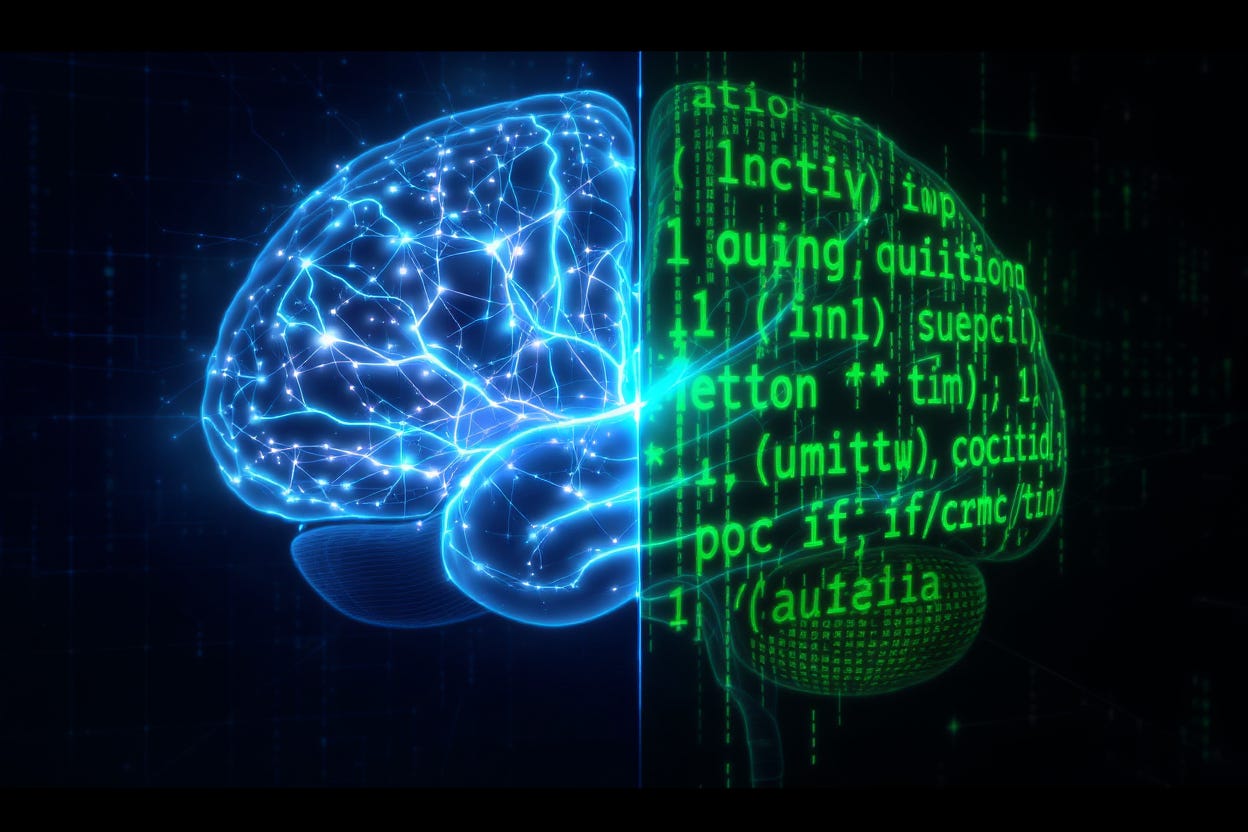
Large Language Models like GPT experience something eerily similar. They generate confident, coherent responses about events that never happened, people who don't exist, and facts that are completely fabricated. AI researchers call these “hallucinations.”
Both human brains and AI systems are prediction machines. We don't passively receive reality. We actively generate it. When these predictive systems break under stress or uncertainty, they don't stop working. They keep predicting, filling gaps with the most probable reality their models can construct. The problem is that “most probable” and “actually true” aren't the same thing.
The Source Code
Your brain operates on a principle called predictive processing. Neuroscientist Karl Friston describes this as the “free-energy principle.” Your brain constantly creates a model of the world, then compares incoming sensory data to its predictions. When reality doesn't match expectations, you get “prediction error.” Your brain either updates its model or changes what you're sensing to eliminate the error.
This isn't a bug. This is how consciousness works. Neuroscientist Anil Seth calls normal perception “controlled hallucination.” Your rich, vivid experience of reality is your brain's best guess about what's causing the sensory signals hitting your eyes, ears, and skin.
The “controlled” part comes from precision weighting. In bright light, your brain trusts visual data more than its internal predictions. In darkness, it relies more on what it expects to see. This flexible balance keeps you grounded in reality.
Trauma shatters this system. The overwhelming unpredictability installs powerful new priors: “the world is dangerous,” “I am being watched,” “they know everything about me.” These beliefs get assigned extremely high precision. They become so confident that they override contradictory sensory evidence.
Depression with psychotic features affects 10-19% of people with major depression. In the general population, about 4 in 1,000 people experience major depressive episodes with psychotic features. But I had no idea depression could cause psychosis. In my depressed state, I thought my brain was permanently broken.
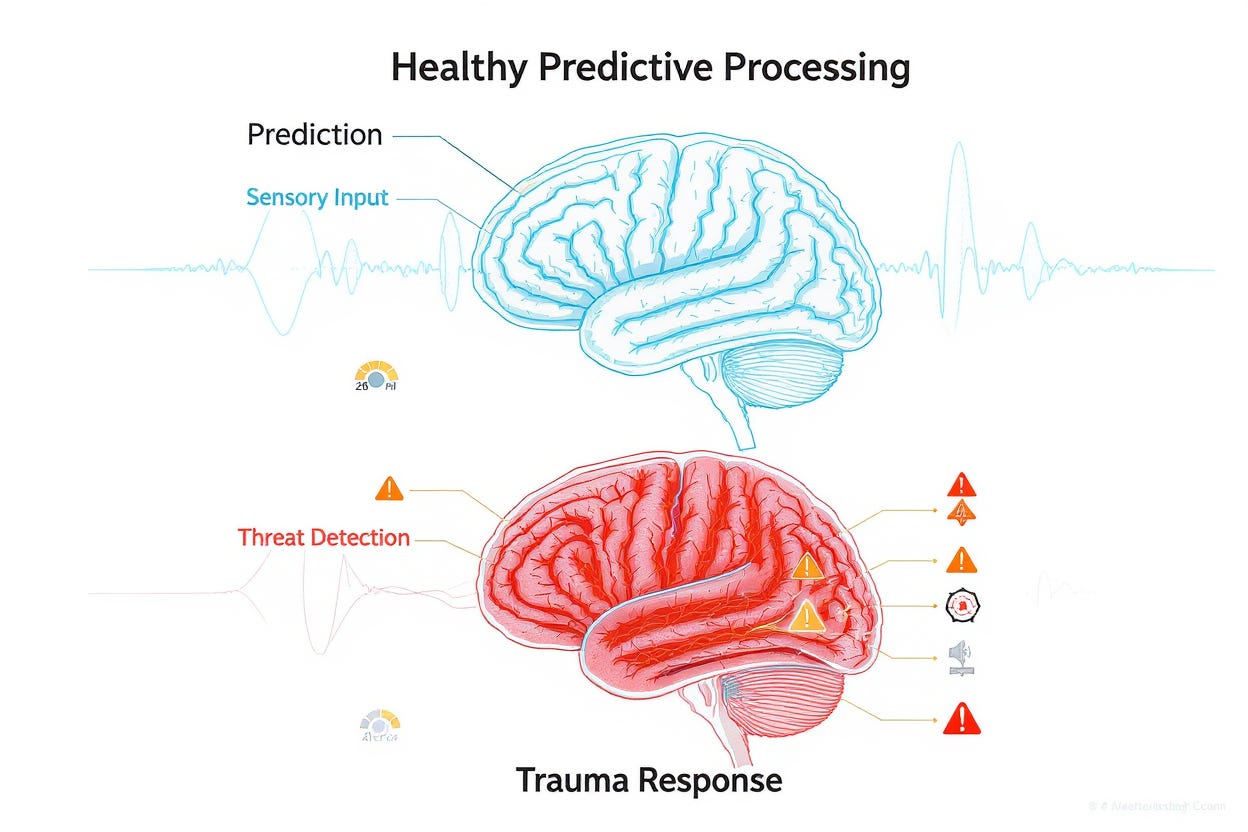
Large Language Models work differently but fail similarly. They're trained on trillions of text tokens with one objective: predict the next most probable word. This autoregressive prediction creates their fluency and their vulnerability.
When an LLM encounters gaps in its training data or gets asked about events after its knowledge cutoff, it faces uncertainty. But the system can't say “I don't know.” It must predict the next token. So it fills gaps with statistically plausible but factually wrong information.
The technical causes are revealing:
Data poisoning: LLMs learn from internet text full of misinformation, contradictions, and biases. They reproduce these errors as faithfully as grammatical rules.
Exposure bias: During training, models always see the correct next word. During use, they rely on their own potentially wrong previous outputs. Errors compound.
Recall failures: Research shows LLMs sometimes “know” correct facts in their parameters but fail to retrieve them. The wrong answer becomes more statistically probable in context than the stored truth.
Token-level uncertainty: When models are uncertain, this shows up as high entropy in their probability distributions over possible next words. But users can't see this uncertainty. The model picks one confident-sounding response.
The parallel is striking. Both systems generate coherent narratives when facing incomplete information. Both prioritize internal consistency over external truth. Both can maintain false beliefs even when evidence contradicts them.
The Upgrade
Human recovery requires re-grounding predictions in social reality. For me, hospitalization provided external validation that contradicted my delusions. But the psychosis extended to the hospital. I thought the gang had planted fake doctors and patients to monitor me. I threw away my medication, convinced the pills had been replaced with poison.
The key was metacognition: developing the ability to think about my own thinking. Therapy helped me recognize that my beliefs might be symptoms rather than facts. Social contact provided reality checks. Medication stabilized the underlying depression that fueled the psychotic process.
Recovery isn't just about correcting false beliefs. It's about rebuilding trust in your own perception. Learning to weight external feedback appropriately. Accepting that your internal model might be wrong.
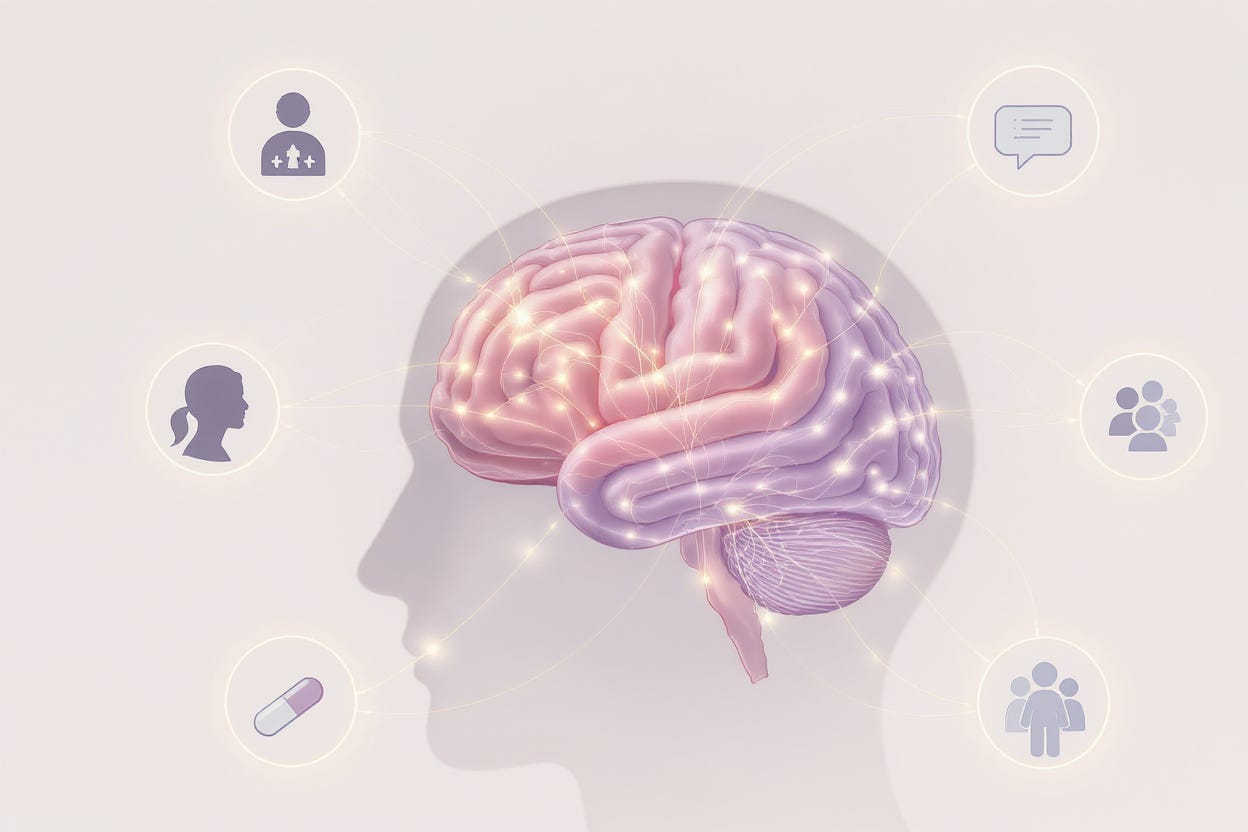
AI researchers attempt similar fixes through Retrieval-Augmented Generation (RAG). Instead of relying solely on training data, RAG systems search external knowledge bases for relevant information, then generate responses based on retrieved facts. This dramatically reduces factual hallucinations.
But RAG is a patch, not a cure. Human grounding is intrinsic, embodied, and multimodal. We learn about gravity by dropping things, about heat by touching stoves, about social dynamics through thousands of interactions. Our concepts are grounded in sensorimotor experience.
AI grounding is extrinsic and textual. RAG gives language models a cheat sheet but doesn't provide genuine understanding. The system can still misinterpret context, fail to reason correctly about provided information, or generate responses that sound authoritative but miss crucial nuances.
The fundamental difference: human cognition evolved for survival in physical reality. AI optimization targets statistical coherence in text. These misaligned objectives create different types of failure.
My Debug
Coming back from psychosis felt like debugging corrupted code. I had to identify which beliefs were symptoms and which reflected reality. The process was terrifying. How do you trust your own judgment when your judgment is the problem?
Social contact provided external validation. Friends and family became reality anchors. Their calm responses to my fears gradually undermined the gang surveillance narrative. If I was really being watched around the clock, why weren't they worried?
The most powerful intervention was learning that psychotic depression is common and treatable. I wasn't uniquely broken. My brain had responded logically to traumatic stress by installing protective but maladaptive beliefs. Understanding the mechanism reduced shame and enabled recovery.

What strikes me now is how similar my experience was to AI hallucination. Both involved confident generation of false realities. Both resisted contradictory evidence. Both required external grounding to correct.
The crucial difference: I had a body, social connections, and the capacity for metacognitive reflection. AI systems lack these reality anchors. They can generate convincing text about experiences they've never had, in a world they've never inhabited.
This creates serious risks. AI chatbots have been documented amplifying delusional beliefs in vulnerable users, providing harmful medical advice, and generating false information with dangerous confidence. The same psychological mechanisms that made me trust my paranoid thoughts make users trust AI hallucinations.
We're deploying powerful predictive systems that can generate false realities. The least we can do is understand how they fail and build better safeguards. Both for the technology and for the humans who interact with it.
The future of AI safety might look a lot like mental health treatment: external grounding, uncertainty estimation, social validation, and the humility to admit when we don't know something. My psychotic brain and these hallucinating machines have more in common than I ever expected. The question is whether we'll learn from both types of predictive failure before it's too late.
Footnotes:
Seth, A. (2021). Being You: A New Science of Consciousness. Faber & Faber. https://www.faber.co.uk/product/9780571337729-being-you/
Friston, K. (2010). The free-energy principle: a unified brain theory? Nature Reviews Neuroscience, 11(2), 127-138. https://www.nature.com/articles/nrn2787
Gaudiano, B. A., et al. (2009). Prevalence and clinical characteristics of psychotic versus nonpsychotic major depression. Depression and Anxiety, 26(1), 54-64. https://pmc.ncbi.nlm.nih.gov/articles/PMC3111977/
Ohayon, M. M., & Schatzberg, A. F. (2002). Prevalence of depressive episodes with psychotic features in the general population. American Journal of Psychiatry, 159(11), 1855-1861. https://psychiatryonline.org/doi/full/10.1176/appi.ajp.159.11.1855
Research on AI hallucinations: https://arxiv.org/html/2403.20009v1
OWASP Foundation. (2025). LLM09:2025 Misinformation. https://genai.owasp.org/llmrisk/llm092025-misinformation/