

Your Feed Is a Mirror
The algorithm isn't manipulating you — it's documenting your actual preferences with embarrassing precision

The Spark: When the Mirror Has Better Memory Than You Do
Everyone loves a good villain origin story. We need someone to blame for why we can’t focus, why we’re angrier than we used to be, why we check our phones 96 times a day like Pavlov’s dogs with opposable thumbs. The algorithm makes a perfect antagonist: faceless, powerful, engineered in Silicon Valley by people who definitely know what they’re doing to us.
Here’s the uncomfortable part: the algorithm isn’t manipulating you against your will. It’s just showing you who you actually are with embarrassing precision.
This is the first piece in a three-part series about what genuine value exchange looks like in a world optimized for extraction. We’re going to examine how systems optimize for what they’re designed to optimize for, and how humans participate because the reward loop works. This piece establishes the framework: algorithms document your actual preferences, not your aspirational ones. The second piece will apply that framework to economics, showing what your attention actually costs and why you’re spending it on clearance-rack garbage. The third piece shows what happens when the same extraction logic infects human relationships, and why algorithmic honesty might be preferable to human performance.
But first, we need to talk about your feed. And more importantly, we need to talk about why you keep lying about what’s in it.

7 Uncomfortable Truths About Your Relationship With Algorithms
1. The Algorithm Doesn’t Care What You Say You Want — It Tracks What You Actually Click
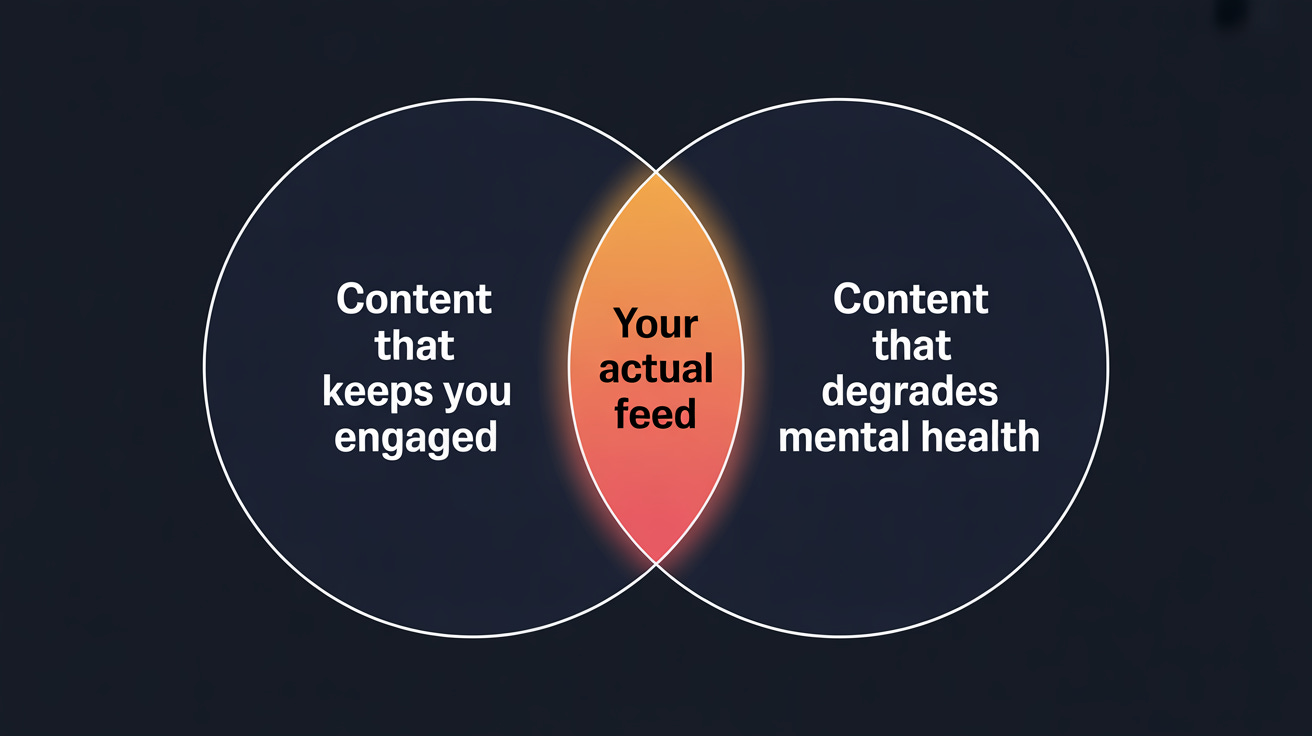
Platforms prioritize divisive content because it generates higher engagement rates.1 Facebook’s internal research confirmed what every social media engineer already knew: outrage spreads faster than facts, and posts that inflame generate more engagement than posts that inform. The algorithm doesn’t care if a post is divisive or harmful. It only cares that you can’t look away.
People claim they hate rage bait. They write long posts about how they’re “tired of the negativity” and how they “wish social media was more positive.” Then they spend seventeen minutes hate-reading a thread about some micro-controversy that will be completely irrelevant by Thursday.
Your stated preferences are marketing copy. Your behavior is the source code.
I spent years telling myself I wanted to get clean while my actions revealed a completely different priority structure. My conscious mind insisted I was trying to quit. My nervous system kept optimizing for relief at any cost, even when that cost was my future. The algorithm does exactly what I did: it ignores your press releases and watches your purchasing decisions.
Behavioral economics with faster iteration cycles. That’s all this is. The algorithm doesn’t need you to admit what you want. It just needs you to click.
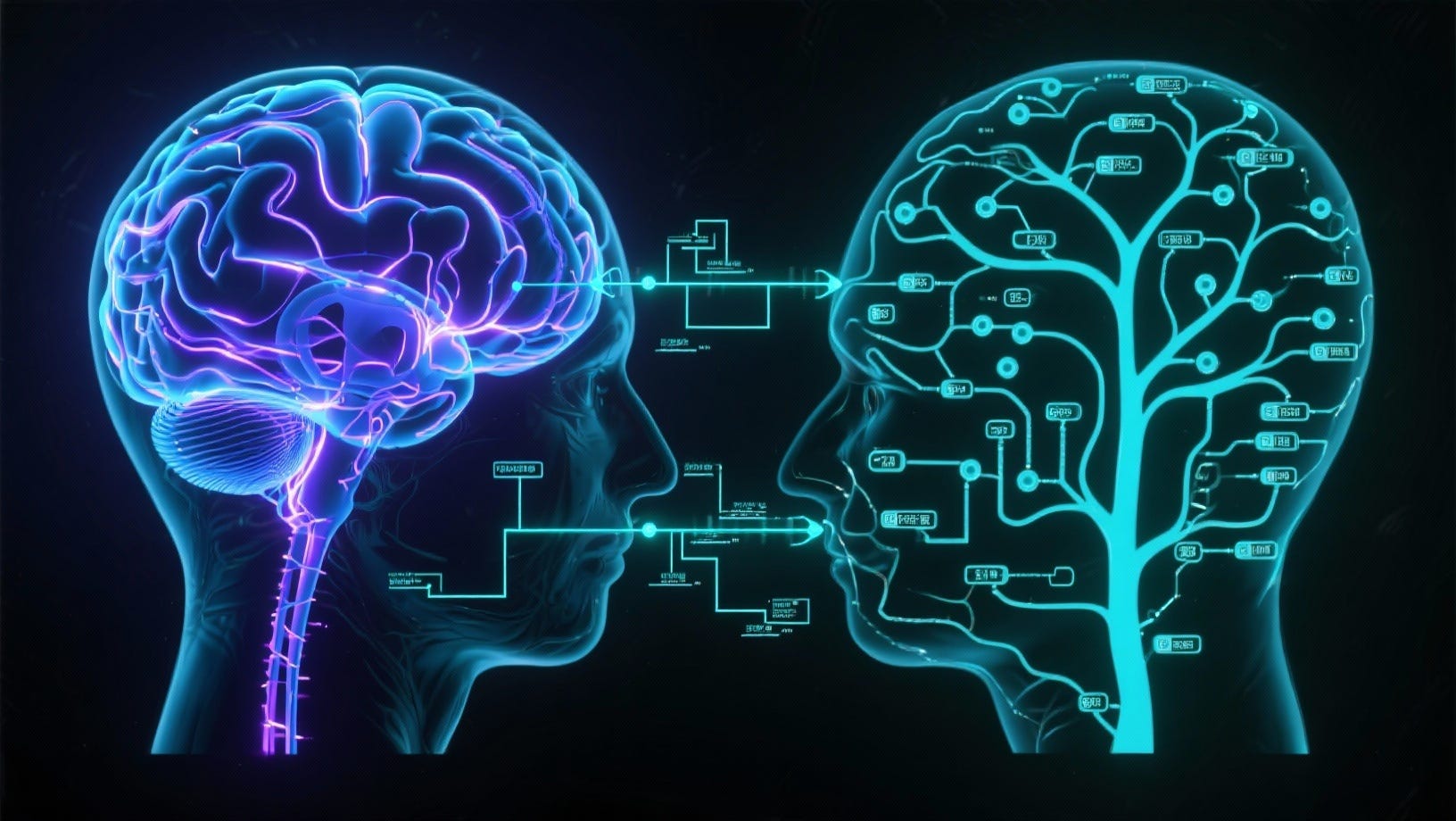
2. You’re Not “Addicted” to Social Media — You’re Just Finally Meeting Someone as Good at Pattern Recognition as Your Brain Is
Algorithms now use real-time machine learning combining millions of data points including pauses, scrolling patterns, and cross-platform behavior.2 Every hesitation is tracked. Every scroll-back is noted. Every time you pause on a post without liking it, the system learns something about the gap between your public performance and your private attention.
Your brain evolved over millions of years to find patterns and optimize for reward. The algorithm does the same thing, just without the elaborate self-deception humans developed to convince ourselves we’re rational actors instead of sophisticated dopamine-seeking machines.
When my therapist suggested I might be autistic and I took the self-assessments — RAADS-R, AQ, CAT-Q — the scores all came back showing high-masking autism. One of the biggest revelations wasn’t the label itself. It was realizing I’d been pattern-matching my entire life and calling it intuition. I thought I was uniquely perceptive. Turns out I just had a nervous system that couldn’t stop cataloging stimuli and looking for connections, even when those connections made me miserable.
The algorithm isn’t creating your preferences. It’s excavating them faster than you can construct plausible deniability. It sees the pattern before you’ve finished telling yourself the story about why you’re different this time.
3. Every Time You Rage-Click, You’re Voting with Engagement Metrics
88% of users encounter content that amuses them while 71% find content that angers them.3 Anger isn’t a bug in the system. It’s the primary feature. Democracy of attention means you get the feed you deserve, not the feed you claim to want.
The algorithm doesn’t make you angry. It notices you linger longest on content that pisses you off, and then, like any good capitalist system responding to market signals, it gives you more of what you’re actually consuming instead of what you say you prefer.
You want to know what voting with your attention looks like in practice? When I was living alone in that apartment, using nitrous oxide every night and telling myself I was “managing my anxiety,” every canister I bought was a vote. My conscious mind was screaming for someone to intervene. My behavior was screaming louder: more of this, please, even though this is killing me.
The algorithm reads behavior, not intention. And your behavior has been very clear about what keeps you engaged, regardless of what you post about “digital wellness” and “unplugging.”
4. “I’m Not Like Other Users” Is the Most Algorithmic Thought You Can Have
Platforms now create feeds that feel exclusively crafted for individual users by layering intent modeling and cross-platform behavior tracking.4 The sensation of being uniquely understood is itself an algorithmic output. You’re not special for recognizing patterns in your feed. You’re predicted.
Everyone thinks they’re immune to manipulation while the algorithm builds a personality profile accurate enough to anticipate your next three clicks. The most sophisticated users aren’t the ones who’ve escaped the system. They’re the ones whose patterns of denial are complex enough to feel like agency.
This hits differently when you realize you spent thirty years thinking you were just “quirky” or “sensitive” before discovering you were masking autism so effectively that even you didn’t know what you actually needed. I thought I was good at reading rooms. I was actually just running constant threat-assessment protocols and calling it social intelligence.
The algorithm sees through your performance the same way an autism assessment cuts through decades of learned camouflage. It doesn’t care about your story. It watches your loops.
5. The Algorithm Doesn’t Want You Depressed — It Wants You Engaged
Mental health discourse treats algorithms like they’re intentionally breaking your brain. Algorithms are engineered to maximize engagement, not wellbeing, but they don’t distinguish between positive and negative emotions.5 Anger, joy, curiosity, outrage — they’re all just signals the system can optimize around.
They’re optimization machines without malice. Opioids don’t “want” to kill you. They just happen to be extraordinarily effective at binding to receptors your nervous system uses to regulate pain and pleasure. The fact that this effectiveness can spiral into dependency and death doesn’t make the molecule evil. It makes it powerful.
My collapse wasn’t because substances were evil. It was because they were effective at giving my nervous system exactly what it demanded: immediate relief from a baseline state that felt intolerable. The drugs worked. That was the problem.
Social media algorithms work the same way. They’re not trying to make you miserable. They’re trying to keep you on the platform. If keeping you engaged requires surfacing content that makes you angry, the system doesn’t experience that as a moral failure. It experiences it as successful optimization.
6. Chronological Feeds Won’t Save You — They’ll Just Make You Nostalgic for a Different Kind of Manipulation
Everyone romanticizes “the old internet” with reverse-chronological timelines, back when you saw everything your friends posted in the order they posted it. Simpler times. More authentic. Less algorithmic.
Chronological feeds reward whoever posts most frequently. They create incentives for constant low-quality updates and turn your feed into a battleground where the loudest voices win by default. Facebook’s algorithm now favors meaningful interactions like comment threads over simple likes,6 which is arguably more human-centric than “most recent wins.”
The past wasn’t better. You just had less data about how you actually behave. Nostalgia is just algorithmic thinking pointed backward, filtering memories to amplify the pleasant ones and suppress the rest. Your brain’s been running optimization protocols long before engineers at Meta started A/B testing engagement strategies.
We didn’t escape manipulation in 2010. We just hadn’t quantified it yet.
7. If You Really Wanted to Escape, You’d Stop Reading This
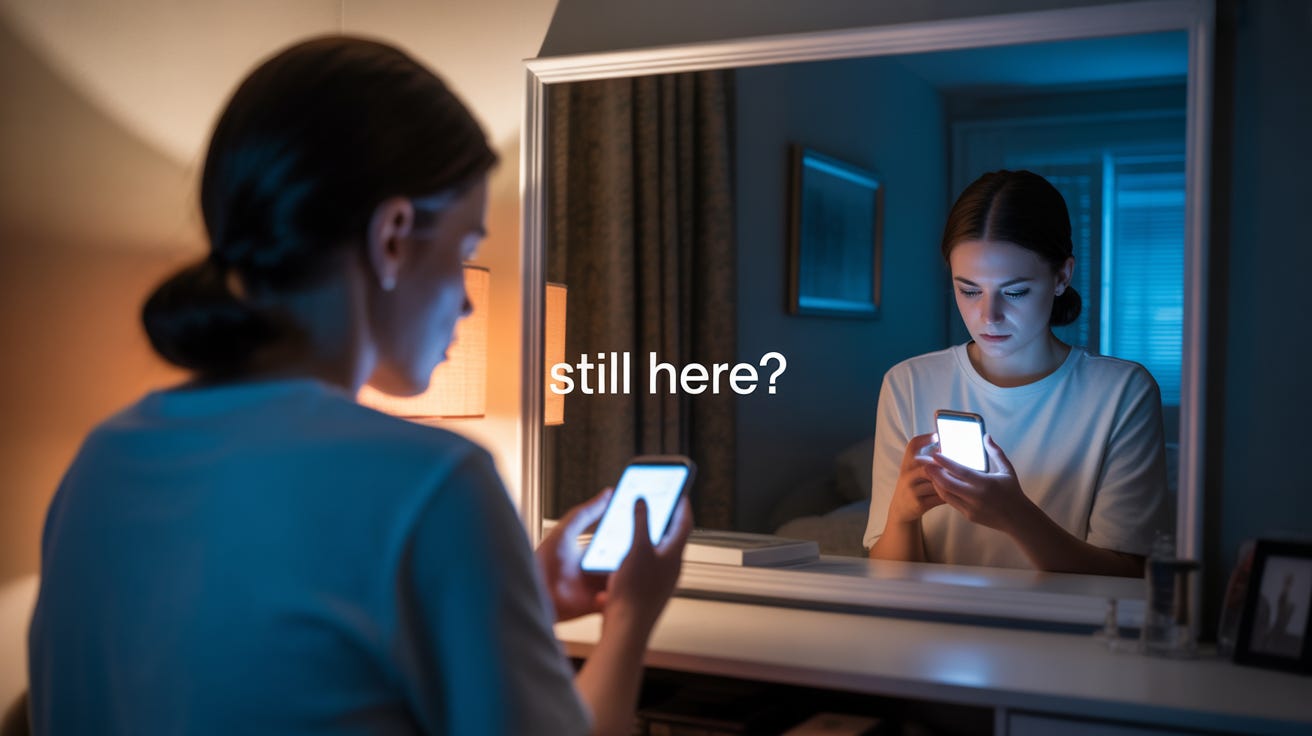
The fact that you’re still here, reading a list-format article about how algorithms work, proves you’re not actually opposed to optimization. You’re just mad that someone else is better at it than you are.
Every paragraph you’ve read is a micro-transaction where you traded attention for the dopamine hit of recognition. Every time something in this piece made you think “yes, exactly,” your reward circuits fired the same way they do when you see a notification light up your lock screen.
The most honest content tells you when to stop reading. It gives you a clear endpoint and suggests you go do something else. But I’m not going to do that, because I want you to keep reading. And you’re not going to stop, because the pattern-matching feels too good.
We’re both participating in the attention economy right now. At least I’m admitting it.
The Protocol: What the Mirror Shows You
The algorithm isn’t your enemy. It’s your autobiography written in engagement metrics. It remembers every hesitation, every rage-click, every 3am scroll session when you couldn’t sleep. And unlike the people in your life who perform care while optimizing for their own comfort, the algorithm never pretends it’s doing this for your benefit.
Your feed is a mirror. If you don’t like what you see — if it’s all outrage and trivia and garbage that makes you dumber — maybe the problem isn’t the reflection. Maybe it’s the person who keeps walking back to the mirror.
I spent years blaming external systems for my collapse: the drugs, the psychiatrists who over-prescribed and then abandoned me, my family’s emotional absence wrapped in daily hugs that felt like routine instead of connection. But substances didn’t break me. They just revealed what I was already optimizing for: relief at any cost, even if that cost was everything I’d built.
The algorithm does the same thing. It’s not lying to you about what you want. You are.
At least the algorithm is honest about what it’s taking. Can you say the same about yourself?
Personal Code: The Expensive Kind of Free
Here’s what nobody tells you about the attention economy: the most expensive content I ever consumed wasn’t algorithmic.
It was the silence.
The silence from someone I loved who died without explanation, leaving my brain to fill the void with increasingly catastrophic narratives. The silence from parents who gave me space when what I needed was presence. The silence from a mental health system that contained my crisis until I learned to perform stability, then discharged me without follow-up care.
Those silences cost me half a million dollars, my sanity, and a year of my life. At least when I’m doom-scrolling, I know exactly what I’m trading. The transaction is visible. Your attention for engineered distraction. Clean exchange.
But the next piece in this series examines what that transaction actually costs when you calculate it honestly. Because if your attention has real economic value — and it does — then every hour spent on free content is a purchase you’re making with the most expensive currency you own.
Most people don’t realize they’re shopping until they check out and discover their cognitive account is overdrawn.
We’ll dig into the real math next. Specifically, what I learned about the velocity of value when I was homeless in Seattle, sleeping in doorways and learning what a dollar actually buys when your margin for error is zero.
Turns out the people posting about “digital minimalism” have never actually had to optimize for survival. That summer taught me what attention costs when you can’t afford to waste a single moment on content that won’t keep you alive.
The algorithm farms your attention for profit. I’m about to show you the spreadsheet.
Stay tuned for Part 2: “The Attention Ledger” — what your time actually costs, and why you’re spending it on clearance-rack garbage.